Last month, the standard-setting EU news site Brussels Jungle has revealed that there will be the euPad, the all in one EU tablet with the best new features for the old continent.
The EU telecommunication ministers now have asked the European Commission to draft a regulation that should lay down the specifics of the device as a necessary condition for EU citizens and business to be allowed to use it on a daily basis.
First indications on the details of the regulation show that according to EU standards it needs to operate in 23 languages at once, blocking any website or app that doesn't fulfil the requirements. Every application and website shown on the euPad thus has to be confirmed by a special national authority set up for this purpose only. These authorities could be co-ordinated by the European Moveable Electronic Devices and Small End User Computers Agency (EMEDSEUCA), probably set up on La Réunion.
The European Commissioner for Consumer Policy, John Dalli, also has already made clear that every euPad has to come with a warning sign that covers at least 30% of the frontside listing all the possible dangers of the internet.
In the same line, the European Agency for Safety and Health at Work has made clear that employees may not use those devices more than one hour per day to protect their eyes and may not share the euPad with other colleagues in order to lower the risk of the transmission of work-related diseases such as laziness and procrastination.
Antonio Tajani, EU Commissioner for Industry has reportedly spoken with the music and film industry which demands that the euPad should not be able to play music or videos because most of them are copied, and if the industry cannot make money out of audiovisual material, nobody in the EU should be able to watch or listen to anything. EU budget Commissioner Lewandowski has already applauded this proposal because this will strengthen his arguments to scrap the costly production of EU promotional and informational audiovisual material for the internet.
It is expected that the European Book Seller Federation and the representatives of the European paper industry will meet their respective contacts in the EU institutions to also make sure that it should not be possible to replace the good old printed book with the device, limiting the use of the euPad to official EU documents and other non-relevant texts produced by comparable national authorities.
On the request of one member state's delegation, the Commission will now first organise a 6-month consultation process asking industry and citizens which other features they would not like to see included in the device.
A Commission official told your blogger that this would then need to be complemented by a feasibility study and a large-scale needs assessment study that can be executed by the EU's Joint Research Centre in close co-operation with the Data Protection Supervisor, the European Economic and Social Committee and the Committee of the Regions, the latter to make sure that the new tool will reflect the actual needs of local communities' mayors, regional tsars and citizens not yet covered by other democratic institutions.
The results of the studies are expected for 2013.
The final regulation will most likely have to go through the Conciliation Committee, because it is hard to imagine that EU Parliament and Council will be able to agree on what they don't want the euPad to do and what kind of cultural projects in the least important constituencies of MEPs need to be co-financed to make them agree to this piece of legislation.
It is thus expected that the regulation will probably be in place until 2017, before a European industry consortium can start specifying the necessary technical details, making sure that the number of parts of the euPad is a multiple of 27 so that every EU member state can produce an equal number before the final product will be assembled in China.
If there are no complications, the innovative euPad will be ready in 2025, showing that Europe has become the most innovative and productive region in the world thanks to the Europe 2020 reform process.
Showing posts with label Satire. Show all posts
Showing posts with label Satire. Show all posts
Wednesday, 2 June 2010


Saturday, 29 May 2010
EU study: Small countries profit massively from EU accession
According to a recent study (only partially public) of the European Executive Agency for Small and Medium Size Member States (EEA-SMSMS), tiny states profit most from the accession to the European Union.
The study finds, for example, that 50% of Maltese work for the EU as translators or in similar jobs directly or indirectly financed by the EU institutions.
An expert from Cyprus (who asked not be named because his Greek mother is the secretary of Slovenian President Türk) found that while there is only 1 Member of the European Parliament (MEP) per 100 million German speaking EU citizens, 1 in 10 Luxembourgers did make it into the European Assembly at the last local elections. If the study's calculations are correct, this is approximately 99% of the Luxembourg population that earns less than the MEP salary.
The Estonian Director of the Agency, Mr. Väikemaa, also told me in an interview that his country of origin, Latvia, had split itself from its northern region Lithuania in the late 1980s to gain extra points on the EU tininess scale in order to profit from the EU's Small Country Funds (SFCs) that are distributed indirect proportionally to the size of a country's population and the actual needs of the recipients.
In it's last chapter, the EEA-SMSMS study however comes to the conclusion that large member states should receive a compensation for the support they give to the SMS countries. It proposes to move the seat and the 75,000 employees of the SMSMS agency every 73 days (a compromise between 10 years proposed by a former French president and 1 day proposed by a Polish plumber) in random order between London, Paris, Berlin, Rome, Madrid and Warsaw.
The UK press has already reacted positively with long, well-argued articles, considering inter alia the different options of splitting up Great Britain in its original shires while raising the amount of British contributions to the EU budget. Unnamed sources close to Catherine Ashton have even confirmed that she wants to be the Queen of Upholland in case this decision is taken until the end of 2025, that is 10 years before the end of her term and 5 years before the end of the Liberal-UKIP coalition David Cameron has proposed from 2015.
I don't have time to go deeper into the matter now, but it looks like the study is going to cause more positive reactions all across Europe and so I really recommend that everyone takes the time to read it*. Comments can be send to herman@vanrompuy.nl-be-fr.
* It is available online under smallbutrich.eu and in bookstores all across China.
The study finds, for example, that 50% of Maltese work for the EU as translators or in similar jobs directly or indirectly financed by the EU institutions.
An expert from Cyprus (who asked not be named because his Greek mother is the secretary of Slovenian President Türk) found that while there is only 1 Member of the European Parliament (MEP) per 100 million German speaking EU citizens, 1 in 10 Luxembourgers did make it into the European Assembly at the last local elections. If the study's calculations are correct, this is approximately 99% of the Luxembourg population that earns less than the MEP salary.
The Estonian Director of the Agency, Mr. Väikemaa, also told me in an interview that his country of origin, Latvia, had split itself from its northern region Lithuania in the late 1980s to gain extra points on the EU tininess scale in order to profit from the EU's Small Country Funds (SFCs) that are distributed indirect proportionally to the size of a country's population and the actual needs of the recipients.
In it's last chapter, the EEA-SMSMS study however comes to the conclusion that large member states should receive a compensation for the support they give to the SMS countries. It proposes to move the seat and the 75,000 employees of the SMSMS agency every 73 days (a compromise between 10 years proposed by a former French president and 1 day proposed by a Polish plumber) in random order between London, Paris, Berlin, Rome, Madrid and Warsaw.
The UK press has already reacted positively with long, well-argued articles, considering inter alia the different options of splitting up Great Britain in its original shires while raising the amount of British contributions to the EU budget. Unnamed sources close to Catherine Ashton have even confirmed that she wants to be the Queen of Upholland in case this decision is taken until the end of 2025, that is 10 years before the end of her term and 5 years before the end of the Liberal-UKIP coalition David Cameron has proposed from 2015.
I don't have time to go deeper into the matter now, but it looks like the study is going to cause more positive reactions all across Europe and so I really recommend that everyone takes the time to read it*. Comments can be send to herman@vanrompuy.nl-be-fr.
* It is available online under smallbutrich.eu and in bookstores all across China.
Thursday, 20 May 2010
Kroes & King
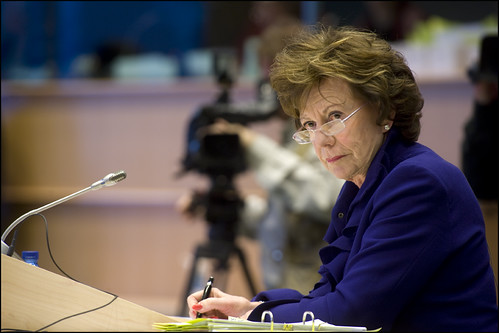
The last words of Neeli Kroes' blog post on the Digital Agenda:
But if we all – European Union institutions, national governments, businesses, citizens, researchers – join forces, it will be possible to make every European digital. And we can all look forward to some fascinating and exciting days if that happens.The last words of Martin Luther King Jr.'s speech:
And when this happens, when we allow freedom ring, when we let it ring from every village and every hamlet, from every state and every city, we will be able to speed up that day when all of God's children, black men and white men, Jews and Gentiles, Protestants and Catholics, will be able to join hands and sing in the words of the old Negro spiritual: Free at last! Free at last! Thank God Almighty, we are free at last!Do you see how well this fits together?
Picture: © european_parliament / CC BY-NC-ND 2.0
Monday, 17 May 2010
The joke: Part 2 of the story
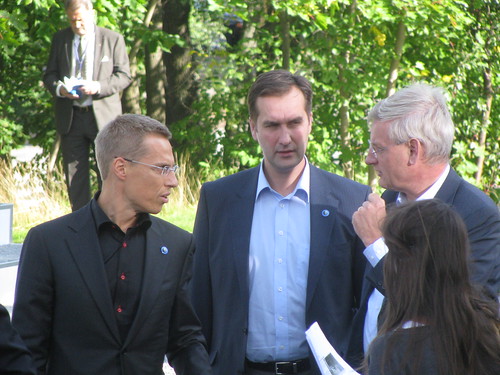
Last Wednesday I wrote about the EU joke that Ashton told at the LSE in London, and according to the press and the moderator at LSE this joke was first told by Finnish foreign minister Alexander Stubb.
I wrote to Mr. Stubb to ask whether this was true, and via his secretary he told me that he heard the joke from Māris_Riekstiņš, who was the foreign minister of Latvia until March.
Does anyone know what Mr Riekstins is doing now or how one could contact him? Since he is no longer foreign minister, it's kind of difficult to address him.
Because the question now is: Was he the originator of the joke?
Picture (from the left: Stubb, Riekstins, Bildt): © latvianmfa/ / CC BY-NC-ND 2.0
Monday, 22 March 2010
Journalism vs bloggers in Brussels
I have just set out my vision for journalism in Brussels and already now I receive self-produced support.
I have nothing to add to what I laid into the mouth of the digital journalist - and real journalists should have noticed by now that we don't need them at all from now on!
I have nothing to add to what I laid into the mouth of the digital journalist - and real journalists should have noticed by now that we don't need them at all from now on!
My vision of journalism in Brussels
In my opinion, there should be no independent journalism in Brussels.
The EU institutions just need to create their proper press corps which produces favourable news for them. In addition, they should fund a group of about 30 bloggers who pretend that whatever the EU institutions are doing is interesting. To do so, they will usually link and comment the news coming from the institutional press.
From time to time, the bloggers will write something critical. One or two EU officials will agree with them through comments or tweets. Thereupon, the bloggers will be invited by the institutional TV station (broadcasting live on air and on the web) for an interview.
In the interview, the EU journalists will make the bloggers weaken their opinion so that it can be taken up by members of the European Parliament to be introduced in the proper decision-making process.
Afterwards, the bloggers will have drinks at Kitty O'Sheas at the expense of the EU institutions and will start one or two creative projects when they are drunk. With these projects they can be invited to international conferences where they will explain technology and Europe to local freelance journalists.
The local journalists will not understand everything properly and so the bloggers can make fun of their newspaper articles the next day in their blogs. These articles will be used by the EU Commission as basis to continue keeping independent journalists away from Brussels.
You see: Nobody needs independent journalism in Brussels when there are bloggers and some good news products funded by the institutions - and I hope the EU institutions will soon have understood!
PS.: This blog post is the translated and slightly adapted version of a comment I made to a related article by europaeum on the current debate of declining numbers of journalists in Brussels. I had to write down this vision to make sure that everyone knows that we eurobloggers are against independent journalism in Brussels. It's us against them. And in the end, we will win.
The EU institutions just need to create their proper press corps which produces favourable news for them. In addition, they should fund a group of about 30 bloggers who pretend that whatever the EU institutions are doing is interesting. To do so, they will usually link and comment the news coming from the institutional press.
From time to time, the bloggers will write something critical. One or two EU officials will agree with them through comments or tweets. Thereupon, the bloggers will be invited by the institutional TV station (broadcasting live on air and on the web) for an interview.
In the interview, the EU journalists will make the bloggers weaken their opinion so that it can be taken up by members of the European Parliament to be introduced in the proper decision-making process.
Afterwards, the bloggers will have drinks at Kitty O'Sheas at the expense of the EU institutions and will start one or two creative projects when they are drunk. With these projects they can be invited to international conferences where they will explain technology and Europe to local freelance journalists.
The local journalists will not understand everything properly and so the bloggers can make fun of their newspaper articles the next day in their blogs. These articles will be used by the EU Commission as basis to continue keeping independent journalists away from Brussels.
You see: Nobody needs independent journalism in Brussels when there are bloggers and some good news products funded by the institutions - and I hope the EU institutions will soon have understood!
PS.: This blog post is the translated and slightly adapted version of a comment I made to a related article by europaeum on the current debate of declining numbers of journalists in Brussels. I had to write down this vision to make sure that everyone knows that we eurobloggers are against independent journalism in Brussels. It's us against them. And in the end, we will win.
Friday, 5 March 2010
Europe 2020 - The missing points
I was born in a socialist country, so I am no fan of 10-year plans unless they come from the European Union.
With the Lisbon Strategy, the EU has invented the internet. It has reformed its agricultural policy and made it greener, more efficient, and more fair for the rest of the world. It has become a global leader in protecting human rights. And English has become our lingua franca that every EU citizen speaks beside his mother tongue and the languages of all national minorities (including Welsh).
Despite this success, our majesty Barroso II has called from above to create a European Union 2.020 - that is more than Web 2.0 - and I feel obliged to point to three missing details in the new strategic superplan of our Union, a plan that I haven't read out of pure conviction that it must be good anyway.
1. Invent the interdrum
In 2010, only a small number of visionary politicians sees a chance to connect people via modern technology. Shocked by the dullness of digital communication tools - toys only kids and terrorists are using - they have proposed to use drums to communicate from European village to European village. If implemented through the 2020 strategy, their proposal will not only boost the European drum industry. It will also satisfy the French stick manufactures who might complain that they are disadvantaged by the billions of Euros that are invested to turn tomato plantations in Spain into eco-friendly ice-cold polar bear habitats (see next point).
However, critics say that the interdrum could enable ordinary citizens to drum with each other freely, disturbing the upper classes enjoying classical live music concerts on their 40 inch iPosters produced by Apple-Google Inc. Yet, if we put in place effective measures to control the copying and distribution of volume-controllable drums, there will be no particular danger in the emerging interdrum. To the contrary: We will finally be able to track citizens wherever they are because they will be too loud to hide.
2. Foster a modern and climate change oriented agriculture
In 2020, the earth will be so warm that polar bears will have almost disappeared from Europe if we don't do something over the next 10 years. Once trekking in large herds through our continent, the polar bear has become a vital part of the European climate compassion industry. In Copenhagen, the Union has shown its strength and global leadership potential in that regard - it deserved our compassion - and it now needs to follow up. Now the Common Agriculture Policy of the EU will have to implement its usual sound and balanced set of measures to save future-oriented products (polar bears) by first creating mountains of these products (i.e. "ice beargs") that then can be dumped into the (Arctic) sea which will make the north of Europe white again.
3. Chinese courses for all
Finally, until 2020 China will have understood how great the European Union is. They will come to copy our democratic model, the "Citizen Bureaucracy", buy our cheap manufactured and agricultural goods (sticks and polar bears) and sell their high-tech products (drum detection and supervision equipment) to us. In order not to lose them as our customers and students to the prospering region of Darfur, we all need to speak Chinese in 2020 (beside Romani and Maltese).
I know these are visionary ideas - but if we can imagine Nigel Farage being European Council President and Geert Wilders being EU Foreign Minister in 2020, why can't we also dream in other areas and formulate these dreams in a strangely bureaucratic language so that nobody can complain if they don't come true over the next 10 years?
With the Lisbon Strategy, the EU has invented the internet. It has reformed its agricultural policy and made it greener, more efficient, and more fair for the rest of the world. It has become a global leader in protecting human rights. And English has become our lingua franca that every EU citizen speaks beside his mother tongue and the languages of all national minorities (including Welsh).
Despite this success, our majesty Barroso II has called from above to create a European Union 2.020 - that is more than Web 2.0 - and I feel obliged to point to three missing details in the new strategic superplan of our Union, a plan that I haven't read out of pure conviction that it must be good anyway.
1. Invent the interdrum
In 2010, only a small number of visionary politicians sees a chance to connect people via modern technology. Shocked by the dullness of digital communication tools - toys only kids and terrorists are using - they have proposed to use drums to communicate from European village to European village. If implemented through the 2020 strategy, their proposal will not only boost the European drum industry. It will also satisfy the French stick manufactures who might complain that they are disadvantaged by the billions of Euros that are invested to turn tomato plantations in Spain into eco-friendly ice-cold polar bear habitats (see next point).
However, critics say that the interdrum could enable ordinary citizens to drum with each other freely, disturbing the upper classes enjoying classical live music concerts on their 40 inch iPosters produced by Apple-Google Inc. Yet, if we put in place effective measures to control the copying and distribution of volume-controllable drums, there will be no particular danger in the emerging interdrum. To the contrary: We will finally be able to track citizens wherever they are because they will be too loud to hide.
2. Foster a modern and climate change oriented agriculture
In 2020, the earth will be so warm that polar bears will have almost disappeared from Europe if we don't do something over the next 10 years. Once trekking in large herds through our continent, the polar bear has become a vital part of the European climate compassion industry. In Copenhagen, the Union has shown its strength and global leadership potential in that regard - it deserved our compassion - and it now needs to follow up. Now the Common Agriculture Policy of the EU will have to implement its usual sound and balanced set of measures to save future-oriented products (polar bears) by first creating mountains of these products (i.e. "ice beargs") that then can be dumped into the (Arctic) sea which will make the north of Europe white again.
3. Chinese courses for all
Finally, until 2020 China will have understood how great the European Union is. They will come to copy our democratic model, the "Citizen Bureaucracy", buy our cheap manufactured and agricultural goods (sticks and polar bears) and sell their high-tech products (drum detection and supervision equipment) to us. In order not to lose them as our customers and students to the prospering region of Darfur, we all need to speak Chinese in 2020 (beside Romani and Maltese).
I know these are visionary ideas - but if we can imagine Nigel Farage being European Council President and Geert Wilders being EU Foreign Minister in 2020, why can't we also dream in other areas and formulate these dreams in a strangely bureaucratic language so that nobody can complain if they don't come true over the next 10 years?
Thursday, 4 March 2010
Is Greece a natural disaster?
Two years ago, Stephen Colbert wanted to convince the US to join the EU, but now he is happy "about the self-destruction of Europe". And he knows why P.I.G.S is a perfect acronym on our continent.
For those of you who have watched the full seven minutes: Yes, you heard correctly - a satirical American news show dares to quote from an actual article of the Lisbon Treaty, something European news don't even consider doing (not even as a joke)...
| The Colbert Report | Mon - Thurs 11:30pm / 10:30c | |||
| Greece's Economic Downfall - Scheherazade Rehman | ||||
| ||||
For those of you who have watched the full seven minutes: Yes, you heard correctly - a satirical American news show dares to quote from an actual article of the Lisbon Treaty, something European news don't even consider doing (not even as a joke)...
Monday, 8 February 2010
Proxy shame & EUGOCOCO
Imagine you organise a large conference with communication professionals from 27 EU member states: What kind of announcement video would you produce?
Okay, you need to know two more things:
If you stopped watching the video after 30 seconds because you cannot stand the amazing video and sound effects, please remember you are a Bob Dylan fan and at least watch the next clip until you have read the word that comes at minute 1:17...
Well, what I forgot to mention: You have a friend who is a fan of Star Wars. Maybe you should try this adapted version instead:
On Twitter, we have started using the hashtag #eugococo (European Government Communication Conference) for this conference that is announced so professionally that it can only become a major success.
Okay, you need to know two more things:
- You are fan of Bob Dylan.
- Your budget is 0 €.
If you stopped watching the video after 30 seconds because you cannot stand the amazing video and sound effects, please remember you are a Bob Dylan fan and at least watch the next clip until you have read the word that comes at minute 1:17...
Well, what I forgot to mention: You have a friend who is a fan of Star Wars. Maybe you should try this adapted version instead:
On Twitter, we have started using the hashtag #eugococo (European Government Communication Conference) for this conference that is announced so professionally that it can only become a major success.
Wednesday, 4 November 2009
10 steps to becoming a Euroblogger
Some time ago, I have already given an answer on why I blog, but I think there might be some interest in knowing how to actually become a Euroblogger - in 10 steps, because anything can be done in 10 steps.
1. You need to become crazy.
If you are not crazy yet, start reading the consolidated Lisbon Treaty from the first to the large page. If you finished reading and you are still not crazy, please apply for a job in one of the EU institutions.
2. You need to make the first and most important choice.
If you finished reading the Lisbon Treaty, you think it is crap and you don't like the EU because of that, you need to call yourself a "eurosceptic". If you think it is crap and you still like the EU you are now called "federalist". As a Euroblogger you will belong in one of the two categories, and officially there is nothing in between.
3. You need a good name.
If you are lucky, you already have a good name or nickname that is easy to remember. If not, invent something. And since you are crazy, don't hesitate to think of really strange animals when choosing your nickname.
4. You need to write a first post.
It doesn't matter what you write, just use "Europe" and "EU" several times, first in the title and then in the text. Since normal bloggers don't use these terms you will be clearly identified as a Euroblogger. Be aware that from now on you are an outcast in the general blogosphere.
5. You need to get the attention of other eurobloggers.
The easiest way is to start at bloggingportal.eu. Go to every post that appears there and comment on anything you read. Eurobloggers don't get many comments, so they are glad about anyone coming their blogs. By commenting, you are telling them that there is at least one person interested, and they will thankfully go to your site, see that you used "Europe" and "EU" in your first post and add your RSS-feed to their feed readers.
6. You need to write a second post.
Since you are now recognised as a euroblogger by the community, you need to show your web 2.0 competence. So write anything that combines "EU" and "2.0", "Twitter" and a Youtube video. Since 95% of eurobloggers organise their life around new communication tools, you will now be seen as a euroblogger who is also a tech geek - which means that you are now formally part of the club.
7. You need to get a Twitter account.
You cannot write a euroblog without using Twitter these days. If you don't have one yet, get one. Follow all the eurobloggers who will also follow you. Then find one MEP from your country on Twitter and retweet every second message s/he writes. Then discuss with other Eurobloggers on Twitter the added value of Twitter for European democracy. Retweet most of what the others are saying. Then address the MEP with an @-message and ask what s/he thinks about the latest Barroso press conference. If s/he doesn't react, write a blog post about how European politicians have not understood the idea of Web 2.0.
8. You need to comment on an important European event.
The added value of euroblogs is that they comment on important European events, i.e. those events that even the national media notice. Having an opinion on these events and writing excessively long posts on EU-related topics everyone understands will finally bring 20 readers (from the US) via Google. So wait until an important referendum, European elections, or a huge corruption scandal and then voice your anger in your blog. Since all eurobloggers write about it, you will be quoted at least twice, bringing 20 more readers (from Brussels) to your blog.
9. You need to write on Twitter that you wrote a blog post about an important event.
If you don't write about your blog posts on Twitter, you show that you don't think you are important enough. So tell your followers that you have blogged. You will start realising that from now on you don't only care how many people read your blog post but how many of the other eurobloggers retweet your tweet on your blog post. Over the next 60 minutes, you will get 10 extra readers on your blog and two new Twitter followers (one of them will be called Mary Lu and her last tweet links to a porn site).
10. You need to repeat steps 4-9 for three months.
If you don't get frustrated by self-referential and repeating discussions with a small number of like-minded people, if you don't get fed up with boring sources, and if you can draw your motivation to blog out the same 10 people commenting your posts all the time for more than three months, you will be an established euroblogger. After six more months, you will get a comment from an EU Commissioner and some people will start calling you "guru". You will know that this is becoming crazy - and then you realise that this is how everything started (see step 1).
And yes, one day, when you get bored by just being a Euroblogger, you can still organise an anti-religion campaign that becomes news all around the earth...
1. You need to become crazy.
If you are not crazy yet, start reading the consolidated Lisbon Treaty from the first to the large page. If you finished reading and you are still not crazy, please apply for a job in one of the EU institutions.
2. You need to make the first and most important choice.
If you finished reading the Lisbon Treaty, you think it is crap and you don't like the EU because of that, you need to call yourself a "eurosceptic". If you think it is crap and you still like the EU you are now called "federalist". As a Euroblogger you will belong in one of the two categories, and officially there is nothing in between.
3. You need a good name.
If you are lucky, you already have a good name or nickname that is easy to remember. If not, invent something. And since you are crazy, don't hesitate to think of really strange animals when choosing your nickname.
4. You need to write a first post.
It doesn't matter what you write, just use "Europe" and "EU" several times, first in the title and then in the text. Since normal bloggers don't use these terms you will be clearly identified as a Euroblogger. Be aware that from now on you are an outcast in the general blogosphere.
5. You need to get the attention of other eurobloggers.
The easiest way is to start at bloggingportal.eu. Go to every post that appears there and comment on anything you read. Eurobloggers don't get many comments, so they are glad about anyone coming their blogs. By commenting, you are telling them that there is at least one person interested, and they will thankfully go to your site, see that you used "Europe" and "EU" in your first post and add your RSS-feed to their feed readers.
6. You need to write a second post.
Since you are now recognised as a euroblogger by the community, you need to show your web 2.0 competence. So write anything that combines "EU" and "2.0", "Twitter" and a Youtube video. Since 95% of eurobloggers organise their life around new communication tools, you will now be seen as a euroblogger who is also a tech geek - which means that you are now formally part of the club.
7. You need to get a Twitter account.
You cannot write a euroblog without using Twitter these days. If you don't have one yet, get one. Follow all the eurobloggers who will also follow you. Then find one MEP from your country on Twitter and retweet every second message s/he writes. Then discuss with other Eurobloggers on Twitter the added value of Twitter for European democracy. Retweet most of what the others are saying. Then address the MEP with an @-message and ask what s/he thinks about the latest Barroso press conference. If s/he doesn't react, write a blog post about how European politicians have not understood the idea of Web 2.0.
8. You need to comment on an important European event.
The added value of euroblogs is that they comment on important European events, i.e. those events that even the national media notice. Having an opinion on these events and writing excessively long posts on EU-related topics everyone understands will finally bring 20 readers (from the US) via Google. So wait until an important referendum, European elections, or a huge corruption scandal and then voice your anger in your blog. Since all eurobloggers write about it, you will be quoted at least twice, bringing 20 more readers (from Brussels) to your blog.
9. You need to write on Twitter that you wrote a blog post about an important event.
If you don't write about your blog posts on Twitter, you show that you don't think you are important enough. So tell your followers that you have blogged. You will start realising that from now on you don't only care how many people read your blog post but how many of the other eurobloggers retweet your tweet on your blog post. Over the next 60 minutes, you will get 10 extra readers on your blog and two new Twitter followers (one of them will be called Mary Lu and her last tweet links to a porn site).
10. You need to repeat steps 4-9 for three months.
If you don't get frustrated by self-referential and repeating discussions with a small number of like-minded people, if you don't get fed up with boring sources, and if you can draw your motivation to blog out the same 10 people commenting your posts all the time for more than three months, you will be an established euroblogger. After six more months, you will get a comment from an EU Commissioner and some people will start calling you "guru". You will know that this is becoming crazy - and then you realise that this is how everything started (see step 1).
And yes, one day, when you get bored by just being a Euroblogger, you can still organise an anti-religion campaign that becomes news all around the earth...
Thursday, 14 August 2008
That is so 20th century!
You know what strikes me? - This Georgian-Southossetian-Abkhazian-Russian war is so 20th century.
I was getting used to planes flying into skyscrapers, wars on terror including extralegal detention of people, overthrowing of far-away dictatorships, African genocides, car bombs, suppression of minority uprisings, and 21st century cyber war acts.
But I cannot stand pictures of tanks and soldiers actually fighting for territories on the European continent. That is so 20th century. A real war where you invade neighbouring regions to win-lose-win 10 kilometres and say: "Well, I won 10 kilometres!" - and that's all?
I haven't seen any nice images of clean shots with cruise missiles. It is not even totally clear for my media who are the good guys and who are the bad ones. I am confused. How can we be in the 21st century with such kind of a war? We are even starting to have an open East-West, Cold-War-like confrontation (although some are trying hard to ignore it). Is that really the 21st century?
Aren't we supposed to be fearful of African immigrants coming north? Haven't we just been ready to accept that far-away things like China and India and Brazil and Iran and Hugu Chavez are the new interesting political issues - instead of European on-the-ground wars with moving front lines?!
Where is progress when you need it? No weapons of mass destruction? No terrorism? No stealth and digital technology? That is ridiculous!
Europe could do better than this. Europe has to be at the technological front-line. Let's make conflict more modern, adapt it to the decentralised needs of today's citizen, something where our European leaders can stand together and celebrate the glory of innovation. Maybe we find a bureaucratic way of institutionalising the conflict at the Community level: Think global, bomb local! But let's stop this non-21st-century conflict, it is disturbing!
Let's not confuse ourselves with this traditionalist way of country-to-country confrontation. We are not used to this kind of story-telling anymore and, because of that, our leaders have no clue how to react.
So we don't want 20th century conflicts to happen! They make us think that actually the world is not changing. We have learnt to live with a situation where changing times bring changing challenges. But when changing times bring old challenges, are we really living in changing times?
Instead of answering this disturbing question, let's rather look forward to the good wars, those where we feel that the future has arrived. Let us all live in the 21st century, with new wars, new problems, and new solutions that bring about completely new conflicts!
And please, tell that to the Georgians and Russians!
I was getting used to planes flying into skyscrapers, wars on terror including extralegal detention of people, overthrowing of far-away dictatorships, African genocides, car bombs, suppression of minority uprisings, and 21st century cyber war acts.
But I cannot stand pictures of tanks and soldiers actually fighting for territories on the European continent. That is so 20th century. A real war where you invade neighbouring regions to win-lose-win 10 kilometres and say: "Well, I won 10 kilometres!" - and that's all?
I haven't seen any nice images of clean shots with cruise missiles. It is not even totally clear for my media who are the good guys and who are the bad ones. I am confused. How can we be in the 21st century with such kind of a war? We are even starting to have an open East-West, Cold-War-like confrontation (although some are trying hard to ignore it). Is that really the 21st century?
Aren't we supposed to be fearful of African immigrants coming north? Haven't we just been ready to accept that far-away things like China and India and Brazil and Iran and Hugu Chavez are the new interesting political issues - instead of European on-the-ground wars with moving front lines?!
Where is progress when you need it? No weapons of mass destruction? No terrorism? No stealth and digital technology? That is ridiculous!
Europe could do better than this. Europe has to be at the technological front-line. Let's make conflict more modern, adapt it to the decentralised needs of today's citizen, something where our European leaders can stand together and celebrate the glory of innovation. Maybe we find a bureaucratic way of institutionalising the conflict at the Community level: Think global, bomb local! But let's stop this non-21st-century conflict, it is disturbing!
Let's not confuse ourselves with this traditionalist way of country-to-country confrontation. We are not used to this kind of story-telling anymore and, because of that, our leaders have no clue how to react.
So we don't want 20th century conflicts to happen! They make us think that actually the world is not changing. We have learnt to live with a situation where changing times bring changing challenges. But when changing times bring old challenges, are we really living in changing times?
Instead of answering this disturbing question, let's rather look forward to the good wars, those where we feel that the future has arrived. Let us all live in the 21st century, with new wars, new problems, and new solutions that bring about completely new conflicts!
And please, tell that to the Georgians and Russians!
Subscribe to:
Posts (Atom)

