Showing posts with label budget. Show all posts
Showing posts with label budget. Show all posts
Wednesday, 9 June 2010
The European Financial Stability Facility is there
EU Law (Wordpress) writes about the fact that the legal framework for the Euroepean Financial Stability Facility - the mechanism to handle the big bailout money - is in place now and describes its details. Worth reading!


Sunday, 30 May 2010
European External Action Service - Budget & posts
According to a Council document forwarded from the Council Secretariat to the Council's budget committee, there is the need for a draft budget and a staff plan for the European External Action Service (EEAS) for 2010.
The proposed EEAS budget (this is a Council proposal, not a formal Commission proposal!) is an amendment to the 2010 EU budget and it is necessary to have it even before the EEAS is formally in place because:
As you can see, the figures at present don't include any member states' diplomats because the EEAS is not in place yet. It also doesn't seem to involve much additional posts except for the 38 proposed.
However, this Council Secretariat's proposal gives quite a good indication on the possible dimensions of the new EEAS and the possible share of posts coming from the EU bureaucracies.
I suppose that this is not the last word, though.
The proposed EEAS budget (this is a Council proposal, not a formal Commission proposal!) is an amendment to the 2010 EU budget and it is necessary to have it even before the EEAS is formally in place because:
"there is a serious and real risk of major disruption of operations (including payments of salaries and other obligations), at headquarters and in delegations, which would be prejudicial for the reputation of the newborn EEAS."The figures (indicative as explained in the footnote!) can be seen on the bottom of page 6 of the document which shows that for 2010 the EEAS could have 1563 posts of which 411 come from the Council and 1114 from the Commission, 38 posts would be newly created. Of the 1563 EEAS people, 1082 would work in Brussels and 481 in delegations all around the world. A detailed split of the the 411 Council staff members is in the annex.
As you can see, the figures at present don't include any member states' diplomats because the EEAS is not in place yet. It also doesn't seem to involve much additional posts except for the 38 proposed.
However, this Council Secretariat's proposal gives quite a good indication on the possible dimensions of the new EEAS and the possible share of posts coming from the EU bureaucracies.
I suppose that this is not the last word, though.
More or less control in the supervision of EU funds? - On the Commission Communication
They are worth having because almost every EU citizen, business, public authority or non-governmental organisation is directly or indirectly concerned.
In this regard, I find the newly published Commission Communication
"More or less controls? Striking the right balance between the administrative costs of control and the risk of error"a very good start and probably the right way to go.
This seems to be the beginning of a discussion about what is a "Tolerable Risk of Error" (TRE) when it comes to the spending of EU funds, and while this communication "just" covers the fields of "Research, energy and transport" and the "European Agricultural Fund for Rural Development" it is foreseen to continue this exercise in other policy areas, too.
The big question raised in the communication is whether it is worth spending more money on controlling how EU funds are used when the amount of money and effort you have to invest to do so exceeds the the financial gains you have.
The conclusion is, if I read the document correctly, that a certain margin of error should be formally introduced that is somewhere between 2 and 5% because there a balance between effectiveness of control and efficiency of administrative costs spent seems to be reasonable.
More background information is in the two accompanying Commission Secretariat documents SEC(2010)640 (on the rural development policy area) and SEC(2010)641 (on the research, energy and transport policy area). As so often, both documents are not yet available in the respective PRE-LEX procedure, so thanks to the Council register for making it public first!
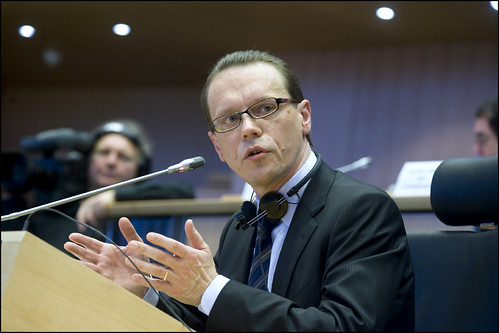
According to the agenda of last week's Commission meeting, Commissioners Semeta (Audit and Anti-Fraud; on the picture) and Lewandowski (Financial Programming & Budget) are responsible for this process.
I suppose it'll be interesting to follow this process and to listen to the upcoming debate between control freaks and laissez-faire freaks in the Council, the European Parliament and all around in the stakeholder community.
Picture: © European Parliament (flickr) / CC BY-NC-ND 2.0
Sunday, 21 March 2010
Olli Rehn interview makes big news in Germany

The main point of Rehn (on the right on the photo, sitting with Greek prime minister George Papandreou) in the interview is that he wants the EU to be involved already at the planning stage of the establishment of national budgets to prevent excessive deficits. He also criticised Germany's budget plan for 2010.
What is not clear from the interview is which legal consequences this proposal would have. The only consequence Rehn mentions for bad budget plans is that this would result in "very serious discussions" in the Eurogroup - whatever that means.
This interview has received wide attention in Germay, including the top online news platform Spiegel Online, the top TV news Tagesschau (video of the 14:00 edition), national newspaper platform Süddeutsche.de, economic newspaper Handelsblatt and others (e.g. here, here). The Austrian newspaper Der Standard has also taken up the matter.
The Greek crisis has made EU politics hard news, and European politicians like Rehn are apparently using this opportunity to strengthen the public agenda setting power of the Commission - let's see where his proposal will lead.
Wednesday, 10 March 2010
The EU budget procedure under Lisbon
The Commisssion has issued the "Draft Interinstitutional Agreement between the European Parliament, the Council and the Commission on cooperation in budgetary matters" which, in its Annex (from page 14), contains a clear procedure for the setting-up of the EU's yearly budget under the Lisbon Treaty.
- Until April: The three institutions meet to discuss the priorities for the next year.
- Last week of April/first week of May: The Commission passes the draft budget.
- Until mid-June: Council and Parliament inform the Commission about possible amendments.
- June/July: The three institutions meet to discuss the draft budget.
- Until the end of July: Council decides on the draft budget.
- Until early October: The Parliaments budget committee votes on the budget (in the version of the Council).
- Until mid-October: The Parliament plenary votes on the budget.
- Until mid-November: If the Parliament has amended the budget in the Council version in its reading, the institutions have 21 days to come to an agreement in the "Conciliation Process" (which is described at length in the draft document)
Wednesday, 28 October 2009
UPDATE: Leaked: The Commission's EU budget review
UPDADTE 12 Nov. 2009: It looks like this story has been burried because the Commission has no guts to stand against the interest of farmers!
After the recent leak of the Presidency proposal for the Stockholm Programme, FollowTheMoney.eu has now published a leaked draft EU budget review (PDF) by the Commission.
The first and most notable quote is that "the Commission considers that a root and branch reform of the budget is needed". In other words, the EU budget as it stands is completely outdated and needs an extreme reform to stand the demands and necessities of these days.
Then, the document focuses on five priorities the new budget design should focus on:
- generation of European added value
- concentration on key priorities
- greater flexibility and responsiveness
- simplification and efficiency of delivery
- fairness and added value in the financing of the budget
In fact, the whole document is fairly general, and so let me focus on some conclusions and points that are more concrete and that I find important enough to highlight:
- cohesion funding needs to be made according to clear conditionality and it also needs to be performance-oriented (p. 12)
- funding shall become more competitive and focus on cross-border activities (p. 13)
- the climate and energy change budget should be adapted to the goals set, inter alia by making the cohesion and agriculture spending "climate proof" (p.15)
- "considerably more funds" for transport infrastructure are needed (p. 16)
- a "significant reduction" in agricultural spending (p. 17) and a possible co-financing of direct aids by member states (p. 19) are foreseen
- the neighbourhood policy funding shall be reinforced (p. 20)
- the EU needs closer co-operation regarding migration and a Migration Management Support Fund should be established (p. 23)
- on page 24 there are a number of interesting measures to increase flexibility in the budget
- lighter procedures for smaller funds shall be applied (p. 25)
- integration of national programmes and EU spending (p. 26) and more national co-funding (p. 27)
- develop new financing resources for the EU that make it profit from its own successes (p. 29, 2nd para)
Altogether, I think the draft text of the document is quite ambitious in many regards but remains quite vague in many other instances too.
It also mixes policy-related points with an obvious political dimension and administrative issues that almost look self-evident. I am not sure whether this is very helpful because if you have seen diplomatic negotiations around such documents, the debates will concentrate on the policy issues and the most obvious administrative issues that could be tackled immediately are left aside and disappear in the jungle of diplomatic speeches and addenda.
And the CAP reduction will be a tough fight, and the Commission has all my support to fight hard!!
But I am not sure whether the Commission will be able to get this thing through (and we haven't even seen the final version of this document yet) and so by now all it is is nice talk that hasn't gone through the hands of the member states who will talk it down as they always do...
But I am not sure whether the Commission will be able to get this thing through (and we haven't even seen the final version of this document yet) and so by now all it is is nice talk that hasn't gone through the hands of the member states who will talk it down as they always do...
Wednesday, 14 October 2009
The story of Farmsubsidy.org
Getting things out of the Brussels bubble, co-operating to make the EU more transparent, informing citizens and a wider public - all this is discussed here on this blog and elsewhere, while others - like farmsubsidy.org - are actually doing something.
The farmsubsidy.org initiative has now produced a 20 minutes video titled "Fields of Gold" to talk about how this incredible project-network has evolved, how they work, and what they have achieved.
If you have these 20 minutes (you should have them!), take your time to watch the film, because it tells a lot about how we could change the political system of the EU if we were able to get more things like this one done:
And if you don't have the time to watch the video, go to their website, go to fishsubsidy.org or follow a whole lot more on FollowTheMoney.eu which brings together the joint efforts of the many to make the EU budget more transparent.
Thanks for that!!
The farmsubsidy.org initiative has now produced a 20 minutes video titled "Fields of Gold" to talk about how this incredible project-network has evolved, how they work, and what they have achieved.
If you have these 20 minutes (you should have them!), take your time to watch the film, because it tells a lot about how we could change the political system of the EU if we were able to get more things like this one done:
Fields of Gold: Lifting the Veil on Europe's Farm Subsidies from farmsubsidy.org on Vimeo.
And if you don't have the time to watch the video, go to their website, go to fishsubsidy.org or follow a whole lot more on FollowTheMoney.eu which brings together the joint efforts of the many to make the EU budget more transparent.
Thanks for that!!
Monday, 18 May 2009
Another glimpse into the Council's budget committee
It is the second time this year (here is the first time) that Martin Westlake, blogging Secretary General of the European Economic and Social Committee (EESC), allows us a glimpse into the Council's budget committee:
"I spent most of the afternoon in less comfortable surroundings; defending the Committee’s draft 2010 budget before the Council’s Budget Committee. These annual hearings with the other institutions, chaired by the future Swedish Presidency (since the final budget will be adopted during their mandate), are something of a ritualistic occasion. [...]Sounds like the member states are not big friends of the EESC and the Committee of the Regions (CoR).
National treasuries had clearly been given tough instructions. As I sat down I could hear blades being sharpened and blow torches being lit and the occasional thud of a baseball bat in glove. [...]
It’s not easy for the smaller institutions and maybe particularly difficult for the two consultative committees. They are not big and indispensable like the European Commission and certainly not big enough to undertake major redeployment exercises without prejudicing vital functions. They don’t have a gentlemen’s agreement, as the Council and the Parliament do, not to look into each others’ administrative budgets. [...]
One [member state; JF] delegate referred to a sort of inverted beauty contest, with delegates competing to declare which of the two Committees is the uglier, but the Committees themselves are certainly not competing with each other in this way. [...]"
Friday, 24 April 2009
The public relations of the EU-Council after its budget denial
The EU-Council has reacted with a press release (PDF) to the denial of the European Parliament to discharge its budget, as shown in this post.
If this is meant to be a public relations activity by the Council, then this is absolutely poor!
It looks to me like the helpless try of the Council Secretariat (not even of the Council itself) to safe its reputation. But its really badly done, and I don't believe that this will satisfy the Parliament, since it doesn't even satisfies me.
Thursday, 23 April 2009
European Parliament challenges the Council, its budget, and Javier Solana
Very, very, interesting interview from EuroparlTV:
The EP's budget control committee is rejecting an old 1970 "gentlemen's agreement" which said that the EP wouldn't care for the budget of the Council.
The committee demands insight into all details of the Council's budget, and Mr. Søndergaard (United European Left) even challenges the post of Council Secretary General Javier Solana in case the Council doesn't present satisfactory figures.
Tuesday, 21 April 2009
Siim's budget, José's campaign
On 4 May, Commissioner Siim Kallas will present the Preliminary Draft Budget for 2010 to the EP's budget committee.
For Follow The Money, this budget will be part of José Manuel Barroso's re-election campaign.
I'd like if the European Parties would comment the draft in campaign style, as soon as it is out. And to use their member parties to make this public!
For Follow The Money, this budget will be part of José Manuel Barroso's re-election campaign.
I'd like if the European Parties would comment the draft in campaign style, as soon as it is out. And to use their member parties to make this public!
Tuesday, 24 February 2009
Barroso postpones EU budget review to be re-elected
Jan argues on FollowTheMoney.eu that EU Commission President Barroso has postponed the EU budget review to October 2009 when the new EU Commission will have taken over office because he wants to be re-elected.
Sounds logical, because I don't think that Mr President wants to fight with member states and EU parliamentarians over fundamental budgetary questions!
http://www.AnyoneButBarroso.eu
Sounds logical, because I don't think that Mr President wants to fight with member states and EU parliamentarians over fundamental budgetary questions!
http://www.AnyoneButBarroso.eu
Monday, 23 February 2009
The Council's budget committee: A rare insight - corrected
Martin Westlake, Secretary General of the European Economic and Social Committee (EESC), has given a rare insight into what is happening in the Council budget committee in his blog, although his report only covers a specific transfer of reserve money into a particular EESC budget line:
By the way: From the public agenda (PDF) of the meeting you would know that something related to EESC was going on, but that we are talking about the sum of 1 Million Euro (which Martin clarifies in his post) would never be clear.Another hint towards the lack of transparency in the Council and its working groups!
Correction: In fact, today the issue has been published in document 6471/09. The 1 Million is mentioned there, so the main insight we get from Martin is the argumentation from the meeting.
A number of Member State delegations quite rightly pointed out that it was very, very early in the year for the Committee to be asking for such a transfer, particularly since, in comparative terms, it was quite large (since there is 15 meuro on the line, this transfer will represent an increase of one fifteenth). My counter-argument was that it was precisely because of the relative size of the amount involved that we needed to know we had got it as early as possible in the year so that we could indeed be sure to spend the money soundly and efficiently. The Presidency called for a vote and asked those against the request to raise their hands. Nobody did. Unanimity! The Committee had unanimously voted in favour of the transfer!We do not have the possibility to compare this with other decisions taken in the committee because the publicity of what is going on in there is rather low. So we don't know whether all decisions made in the Council's budget committee are taken this easily. But since Martin seemed rather happy to get the money, I suppose that sometimes the member states are more reluctant to spend more (or to re-allocate money).
By the way: From the public agenda (PDF) of the meeting you would know that something related to EESC was going on, but that we are talking about the sum of 1 Million Euro (which Martin clarifies in his post) would never be clear.
Correction: In fact, today the issue has been published in document 6471/09. The 1 Million is mentioned there, so the main insight we get from Martin is the argumentation from the meeting.
Wednesday, 21 January 2009
I recommend reading: "2009 and the EU budget: part one"
On the marvellous initiative FollowTheMoney.eu, Jan Seifert (who also runs an individual blog) has published a nice start into the discussions around the 2009 EU budget and the upcoming stages:
"2009 and the EU budget: part one"I recommend reading - and following the whole initiative!
Subscribe to:
Posts (Atom)

