Showing posts with label European Commission. Show all posts

Wednesday, 13 July 2016

UK's EU Commissioner: Hill goes, King comes?

I've already blogged about the selection of Julian King as potential future (and last) EU Commission from the UK.

His nomination has been formally submitted to the EU Council last week (PDF incl. his official CV). Cameron, who had his last day in office today, wrote in the letter:
"Sir Julian is a very experienced diplomat with particular expertise in European affairs who has served successive British Governments with distinction. I believe he would be a strong addition to the Commission for the period ahead."
This followed the official resignation of the current Commissioner Jonathan Hill with effect of 15 July 2016, midnight (PDF with Juncker's letter announcing the resignation).

As I wrote previously, it will be interesting to see what portfolio King gets and what kind of games the European Parliament might be willing (or not willing) to play ahead of his potential nomination.

Friday, 8 July 2016

Will Julian King become the last EU Commissioner from the UK (or will he be blocked)?

"Following the nomination by British Prime Minister David Cameron of Sir Julian King as the candidate to replace outgoing Commissioner Lord Hill, President Jean-Claude Juncker will receive him on Monday, 11 July at 11:00 (CET) for an interview." (COM press release, 8 July 2016)
The announcement that the UK's ambassador to France (since this year), Julian King (Twitter), would be nominated as candidate for European Commissioner for the UK has been floating around for  days, so nothing surprising in the Commission's press release.

What will become interesting is (a) whether Juncker will propose him as a candidate after the interview on Monday, and (b) whether the European Parliament will actually endorse him as Commissioner and (c) whether, in case the EP refuses him, the Council and the Commission President would dare to go against the will of the parliament.

The press release specifies these procedural aspects:
"the appointment of a new Commissioner of UK nationality requires common accord between the President of the Commission and the Council after the consultation of the European Parliament … . In addition, the Interinstitutional Framework Agreement on relations between the European Parliament and the European Commission requires the President of the Commission to “seriously consider” the results of the consultation of the European Parliament – which will audition the candidate – before giving his accord to the decision of the Council to appoint the new Commissioner"
King's CV shows that he had not only experience as representative of his government at the EU Council of Ministers (1998-2003, 2004-08), including as representative to the EU Council Security Committee during the time of the UK's last presidency of the EU Council (as proven by this document). Afterwards (2008-09), he was also in the cabinet of former UK EU Commissioner Catherine Ashton while she was still responsible for trade, not foreign affairs.

Thus, he knows his way around the Council, including at the level of the Council Presidency, and he has served at cabinet-level inside the Commission in a not-so-distant past, which will have given him quite some insights into Commission business.

In other words, the UK sends a person who looks very much qualified for the job, probably better qualified in EU terms than any of his recent predecessors. Don't know anything about him personally, but, short of Jonathan Faull, this sounds like a good choice and I don't see why the EP should not approve him except for broader political considerations.

Wednesday, 6 July 2016

The Creation of the European Commission by EU Media, in 7 Days

EU media, day 1:
“Commission doesn’t do what member states want. Bad Commission!“
EU media, day 2:
“Commission does what member states want. Submissive Commission!“
EU media, day 3:
“Commission doesn't work with the European Parliament. Unaccountable Commission!“
EU media, day 4:
“Commission works with the European Parliament. Non-independent Commission!“
EU media, day 5:
“Commission doesn't listen to citizens. Undemocratic Commission!“
EU media, day 6:
“Commission listens to citizens. Populist Commission!“
EU media, day 7:
And EU media rested on the seventh day from all their work that they had done.*
–––
Readers who liked this post also liked: Short Guide to Lazy EU Journalism


Sunday, 3 July 2016

Who has got a plan? (Commission edition)


"The Commission does not speculate on hypothetical situations."
This is the answer given by President Juncker on behalf of the Commission on 29 April 2016 to the question of Cyprus MEP Lefteris Christoforou wether the Commission was prepared for the Brexit scenario and what it believed would be the main problems caused by Brexit.

Nowadays we only hear about the lack of a plan of the UK's leave campaign supporters, but the question is whether there is a real plan inside the Commission about what is there to come. Haven't heard anything concrete so far.

Friday, 25 June 2010

Should Commission staff edit Wikipedia articles?

On the EU Commission social media blog "Waltzing Matilda" Alenka is asking a number of pertinent questions:
"In your opinion, should the European Commission edit EU-related Wikipedia pages? If yes, when and how should we do it? If no, what alternatives would you suggest? I am looking forward to your comments."
So, should EU Commission staff edit Wikipedia articles to correct, for example, factual mistakes?

Wednesday, 23 June 2010

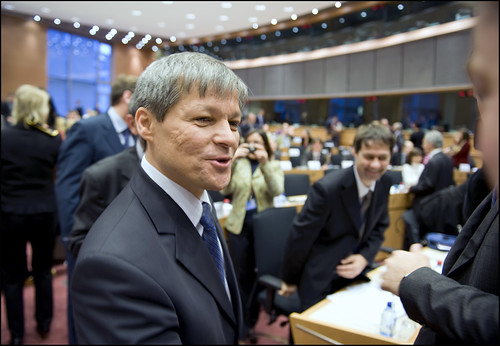
A human Ciolos & an inhuman Reding: Two faces of the EU Commission's social communication

Dacian Ciolos, European Commissioner for the Agriculture, said the following about the value of his presence on Facebook today:
I gather that as from today you are already 500 people following my journey through the European agriculture. I want you to know that I feel your wish for interaction, I enjoy your presence here and it helps me tremendously to remain human, accessible and down-to-earth. Thank you.
I may add to these beautiful words that one should interpret this message as an involuntary but direct attack to Commissioner Reding and her cabinet who are actively working against the European Commission from entering into 21st century communication - disguised as bureaucratic newspeak in the form of a "solid cost-benefit analysis" and a "coherent communication strategy".

These are the inhuman words from the technocratic ages of controlled communication and closed-up public institutions.

As if one could simply measure "cost-benefit" of openness and transparency, reaching out to the public and communicating more humanely or as if the idea of social media wasn't the exact opposite of what were "coherent communication strategies" in the last century where journalists and big media dominated the intermediation between public institutions, citizens and other stakeholders.

But maybe it is a problem when a former journalist and a former legal adviser to a large media corporation are responsible for reforming the communication of the European Commission...

If the Commission was intelligent, it would see that people like Ciolos and so many other human voices from the Commission are not a threat to good communication but the greatest opportunity of opening up a bureaucratic organisation to the public, a public that the organisation is supposed to serve.

Ms Reding, do you hear that? I bet you don't, because it would mean you cared about it!


Picture: European Parliament / CC BY-NC-ND

Monday, 7 June 2010

Relations between the EU Commission and national parliaments in 2009

The Commission has issued a report on its relations with the national parliaments and the activities of these parliaments vis-à-vis the Commission.

Instead of starting to read the full text, I recommend starting with the Annex on pages 12-14, because there you have a nice overview over how active member states' parliaments were in 2009.

Very interesting to note is that Portugal was by far the most active country sending opinions to the European Commission (the Barroso bonus?).

And it is also worth noting that in countries where there is a second or higher chamber, this chamber seems more likely to issue opinions than the main parliament (maybe because the main parliament's majority has usually control via the government).

However, it will be very important to compare these figures with the figures for 2010, because this will be an indication whether the Lisbon Treaty rights for the national parliaments actually made them more involved with EU legislation.

Friday, 4 June 2010

The female Commissioners' communication under scrutiny

Journalist-blogger Prune Antoine is heavily complaining about the heterogeneous quality of the (female) EU Commissioners' press services.

For her series "Drôles de Dames" (see my post), Prune wanted to have short interviews with all female Commissioners.*

So while Prune is very satisfied with the press services of Hedegaard, Reding and Georgieva, she is very unhappy with the press service of Vassiliou, Malmström and Ashton, who are either putting her off or are not reacting at all to her requests.

Prune also regrets that Margot Wallström isn't there anymore - and I agree, in particular since I have the impression that with the new Commission the interest in a common approach to EU <–> citizen communication has been pretty much lost.

One should mention that Wallström's portfolio is now managed by Commissioner Reding who seems to be able to deal with the press (see above) but who doesn't show much interest in modern communication as her disastrous letter to the Commission web editors - which is basically a big fat "NO!" to social media communication - has proven.

So we have some way to go in the interaction between the EU institutions on all levels with journalists and citizens, both via traditional media and through new communication channels, an issue that I've been talking about with many people over the last weeks here in Brussels...

* The ones she got are a very interesting read, so interesting that they even got the attention of the well-read German feminist blog Mädchenmannschaft ("Wie macho ist die EU?"), for which I then took the time to translate the first interview given by Commissioner Reding into German (the interview has been published below the original German article).

Monday, 31 May 2010

The Stockhom Games: Malmström equalises against the Council

10 days ago I reported that the Council looked very unhappy with the Stockholm Programme Action Plan that Malmström had proposed not long before.

The reaction from the Commission (in the annex) doesn't look very friendly either, at least when you read between the diplomatic lines.

The translated version: Go f*** yourself! We heard your complaints but we didn't do anything wrong; to the contrary: we did what citizens and the Parliament expected from us!*

And so they threw the staplers back to towards the Council to equalise in the Stockholm games that will keep going on...

* This is a very rough translations. Commission officials are trained not to speak like this in public, so I am just making a rough guess.

Sunday, 30 May 2010

More or less control in the supervision of EU funds? - On the Commission Communication

It is no secret that the EU is spending a good amount of its budget through funds that are given to diverse recipients all across the Union, and so a discussion on how these funds are spent is always worth having.

They are worth having because almost every EU citizen, business, public authority or non-governmental organisation is directly or indirectly concerned.

In this regard, I find the newly published Commission Communication
"More or less controls? Striking the right balance between the administrative costs of control and the risk of error"
a very good start and probably the right way to go.

This seems to be the beginning of a discussion about what is a "Tolerable Risk of Error" (TRE) when it comes to the spending of EU funds, and while this communication "just" covers the fields of "Research, energy and transport" and the "European Agricultural Fund for Rural Development" it is foreseen to continue this exercise in other policy areas, too.

The big question raised in the communication is whether it is worth spending more money on controlling how EU funds are used when the amount of money and effort you have to invest to do so exceeds the the financial gains you have.

The conclusion is, if I read the document correctly, that a certain margin of error should be formally introduced that is somewhere between 2 and 5% because there a balance between effectiveness of control and efficiency of administrative costs spent seems to be reasonable.

More background information is in the two accompanying Commission Secretariat documents SEC(2010)640 (on the rural development policy area) and SEC(2010)641 (on the research, energy and transport policy area). As so often, both documents are not yet available in the respective PRE-LEX procedure, so thanks to the Council register for making it public first!

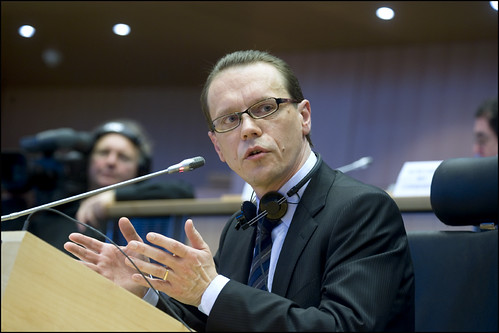
According to the agenda of last week's Commission meeting, Commissioners Semeta (Audit and Anti-Fraud; on the picture) and Lewandowski (Financial Programming & Budget) are responsible for this process.

I suppose it'll be interesting to follow this process and to listen to the upcoming debate between control freaks and laissez-faire freaks in the Council, the European Parliament and all around in the stakeholder community.

Picture: © European Parliament (flickr) / CC BY-NC-ND 2.0

Friday, 28 May 2010

Progress report on the Single European Electronic Communications Market

My own progress report on European electronic communication: Is there progress?

I still have to find a national operator when I move to another EU country instead of having one European mobile phone operator with the same prices and services wherever I am.

The Commission's Progress report on the Single European Electronic Communications Market is a little more detailed than my very personal view, but they also get money to produce a lot of text.

The summary of their report: "There is still work left." Would be surprising if a governmental bureaucracy would one day say: "Yepp, everything is done, we'll go on holidays for the next years."

More interesting than the simple progress report - at least more interesting for all of you interested professionally in electronic communication - is the first addendum to the report, which on over 400 pages lays down the development in the communications market and electronic communications regulation in the EU and in each EU member state. That is kind of a resource worth looking at.

And in the second addendum there are all the raw data, diagrams, tables and sources of the statistics - another 130 fun pages for all of you whose lives are dominated by communication markets, either because you (de-)regulate them or because you earn money on them (or both).

For me this is too much text, but I thought you might be interested to take a look, now that the weekend is approaching.

Thursday, 20 May 2010

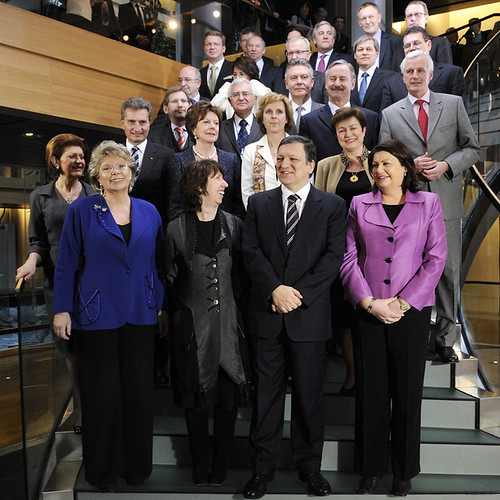
The women who run the Commission

Award-winning journalist-blogger Prune Antoine - who had the guts to show up in jeans for her award ceremony at the Quai d'Orsay (yeah!!!) - is publishing a wonderful series of interviews with female EU Commissioners on her blog.

So far, Connie Hedegaard, Maria Damanaki, Neeli Kroes, Máire Geoghegan and Viviane Reding have answered the same questions about how "macho" they find the EU institutions, how the fact that they are women influences their work and how they would like to change the EU.

If you haven't read the interviews yet - now is the time!

Picture: © european_parliament / CC BY-NC-ND 2.0

Wednesday, 12 May 2010

The regulation of regulations

Many have said much about the plan that was made to save the Euro and the Union.

But why say so much when it can be said as cold-blooded as in Article 1 of the regulation that has changed the Union:
"With a view to preserving the financial stability of the European Union, this Regulation establishes the conditions and procedures under which Union financial assistance may be granted to a Member State which is experiencing, or is seriously threatened with, a severe economic or financial disturbance caused by exceptional occurrences beyond its control, taking into account the possible application of the existing facility providing medium-term financial assistance for non-euro-area Member States' balances of payments, as established by Regulation (EC) No 332/2002."
These are the words that are worth 60,000,000,000 Euro (this sum is not mentioned anywhere in the regulation) and they are followed by words in the second article that are probably historic in the constitutional history of the European Union:
"[T]he Commission shall be empowered on behalf of the European Union to contract borrowings on the capital markets or with financial institutions."
Just to repeat that: A regulation by one institution, the Council, gives new fundamental, quasi-constitutional powers to the another institution of the European Union, the Commission, namely to make debts on the financial markets.

In other words, the Council has given itself the quasi-constitutional right to create quasi-constitutional rights for the Commission. In a meeting that lasted just half a day.

Let's face it: This is the "regulation of regulations".

Picture: © tpcom / CC BY-NC-ND 2.0

Thursday, 6 May 2010

Comitology 2.0: Commission doesn't want parliamentary rights under Article 291 TFEU

In the Council report (page 8-9) from the recent meeting of the European Parliament Committee on International Trade (INTA) we find the true face of the EU Commission when it comes to the new parliamentary rights of the EP after the Lisbon Treaty reform (own highlight):
"A representative of the Commission explained that the proposal was aiming to simplify and make more transparent the existing four comitology procedures. He explained, that Member States could not stop an implementation measure on their own but needed a qualified majority to do so. He said that it did not seem necessary to repeat the scrutiny powers of Council and European Parliament in this Regulation."
This quote refers to the the draft proposal concerning the implementing powers of the European Commission and the related comitology procedures (Article 291 TFEU).

Monday, 3 May 2010

Access to Commission documents

This is just an example:

I was searching for the European Commission working document Sec(2010)426 in their document search and what I get are these results without any link to the actual document(s).

However, the document is accessible on Eur-Lex, in the Council register and even somewhere on the Commission website where it can be found via Google.

Why not making it public through the actual document search of the Commission if it is public anyway?

Friday, 30 April 2010

Contradictory results in Court of Auditors report on the impact assessments of the Commission

A report by the EU Court of Auditors (that was so far confidential but now released by the Council) is generally positive about the way the EU Commission assesses the impact of its programmes. At the same time, the report leaves serious doubts about this conclusion.

For time reasons, I just took a look at the executive summary. But in there one can clearly see the contradiction between different conclusions drawn.

It starts very positive:
"On balance, particularly in recent years, the audit has shown that impact assessment has been effective in supporting decision-making within the EU institutions. In particular, it was found that the Commission had put in place a comprehensive impact assessment system since 2002.

Impact assessment has become an integral element of the Commission's policy development and has been used by the Commission to design its initiatives better. The Commission's impact assessments are systematically transmitted to the European Parliament and Council to support legislative decision-making and users in both institutions find them helpful when considering the Commission’s proposals.
"
So while this sounds good, the summary continues like this:
"Impact assessment reports do not easily reveal their key messages to the reader and comparing the impacts of the various policy options presented in an IA report is often impossible.

Also, due to a lack of appropriate data, the quantification and monetisation of the impacts of the different options assessed were weak and the analysis often did not provide an adequate basis for a comparison of policy options. In addition, comparing different options was made difficult because of the way in which they were presented in the impact assessment reports.
"
In other words, the Impact Assessments are a nice innovation but they are largely worthless because they are unclear and not based on good data.

So Impact Assessments have been introduced but they cannot be an effective tool because their results are blurry as much EU language in decisions and reports is blurry and indefinite. Great!

Tuesday, 27 April 2010

Where are all the promotional clips for the Euro? - updated


Below you see an example on why sometimes it is better to spend some more minutes on research before publishing a blog post. It's still worth a story, but it could have been much more consistent, precise and convincing.

Blogging at the speed of tweeting should be avoided - the results of thoughtful blogging look much better (but are much more work...).


It seems as if we are seeing a small EU communications disaster.

According to Raymond Frenken from EUX.TV, all promotional clips for the Euro have been removed from the EU's channel EUtube on Youtube (Update 1: One video - the one on "low inflation" - seems to be left on EUtube. Update 2: They are still on the Commission website... Update 4: However, the video on interest rates that is shown below is not available on the website.).

Frenken also reports on Twitter that he has been called by a (communications?) agency working for the Commission (Update 3: this one) telling him that he should remove the following video from the EUX.TV channel:


Why can't the Commission stand by (Update: all) its videos (Update 2: on Youtube), even while Greece is in trouble? Don't they believe anymore that the Euro is a good thing? What kind of message are they giving buy such actions? This is idiotic!*

* (even as idiotic as the videos look(ed) like)

Thursday, 22 April 2010

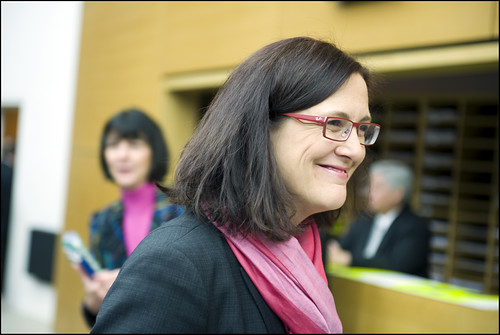
Cecilia Malmström & transparency in the EU Commission

In a recent blog post (Google translated), Commissioner Malmström told that she would (partially) publicise her official communication on a special Commission website called CaROL (Cabinet's online register)*.

In the comments to the post I asked her:
Will you be able to convince your colleagues in the Commission to do the same?
and her Cabinet assistant Love Berggren today gave me the following answer:
Cecilia Malmström’s would certainly welcome if other Commissioner’s were to follow, and hopes to provide a good example by making this register available. But the decision is up to each and every Commissioner.
I want to thank her assistant Love for the answer - and I definitely hope that Ms Malmström will serve as an example for her colleagues, indeed!

PS.: This seems to be "Commissioners' Reactions Day", since fellow euroblogger Samuel just received a reaction to one of his blog posts from EU Commissioner for Agriculture Dacian Ciolos.


* You can use the following short link for direct access to all the correspondence of Commissioner Malmström: bit.ly/9H8ib8 - which can be helpful because in default it shows only the last ten letters.

Picture: © european_parliament / CC BY-NC-ND 2.0

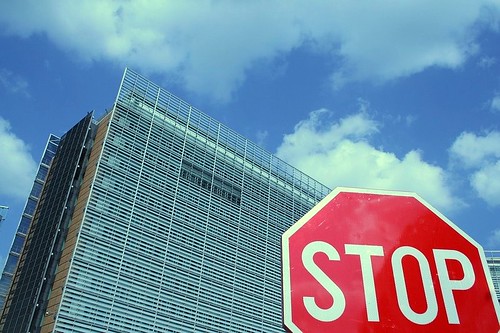
Stop Berlaymont!


I think we could use this photo for every blog post in which we criticise the EU Commission*... Thanks @quarsan!

* For the non-Brussels crowd: This is the main EU Commission building called "Berlaymont" (sometimes also called like this).

Picture: © quarsan / CC BY-NC 2.0

Tuesday, 20 April 2010

Public access to EU documents - A never-ending story

After having written about the 2009 report on public access to EU Council documents* and about "The Leaking Union" these days, I thought I'd just link the previous Council reports, too, and then put these into some perspective regarding the stalemate reform of public access to EU documents.
  • 2002 (first annual report)
  • 2003 (second annual report)
  • 2004 (third annual report)
  • 2005 (fourth annual report)
  • 2006 (fifth annual report)
  • 2007 (sixth annual report)
  • 2008 (seventh annual report)
(Maybe somebody wants to take a look to see whether there are some interesting developments?)

In the meantime, the EU institutions are debating the recast of the Regulation 1049/2001 on public access to EU documents that is the basis for the above-mentioned reports. Already two years ago, in April 2008, the Commission proposed changes, but Council and Parliament have not come to an agreement (see the PRELEX dossier) until now.

Since December 2009, the entry into force of the Lisbon has changed the legal basis of the regulation and of the proposed modifications, as the Commission tells in an explanatory note from January.

The public right to access to documents is now governed by Article 15 paragraph 3 of the Treaty on the Functioning of the European Union (TFEU):
Any citizen of the Union, and any natural or legal person residing or having its registered office in a Member State, shall have a right of access to documents of the Union institutions, bodies, offices and agencies, whatever their medium, subject to the principles and the conditions to be defined in accordance with this paragraph.

General principles and limits on grounds of public or private interest governing this right of access to documents shall be determined by the European Parliament and the Council, by means of regulations, acting in accordance with the ordinary legislative procedure.

Each institution, body, office or agency shall ensure that its proceedings are transparent and shall elaborate in its own Rules of Procedure specific provisions regarding access to its documents, in accordance with the regulations referred to in the second subparagraph.
[...]"
The proposal regarding the recast of the 2001 regulation is not affected, explains the Commission in its note, but since the other two institutions are unable to come to an agreement the Commission considers proposing some modifications.

I hope that there are people within the Commission, the Parliament and even the Council who are willing to bring these things forward - the Union desperately needs more transparency, in particular in the light of the initiatives to create a European public sphere.

PS: If you want to see what kind of requests for access to documents are made at the Council, you can follow this search query.

* full title: "Eigth annual report of the Council on the implementation of Regulation No 1049/2001 of the European Parliament and of the Council of 30 May 2001 regarding public access to European Parliament, Council and Commission documents"