Showing posts with label administration. Show all posts

Sunday, 30 May 2010

More or less control in the supervision of EU funds? - On the Commission Communication

It is no secret that the EU is spending a good amount of its budget through funds that are given to diverse recipients all across the Union, and so a discussion on how these funds are spent is always worth having.

They are worth having because almost every EU citizen, business, public authority or non-governmental organisation is directly or indirectly concerned.

In this regard, I find the newly published Commission Communication
"More or less controls? Striking the right balance between the administrative costs of control and the risk of error"
a very good start and probably the right way to go.

This seems to be the beginning of a discussion about what is a "Tolerable Risk of Error" (TRE) when it comes to the spending of EU funds, and while this communication "just" covers the fields of "Research, energy and transport" and the "European Agricultural Fund for Rural Development" it is foreseen to continue this exercise in other policy areas, too.

The big question raised in the communication is whether it is worth spending more money on controlling how EU funds are used when the amount of money and effort you have to invest to do so exceeds the the financial gains you have.

The conclusion is, if I read the document correctly, that a certain margin of error should be formally introduced that is somewhere between 2 and 5% because there a balance between effectiveness of control and efficiency of administrative costs spent seems to be reasonable.

More background information is in the two accompanying Commission Secretariat documents SEC(2010)640 (on the rural development policy area) and SEC(2010)641 (on the research, energy and transport policy area). As so often, both documents are not yet available in the respective PRE-LEX procedure, so thanks to the Council register for making it public first!

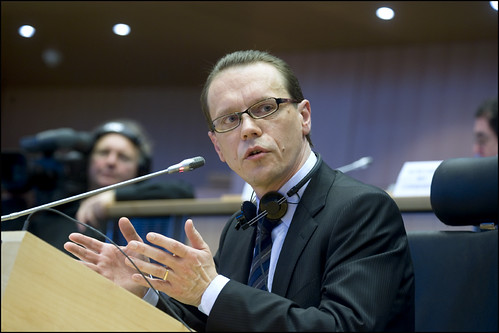
According to the agenda of last week's Commission meeting, Commissioners Semeta (Audit and Anti-Fraud; on the picture) and Lewandowski (Financial Programming & Budget) are responsible for this process.

I suppose it'll be interesting to follow this process and to listen to the upcoming debate between control freaks and laissez-faire freaks in the Council, the European Parliament and all around in the stakeholder community.

Picture: © European Parliament (flickr) / CC BY-NC-ND 2.0

Tuesday, 4 August 2009

Digital co-operation of administrations in the EU: New developments [supplemented]

Since nothing happens in the EU, I took a look at some EU Council documents - and I could discover quite interesting details.

Earlier this year, the Czech EU Council presidency proposed the setting up of an "informal virtual discussion forum" for member states' officials as well as Council and Commission staff dealing with the execution of EU-sanctions.

The idea of this mail-based virtual forum is to informally exchange views between the different officials on how they implement EU sanctions. Officials using the forum can ask questions to their colleagues and are free to answer the questions of others when necessary.

(Very interesting to note is that journalist Bruno Waterfield had requested access to the document linked above [there: the 2nd revised version from April] in its 1st revised version from March.)

According to a new, partially public Council document from the end of June, there are one general list and three specialised (but non-operational) fora set up by now, and until the end of the Czech presidency, 72 officials from 18 member states had registered.

In the same Council document, I also discovered CIRCA (Communication & Information Resource Centre Administrator), apparently a virtual tool the Commission has set up a long time ago (which you can see from its design) to allow geographically spread administrators to work together on a wide range of issues.

Yet, it doesn't seem to be that known if the Commission still needs to present it to the member states and if it raises discussions (see Council document) because certain delegations complaine that CIRCA only exists in English.

Both initiatives show that the EU tries to foster inter-administrative co-operation through means of the 21st century (although an email-forum is still quite 20th century style) - it would be interesting to hear how these things are used in practice.