Thursday, 7 July 2016

Are Europol's anti-terror databases broken?

"The number of FTF [Foreign Terrorist Fighters] in Europol databases does not reflect the numbers reported by MS [Member States]" (Source: EU Council document
Maybe I'm seeing this wrong, but does that mean that Europol's anti-terror databases are broken? Are emails from all around the EU getting lost on the way to The Hague?

Does that mean that all the anti-terror work – including the creation of an EU counterterrorism centre – doesn't even lead to the EU's wannabe FBI to have a full picture on known terrorists and that Europol is thus unable to foster a proper sharing of information within the EU?

I'm in shock (unlike the terrorists).

–––
The rest of the EU Council Terrorism Working Party summary document linked above is also interesting, for example if you care about Daesh narratives.

Wednesday, 6 July 2016

Alexander Betts' TED Talk: Why Brexit happened -- and what to do next


Alexander Betts asks serval questions:

Did it happen overnight? What does Brexit represent? And what should we do about it?

EU member states delay trilogue transparency

This Council document (item 5c) reads like EU member states want to delay increased transparency of EU law-making by trilogues*:

The Presidency informed delegations on the outcome of the General Affairs Council on transparency issues. … Regarding trilogues, the President indicated that discussions had shown the need to balance transparency with the efficiency of the decision-making process and that further discussions were needed.
–––
* Trialogues is EU language for: behind-closed-doors meetings of Parliament, Council and Commission to compromise on new EU laws before first reading without providing any public protocols.

The Creation of the European Commission by EU Media, in 7 Days

EU media, day 1:
“Commission doesn’t do what member states want. Bad Commission!“
EU media, day 2:
“Commission does what member states want. Submissive Commission!“
EU media, day 3:
“Commission doesn't work with the European Parliament. Unaccountable Commission!“
EU media, day 4:
“Commission works with the European Parliament. Non-independent Commission!“
EU media, day 5:
“Commission doesn't listen to citizens. Undemocratic Commission!“
EU media, day 6:
“Commission listens to citizens. Populist Commission!“
EU media, day 7:
And EU media rested on the seventh day from all their work that they had done.*
–––
Readers who liked this post also liked: Short Guide to Lazy EU Journalism


Tuesday, 5 July 2016

Europe in blogs (19): Questions to the Remain campaign

Questions that won't find an answer but that future generations will probably continue to ask unless the Brexit mess turns into a surprising future success that is hard to see:
"Why the clumsy responses to great campaign manoeuvres by Leave; why did they double down on the economy and fear when a quick study of potential voter groups demonstrated that a positive narrative could work; why were key demographics not targeted more directly; and why were get out the vote efforts not more aggressive given that turnout was a concern?"
(Questions asked by Steffen Moller)

–––
You may also want to read: "How remain failed: the inside story of a doomed campaign" (The Guardian) that gives some answers to the questions raised by Steffen.

Article updated with The Guardian link.

Why is there a media campaign against Juncker?

This blogger is no stranger of being part of an anti-Commission President – the old ones among you may remember "Anyone But Barroso" started by Jon Worth in 2008 – but I still wonder why there is and anti-Juncker campaign in EU-media in recent weeks and where it is coming from.

It all seems to have started with Politico's major article on Juncker some weeks ago, followed with pre-Brexit speculations and denials about Juncker's resignation.

Then, on 27 June, the Czech foreign minister went on the record to criticise Juncker, citing the former saying the the Commission President would not be up to the job. Euractiv and Politico both ran the story. The Financial Times had the Polish foreign minister on the record. Politico then ran several stories with denials from Juncker and his surrounding.

Some days later, Politico reported that Juncker still had the backing of a large majority in the EP, the only body that can make the European Commission (and thus Juncker) go, as I've blogged Sunday after the Sunday Times ran another story reporting calls from Germany that Juncker should resign. The Luxemburger Wort covers the attacks in several German media, such as an editorial in

EUobserver simply repeated the Sunday Times story yesterday morning, just to report the opposite in the evening, while still mentioning Commission Vice-Presidents Timmermans and Katainen as potential successors for the job.

I suppose you have to be part of the Brussels bubble to understand where all this is coming from.

Some central and eastern European countries, none of which share Juncker's europhile attitude anyway, and most recently some forces in Germany seem to want to limit the Commission presidents ambitions. A concerted media attack, with few sources on the record, shows that Juncker must have angered quite some people recently.

But since I cannot remember any similar attack on Barroso, this is probably a sign that, indeed, this Commission is more political than the last. Once you are political, you make (political) enemies.

The fact that Brussels (and some other) media play along could mean two things: either Juncker and his team have angered the journalists – I remember Juncker's Chef de Cabinet Selmayr being coined quite a control freak when he was Reding's spokesperson and chef de cabinet, so he may well have angered some journos in his current role – or journalists got bored over the lack of news stories because the EU does so few laws these days.

Or the Brussels bubble is afraid to actually deal with Brexit substantially, so they focus on key players instead. He against them. They against him. The Council fighting back, afraid to lose ground to the supranational level. The media, jumping on board because it makes a simple story.

Since I've been doing anti-Barroso campaigning in the past, I can fully understand the pleasure in running behind Juncker. But it's kind of cheap politics. It's not like Juncker doesn't do anything that could be expected of him when he was elected President; he was known for how he was, his political program was and is more than clear.

All that anyone seems to blame Juncker for post-Brexit is that he speaks out against what seems to have been the most fucked-up political campaign by UK politicians in our lifetime. The EU would do good to strengthen the pro-European Juncker for what will be difficult negotiations over Brexit (or whatever the future EU-UK relations will be called).

Monday, 4 July 2016

Europe in Blogs (18): Poland, Brexit and Polexit

"The only calls for a ‘Polexit’ referendum on whether Poland should leave EU have so far come from fringe politicians on the radical Eurosceptic right. Law and Justice’s anti-federalism notwithstanding the dominant view in the ruling party remains that it is in Poland’s interests to remain in the EU and try to reform it from within."
Over at "The Polish Politics Blog", Aleks Szczerbiak looks at Brexit from the Polish perspective.

The current Law and Justice (PiS) government seems to blame EU elites for the Brexit votes, whereas the opposition sees some of the blame with rising eurosceptic voices (like PiS). Overall, however, there are very few calls for a Polexit, because Poland and Polish citizens overall benefit from the EU.

The Polish case seems interesting to me because, after Brexit, Poland's role as a sizable EU member state should only grow, while payments coming from the EU budget should rather decrease. It will be interesting to see how this can go together…

Interview with the future UK prime minister? - Theresa May on ITV

Yesterday morning, Theresa May, candidate for UK prime minister and thus also one of the candidates for chief negotiator for Brexit in the years to come, gave an interview at ITV.

Most importantly, she doesn't want to evoke article 50 of the EU Treaty before the end of 2016. And she does not want new elections but instead just a Tory party membership vote to decide about the next Prime Minister.

There'll probably be quite some interviews like this in the weeks to come, but they are already telling something about the potential future course of action of the Brexit negotiations.

Sunday, 3 July 2016

Berlin may tell Juncker to go but has no say in this

The Sunday Times reports that Berlin (Merkel etc.) wants Commission President Juncker to go. The problem is: Berlin has no say in this.

It's funny to read an article like the Sunday Times about some government wanting the Commission President to go but not mention once that the only institution that can do this is: the European Parliament.

Article 17.8 of the EU Treaty makes clear that
"The Commission, as a body, shall be responsible to the European Parliament. … the European Parliament may vote on a motion of censure of the Commission"
And for a motion of censure to go through (see article 234 of the Treaty on the Functioning of the European Union), it needs a 2/3 majority, after which not only the President has to resign but the Commission "as a body". Which means that even if "Berlin" wanted Juncker out, Merkel would have to organise a large majority of EP members that kicks out the whole Commission - that's pretty unrealistic.

The only other way to get rid of individual Commission members would be a clear breach of integrity (art. 245 TFEU), which would have to be decided by the Court of Justice of the EU.

It's exactly this kind of little detail that makes media reporting about EU matters – in the UK in particular but also elsewhere – create totally unrealistic expectations about what can and what cannot be done, one of the underlying problems that led to the Brexit majority followed by post-referendum chaos. 

The Brexit mess was predictable

In his post "The five routes to a Brexit: how the UK might leave the European Union" published quite exactly two years before the referendum, Tim Oliver concluded quite neatly:
"This all begs the question then of what ‘out’ means. As noted at the start, a Brexit is a means to an end and not an end in itself. For each of the above scenarios, ‘out’ is a difficult concept. A referendum or unilateral declaration of withdrawal cannot compel the EU to give the UK what it wants beyond an official withdrawal. What ‘out’ the UK then secures will be shaped by what the rest of the EU and other powers such as the United States are willing to grant it in terms of new or recalibrated political and economic relations."
Others like Fabian Zuleeg (for the European Policy Centre) have also predicted in 2014 the rise in nationalistic rhetoric that the UK has experienced throughout the referendum campaign but especially in the days since the Leave side won:
"While it is unlikely that the UK would become a “failed state,” there is a probability that a much more strident nationalism could develop with a negative impact on inter-European cooperation"
Funny enough, while it seemed unlikely the UK would become a failed state, it now very much looks like one, at least when it comes to top-level politics.

I'm not saying nobody told about this during the referendum campaign, but the post-referendum mess and the lack of a plan and the messy situation are not necessarily something you couldn't have seen coming already two years ago…

If Britain was a Youtube channel…

If Britan was a Youtuber or a Youtube channel, this is how the story would be told:


It's by a French Youtuber (Masculin Singulier), in French, with quite well-done English subtitles. Maybe one or the other metaphor less would have done the job, but it's still a fun little story about YT channels (The Channel…?!), trolls, the interests of big business and false information.

Fun element of the video: the European Parliament Brexit debate running in the background while the video was filmed.

What do we learn: With Brexit looming, maybe we have to listen more to non-English voices, learn to appreciate (social) media and perspectives from voices of all 28 countries. 

Who has got a plan? (Commission edition)


"The Commission does not speculate on hypothetical situations."
This is the answer given by President Juncker on behalf of the Commission on 29 April 2016 to the question of Cyprus MEP Lefteris Christoforou wether the Commission was prepared for the Brexit scenario and what it believed would be the main problems caused by Brexit.

Nowadays we only hear about the lack of a plan of the UK's leave campaign supporters, but the question is whether there is a real plan inside the Commission about what is there to come. Haven't heard anything concrete so far.

Saturday, 2 July 2016

€15.8 million more for EU institutions' security

"Following the November 2015 attacks in Paris and those of March 2016 in Brussels, all institutions have reviewed their security needs in the short to medium term. The draft budget for 2017 incorporates additional elements related to security for almost all institutions. However, in some cases the need to accelerate the reinforcement of security measures and installations requires additional resources in 2016 already. 
Draft amending budget (DAB) No 3 for the year 2016 proposes to reinforce the budget for security for a total of EUR 15,8 million."
Source: COM(2016)310

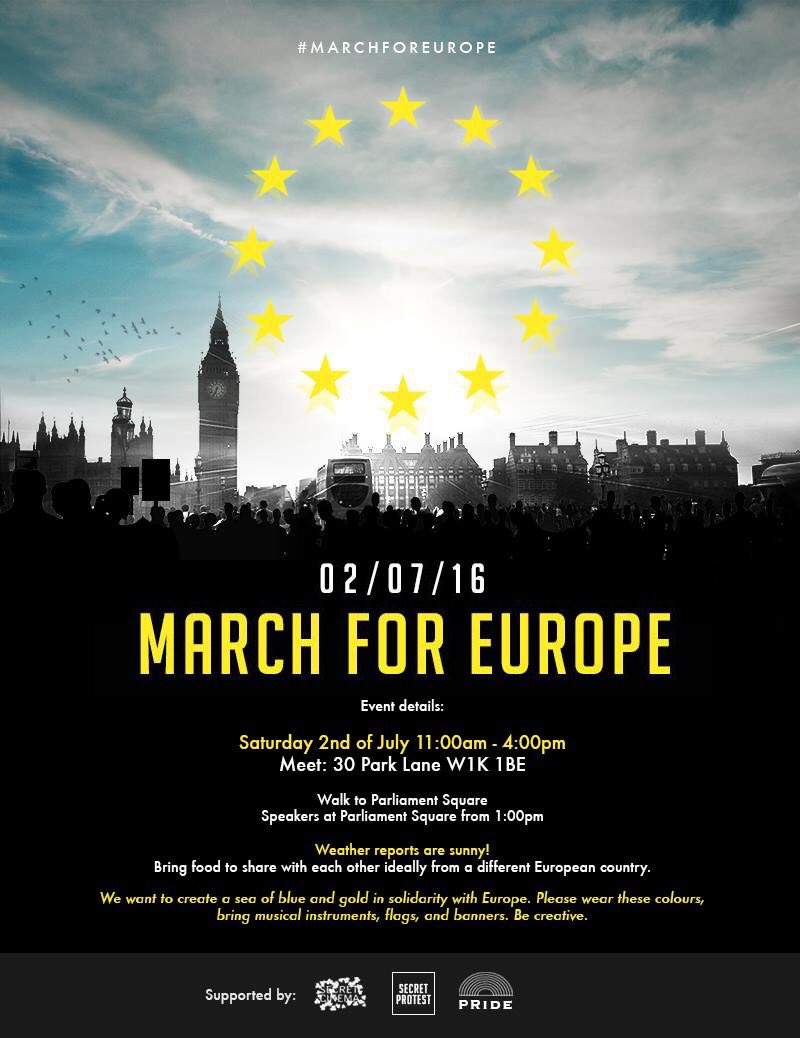
#MarchForEurope: Now they march?

In two hours, several groups want to March for Europe.  Now they march? Why not before the referendum? It's always good to wake up when it is too late. Hoping, that it is not too late.


Image via Techcrunch on Twitter
We will see later how many thought that it's not too late. And whether those who voted for Brexit actually care how many go out to march for Europe.

Could Brexit make the EU stronger? (I doubt it, Vox.com!)

Over at Vox.com, they argue that Brexit could actually make the EU stronger because the remaining countries might work together for more integration.


We are probably going to here this argument in a myriad of ways in the coming months. The way it is made in the Vox video is probably the least convincing way of making this argument. It's pure speculation, built on zero evidence.

There's little strategic thinking about the interests and the options that the different players have in that video, so you may not spend your time watching it.

It's not for this post, but I don't believe that Brexit will make the EU stronger. It'll be messy. If it doesn't make the EU weaker, this is probably the best outcome we can hope for.

Nosemonkey's prophecies: the Brexit vote, UK media, and the EU debate a decade later

This blog would have had a hard time starting off in 2008 without Nosemonkey's "EU blog directory". Thanks to this list, I discovered what was, back then, basically the whole (relevant) EU social media sphere. But more than making me discover the EU blogosphere, Nosemonkey made me discover the UK's distorted reality field that has contributed to the Brexit vote last week.

In the UK's distorted reality, I learnt, you could only be europhile or eurosceptic, down to editorial policies of all major British newspapers. Nosemonkey's "state of British EU news coverage" (2008) or the insights gained from a series of event videos on “The EU in the UK media" (2010) would still largely work today, as confirmed by his 2014 article "The EU, the British media, the BBC, and ‘balance'".

The Sun today hardly seems different to The Sun in 2007. And when you look at this quote from the 2004 Nosemonkey post "The press, politics and the bloggosphere" you could think that nothing has changed in 12 years:
"The Yes Campaign routinely claims that the EU is not a leech on British sovereignty, almost everything it does is great, and anyone who can’t see the benefits must be a fool. This is obviously nonsense. 
The No Campaign likewise consistently alleges that the EU is destroying the British nation, introducing mindless and petty laws, forcing foreigners in, and will destroy everything you know and love. Equally rubbish.
The Brexit vote that ended 48% to 52% last week was thus just a reminder that the YES-NO divide is something that has existed for decades in the UK. If you joined EU social media 10 years ago, you would already have found the seeds of today's euro-sceptic and euro-hate speech online. This phenomenon seems far more mainstream than those crazy voices seemed to me when I joined the field in 2008, but they were already there. And they were many.

Voices like Nosemonkey's that did not fit into either of the YES or NO camp have always impressed me:
It’s time for pro-EU types to start looking rationally at the situation, and to realise that the time to win converts to the cause is long past. Anyone who really wants the EU to succeed in the decades to come shouldn’t be defending the current behemoth of overlapping institutions that make up the thing, but attacking it.
Nosemonkey had it all, and maybe we "pro-EU types" should have learnt much earlier to speak up both against what went wrong in the EU but also against what went wrong in some parts of the public debate about the European Union. Our weakness made Brexit a self-fulfilling prophecy. Or did we actually never have a chance?

Friday, 1 July 2016

Brexit politics in 8 minutes or less

Three journalists from the La Libre (Belgium), the Irish Times (Ireland) and Politico Europe (EU/Brussels) discuss what's happening behind the scenes of EU institutions regarding Brexit.


That's a high speed interview with lots of details. Quick, sharp opinionated views. Not something that I would have found when I left euroblogging six years ago.

Also refreshing to see an all-female panel discuss Brexit politics in which (older) male voices still dominate the scene.

And nobody should say you couldn't get good EU politics on Youtube (even though it's still TV coming from the BBC published by Politico).

Simon Hix on the the EU after the Brexit referendum

Michael Gove thinks that people have had enough of experts. Like others, I would contest this vision. The post-referendum chaos produced by the British government and the lack of a plan of the Leave campaign has left many of us clueless about what will come next. And so we look for experts.

One of them is Simon Hix, whose LSE lecture on the demographics of Leave/Remain voters and on potential future scenarios comes at the right time.


Simon explains how, in the course of the campaign, he and other university experts have come, for the first time, into contact with voters who were genuinely angry. That's not an experience (unlike politicians) academics often get, but one that more than anything represents what this campaign was all about. Directing anger. Old anger, new anger. And the EU as a convenient target for that anger.

Simon's presentation has lots of data on the divide that runs through the British society. Much of this data has been going around social media in recent days, but it's probably the most condensed you will get to see and hear this - and so watching the presentation is well worth the time.

For those of you having followed the Brexit debate closely in the past week, don't expect any surprises, but for those of you who find this in 5 years, 10 years, 20 years: this is what experts like Simon thought has happened and will happen just days after the referendum. You will know better what came next, you will be the future experts where the experts of the present can only speculate.

Aready a day after the speech, yesterday's announcement of Boris Johnson not to run for Tory leaderships indicates that a lot of what one might expect will happen may actually happen much differently, and the coming weeks and months will be full of twists and turns few will be able to predict at this stage. Still, the voices of experts like Simon Hix and others are necessary to guide us through some of the mess that is yet to come. With or without Michael Gove.

Update: Lecture slides uploaded by Simon Hix. (04/07/2016)

Pre-Brexit blues and my return to euroblogging

After six years of silence, "Julien Frisch – Watching Europe (and beyond)" returns to life. The Brexit referendum one week ago was a reminder that those of us who believe that Europe (and the world) should come together cannot afford to be silent. And so I return with a pre-Brexit blues, trying to follow what is ahead in the months and years to come.

I don't know where this is going to go, but when I made the first step with this blog on the 1st of July 2008, exactly eight years ago, I also did not know where this journey would take me. Within a few months, the blog changed the course of my life and over the course of two years it opened doors I did not know existed. In the end, it came to define my career path(s).

Through this blog, I learnt to understand that we, citizens of Europe and of the EU*, we can have an impact on what happens in Brussels and in European politics through our online voices. We do not have to be fatalistic about "them" (faceless EU bureaucrats) over "there" (in evil Brussels) taking decisions "without us" (the public who knows better). We can have a say in what happens, in Brussels and in other European capitals.

Don't get me wrong: Not every word that we wrote and write into the endless plains of the internet makes a difference. But at the end of the first decade of this millennium, some of us first built a pan-European community of bloggers and, over time, did something with this community. Thanks to the feedback we got from EU officials, from journalists and from activists, we realised that some words we wrote actually mattered.

When I left this blog behind me on the 1st of July 2010, I did so because writing a blog under a pseudonym was not enough to change the EU at the pace I wanted change. And I got offered a chance to do more.

I thus left the digital sphere and became a real-life activist under my real name for several years (even though the digital sphere remained a crucial part of activism). Together with many other activists and standing on the shoulders of even more people, we worked to change Brussels politics.

And for those of you who have been watching Brussels in the past decade, you cannot deny that a lot of changes have happened since 2008-10 (for the better and for the worse).

It is now the 1st of July 2016, and I start blogging as Julien Frisch again.

After some years away from EU politics, I feel that the Brexit referendum in the UK one week ago is significant enough for the future of the EU to return to writing regularly about EU politics. The Brexit negotiations will offer a wealth of big questions and nitty-gritty that will require commentary and context. The coming years after the Brexit referendum will require us pro-Europeans speak up more visibly, using every possible channel to defend the idea of us citizens of Europe growing together and staying together.

I could do this in a different format, leaving this blog dormant, but since this blog remains the most pro-European platform I have ever built and that corresponds to my European mind, I think it is the right place to restart active euroblogging.

Unlike in the past, however, this blog will also look beyond the EU and Europe. The reason is simple: whereas there is now something like a European Public Sphere, online and offline, there isn't yet a fully-fledge global public sphere. And yet, what happens to the world happens to the EU. So EU politics need to be seen in the context of global politics, and not just because recent migration from war- and poverty-torn regions of the world have made clear that the EU is not an island.

My own interests have also evolved over the course of the past eight years, so adding new topics will keep this blog interesting, I hope. European post-Brexit (referendum) politics should still be an important part of what this blog will be about.

You may ask, however, why return to good-old blogging?

I return to good old blogging because we cannot leave the field of defining the words for the future of the EU to the professionals – EU and national politicians, journalists and other full-time Europeans – and we cannot leave the field of spontaneous commentary to the trolls (wherever they are today, on newspaper comment sections, on Youtube, Snapchat etc.). Twitter, which I use, is nice and quick, but content vanishes quickly. Video (on Youtube or elsewhere) is often too time-consuming, although I want to experiment with video. And Facebook makes you too dependent on algorithms for your content to be seen.

So, good-old blogging still seems a way to express myself, even though it feels slightly outdated today. I don't know where the second life of this blog is going to go. Maybe it will be a short experiment, maybe I will be there to stay until Brexit actually happens.

My aim is to blog regularly, whatever this means. It may be a little eclectic for a start because I have to find my old voice again or find a new one for Julien Frisch. Feel free to comment, here or on other social media, to say whether this experiment is successful - and I'll try to be responsive (and obvious troll comments will be erased) to what you think.

* I mean bloggers and blogs like Nosemonkey (UK), Jon Worth (everywhere in Europe), Ralf Grahn (Finland), Michaël Malherbe (France), A Fistful of Euros (multi-author), Kosmopolitio (Germany) and quite a number of others - some still active, some less so - who were out there at the time.

Thursday, 1 July 2010

Picture: sockrotation // CC BY-NC-SA 2.0