
Today one year ago, fellow Euroblogger André of MountEUlympus died way too young.
André started his blog about one year after this one, but he continued blogging until a few days before his death with a post on "Possible scenarios for Greece and the Eurozone".
From TTIP to the situation of refugee in Syria, André knew already in 2013 what would be important in 2015. In 2012, he called Martin Schulz a (potential) leftist leader, 1.5 years before the latter would be nominated one of the Spitzenkandidaten (for the centre-left) at the last European elections in 2014.
André put forward a still valid typology of Eurobloggers and had written 100 posts by January 2012. In 2011, he was one of the few bloggers ever to cover the behind-the-scenes of an European People's Party Council but also one sharing photos from Verdun to highlight the value of the European Union or blogging 48 hours to remind Europe of a food crisis in East Africa.
He documented the first bloggers at EU Council meetings during the Hungarian Presidency in 2011. Arguing against the European Parliament travel to Strasbourg every month. And returning from China and quickly restarting to blog about European affairs.
André's very first blog post on MountEUlympus in May 2009 – written in German – was titled "Which EU in the future" about the role of the EU in Germany, Germany in the EU, and about the value that the European Union and free movement have had in particular for the younger generation of EU citizens. Two weeks after the Brexit this June, this sounds all too familiar.
André, you are and you will be missed! It was a pleasure to have known you, first online and later also in person. Thanks for your pro-European voice embedded in a global vision that did not end at the EU's borders but extended to Syria, to China, East Africa and beyond. We will keep your vision alive!
Showing posts with label euroblogs. Show all posts
Showing posts with label euroblogs. Show all posts
Sunday, 10 July 2016


Sunday, 3 July 2016
The Brexit mess was predictable
In his post "The five routes to a Brexit: how the UK might leave the European Union" published quite exactly two years before the referendum, Tim Oliver concluded quite neatly:
I'm not saying nobody told about this during the referendum campaign, but the post-referendum mess and the lack of a plan and the messy situation are not necessarily something you couldn't have seen coming already two years ago…
"This all begs the question then of what ‘out’ means. As noted at the start, a Brexit is a means to an end and not an end in itself. For each of the above scenarios, ‘out’ is a difficult concept. A referendum or unilateral declaration of withdrawal cannot compel the EU to give the UK what it wants beyond an official withdrawal. What ‘out’ the UK then secures will be shaped by what the rest of the EU and other powers such as the United States are willing to grant it in terms of new or recalibrated political and economic relations."Others like Fabian Zuleeg (for the European Policy Centre) have also predicted in 2014 the rise in nationalistic rhetoric that the UK has experienced throughout the referendum campaign but especially in the days since the Leave side won:
"While it is unlikely that the UK would become a “failed state,” there is a probability that a much more strident nationalism could develop with a negative impact on inter-European cooperation"Funny enough, while it seemed unlikely the UK would become a failed state, it now very much looks like one, at least when it comes to top-level politics.
I'm not saying nobody told about this during the referendum campaign, but the post-referendum mess and the lack of a plan and the messy situation are not necessarily something you couldn't have seen coming already two years ago…
Tuesday, 29 June 2010
Dear readers,…
... this is the last real post of this blog, and the day after tomorrow at midnight, quite exactly two years after he came into existence, the blogger "Julien Frisch" will cease to exist.
Two years ago, I have started this blog because I wanted to. I just thought it was right and necessary to discuss European politics from the perspective of a convinced European. And so I did.
However, I didn't want to throw myself into the public at that time. I also didn't want to take my private history with me, I wanted to try to develop a new voice, one that went beyond what I had done before. I wanted to talk about what came to my mind, and I wanted that my words were just taken as the words of an individual person; I wanted to write freely without being interpreted in the context of my private or professional life.
So I decided to write the blog under a pseudonym - "Julien Frisch".
I've always liked the name "Julien" because it sounds good in English, French, and German (even in Spanish), and I added "Frisch" mainly because of Max Frisch, the Swiss author - Switzerland being some kind of a small European Union and Max Frisch an author that I liked reading. Important was also that the combination "Julien Frisch" didn't produce any Google results at that time, so I wouldn't take up a spot that was already covered by others.
In the first year - despite the blog receiving some relevant attention in the EU sphere although the actual readership has never been big compared to big national blogs - almost nobody (except for 1-2 friends) in my surroundings knew I was writing a blog. Even up until today there is only a limited amount of people inside and outside Brussels who know my real name and there is still only a limited amount of friends, family members and people I have met outside the web that know my blog because I told them.
I never had the intention to promote myself, and I have no intention to change that with this last post. So you got to know me as Julien Frisch, and you will see me vanish as Julien Frisch.
The main reason why I will stop writing this blog and stop using the pseudonym is that I feel limited in my work as a political scientist and also that I want to get involved in new projects related to EU politics that would bring about conflicts of interest if I continued writing under a pseudonym.
Actually, I've never had a problem using the pseudonym because I've never been directly involved in EU matters or lived in Brussels (until recently) while writing it.
I even started to react very well to that new name after a while. But today it makes me feel restricted in becoming active outside the digital sphere, in particular because I always have to think about whether I need to tell persons my blogging background or not. Because of the latter I also get uncomfortable as a political scientist whenever I ask people to talk with me.
In addition, blogging on this blog also takes up a lot of time. And since beside my work as political scientist I want to devote some more time for other EU- and non-EU-related projects, there is also the problem that days only have 24 hour and weeks only 7 days.
Hence, I needed to make a choice, and the choice has been made against the blog and against the pseudonym.
Don't get me wrong: This is no spontaneous decision, I've been thinking about that for while already, but I feel that now is the time to leave. I will continue contributing to the development of the euroblogosphere through Bloggingportal.eu, and I will also continue to be around in EU social media communication. But this will not be in the context of this blog and not under the pseudonym that has followed me for the last 24 months.
When I will re-appear, I will be my real me, and even if I will have to start from the scratch, I don't want to take "Julien Frisch" with me. Call it creative destruction or an idiotic digital suicide, but the decision has been taken.
So this blog and this identity will come to an end, the euroblogger "Julien Frisch" will disappear into the digital nirvana from Thursday at midnight and I'll leave this identity behind without much regret because while it has been a great time I still love to move on.
I hope you enjoyed reading and following this blog and my Twitter account, and I hope I could inspire one or the other person to become active and to engage online and offline in EU politics.
It's actually not difficult to become a euroblogger, just take the courage to attack the little stupid things happening around EU decision-making every day, follow 2-3 subjects of interest over time to be able to tell a real story, and interact with others who are involved inside and outside the EU sphere. Share your knowledge and your ideas, spread news and discussions, and you will realise that even when your audience is not massive you reach out to people who care.
Go and fight the hierarchies and the ignorance of the higher ranks, disclose the hidden politics and secret circles that have formed to profit from the complexity of the Union, attack the narrow-minded and the satisfied, show that bureaucratic politics are not without alternatives, unveil that diplomatic language only exist to cover the failure to actually produce solutions, make your voice heard from inside the institutions and shout into the half-open doors of these institutions if you are on the outside.
Write in English or German, Maltese or Polish, but do it, just do it! If we don't do it, the Union might fail due to a lack of open and honest critique.
And don't hesitate, as I did, to use a pseudonym, as long as you stick to it, as long as you don't use it to protect lies or undue attacks. I feel that the pseudonym has given me the freedom to be more objective, to be more direct, to cover issues because I found it important to cover them, not because I wanted to present my person in the best possible way. It allowed me to experiment with my identity, with my style(s), with my thoughts and political positions.
This blog may not have existed if I would have been legally obliged to disclose my real name. And I would not have been the person I am today, doing the things I do the way I do them. This is meant to be a statement against anybody who wants to prevent anonymous or pseudonymous writing.
Yet, it doesn't mean that this is the perfect model, it's just an option that might work well for some people in some situations as it has worked for me over the last two years. I still think that in an ideal society we would all be able to write openly and freely about what we think and about what we want to write in our own name, but society isn't ideal, so sometimes our choices aren't either.
Now these are definitely the last words of the last article of this blog and I could go through a long list of people who deserve thanks and congratulations for so many different reasons, but I will just quit by saying good bye and leaving quietly into the summer sun of Brussels.
See you around in Europe, online or offline!
Sincerely yours,
Julien Frisch
PS.: The comments of this blog will stay open until the day after tomorrow, 11.59 pm, and then I will close them forever. I will also stop writing on my Twitter account at this time. My email address will remain active, so if you need to contact me for whatever reason in the future, feel free to do so.
Monday, 28 June 2010
Where the stories are born
Many have asked me how I get ideas for blog posts, and the truth is that almost everything I've been writing about has come to me via public sources on the web - nothing anybody else couldn't do.
A lot of the stories on this blog - almost all 143 previous posts under the label Council of the European Union - have been born by going through the EU Council RSS feed of Latest Public Documents which can be found in the long list of Council RSS feeds that you may also want to follow if you'd like to get an idea of what the member states are actually (not) doing in different policy areas.
Since the stream usually also includes Commission documents (like Communications) sent to the Council, you also get hold of what the Commission is sending publically to the Council and the Parliament.
I'm still amazed talking to journalists here in Brussels who are not even using this kind of source. With a little extra research, a Council document can easily become a full story, especially when you have good contacts.
But often one fresh original document already tells more than 10 press releases (here's the latest example on this blog)...
PS: If you still don't know what RSS is and why you need that, I recommend reading Jon's post on the matter.
Should bloggers get access badges for the EU institutions?

It is difficult to answer because it is actually a question about why certain people get privileged access to (EU) institutions.
Why does somebody who has a press card easily gets access to the institutions even when she or he doesn't even report about what she or he sees or when he or she reports only tiny bits without much actual research afterwards, or when s/he distorts a story to please a national audience, when s/he only reports about what can be sold for money instead of telling the public what the public should know?
Why can you register as a lobbyist and then have access to institutions like the Parliament without there being a proper definition of what a lobbyist actually is (long discussion, I know)? Why are those who can afford the process of registration better than those who can't afford it?
Why is there no special "scientist access badge" so that people like me who are studying EU politics could work more easily in the Brussels environment?
Why is privileged access to public institutions given only to two categories of people whose professions are in fact hard to distinguish from activities individual citizens or groups of citizens without a clear organisational background are able and willing to do today on their own, namely reporting (=journalism) about and advocating (=lobbying) on questions of special or general interest?
The reason is simple: Old institutions are used to communicate with organisational actors, they hate to deal with real individuals even though in the case of journalistic or interest groups they usually have to deal with a very limited amount of individuals representing these organisations.
Institutions prefer to deal with those who are willing to invest in bureaucracy and structures over those who actually want to do something, because the former are more similar to themselves. Institutions want to deal with institutions, organisations with organisations.
The question whether bloggers should have access to EU institutions is thus actually not the real question, the question is:
Should individuals have access to EU institutions? And if yes, under what conditions?
We have to ask the question like this because there is no clear categorisation of what a blogger is, what a blogger does, how it is done and when, why or with what purpose.
A blogger can be someone like me who writes a blog without the blog being directly related to his/her work, who writes because s/he has fun to write, who follows politics because s/he is interested, because s/he feels s/he can contribute to some discussions as an informed citizen.
Other bloggers may have a more professional interest in writing, using the blog as a medium to publish journalistic texts to earn money with this activity.
A blog can be used as part of the institutional communication, helping the outside world to understand what happens within an organisation beyond stereotype press releases or to influence opinions by being part of an environment of public discussions where you can only prevail if you manage to have your views publicly represented.
A blog can be just a private commentary, involving issues we come across every day, be it culture, society, politics or private issues we want to share and discuss with a smaller or bigger audience, just because we want to and because we can.
Somebody doesn't have to be an EU blogger to write about EU affairs, to the contrary, maybe a national expert in a certain policy field will add a more objective yet more informed view on his or her topic.
A blog can have 100 readers a day who are the ones concerned or the only ones interested or a blog may have 100,00 readers who don't come because they want to be informed but just because it is fun reading the blog.
Bloggers are different kinds of individuals with different kinds of interests and styles and means, and the only thing that is common to them is that they publish on the web in a more or less regular way.
So you won't be able to draw lines to decide on specific criteria to define what kind of bloggers should have access to the EU institutions, but it is still necessary to give individuals with the intent to report about EU politics access to the institutions for a limited time, no matter whether it is for a local school newspaper writer, an international blogger or a scientist who needs to observe certain activities within the institutions for her/his research.
You may need some kind of small-scale body (a "Citizens' Access Unit") in each institution where people can request access for specific purposes, and either this unit will decide on its own or, whenever possible, re-direct the request to other competent people/structures within the institution (e.g. a committee secretariat, a political group, a head of unit in the Commission etc.) to deal with the necessary formalities.
And if this is not possible due to conservative thinking, you have to make at least public what kind of occasions there are already where you can get easy access, e.g. in the case of hearings, seminars or public committee meetings in the European Parliament where any citizen can register and participate quite easily as I have noticed while being here in Brussels.
In the end this is about trusting citizens instead of distrusting them, openness instead of closed up public institutions. And yes there will be one or another case of misuse of this trust, but you also give access to stupid lobbyists or stupid journalists whom you have trusted and who misuse this trust in rare cases.
And beyond this citizen access, the institutions also have to widen the scope of what they call "journalism", allowing permanent access to people who can prove (through previous work, current work, income statistics etc.) that they pursue a journalistic activity.
This kind of professional blogger or independent journalist may be defined by the intention to make a living out of this activity but institutions should end the need to demand that people are registered with some journalistic cartel organisations whose only interest it is to protect newcomers from entering a profession that is undergoing changes, being afraid of loosing to those who are better adapted to today's environment than they are. Journalists should be defined by what they do, not by the fact that they are registered as such with some national or European organisations.
Now this was more some kind public brainstorming than an argued blog post, but my main message is that the institutions need to find a way to allow access to those who are interested in dealing with these institutions, in particular when they do so with the interest of analysing and reporting their work to the outside world, making European politics accessible to new audiences or making European topics public and understandable that have remained in expert circles so far, out of the range of journalists or institutional communication.
The answer how to do that is not easy to give, but EU institutions that are able to decide about budgets of billions of Euros should be able to decide how they will allow individual access to their premises - but it seems it is easier to deal with big money than with human beings for them.
Picture: I took this photo in a European Parliament hearing for which I simply applied with an email sent to the political group secretariat. With the badge I received I was able to walk around freely in the European Parliament. Many of the participants seemed to have permanent badges (EP staff, permanent representations, lobbyists, not much press).
Thursday, 17 June 2010
A Euroblogger's report from the EPP Summit

But let's report from the beginning, starting on Tuesday evening when I began to write this blog post.
Tuesday, 15 June 2010, 23h11
The EPP has invited me to come to the their pre-European Council summit on Wednesday in Meise near Brussels. I'm not a journalist, I am a blogging political scientist, and so I've no clue what my role can, will and should be. I'm not even sure why exactly they want me to be there and why they trust me - I've just met their spokesperson Kostas Sasmatzoglou once over a beer.
But I have agreed with pleasure to go to the summit because the scientist in me finds it fascinating to watch such an event from as close as possible, the blogger thinks it is worth trying to write about this from a different perspective, and the Bloggingportal.eu editor expects that it is definitely worth having (euro)bloggers at this and other comparable meetings, showing that a coverage beyond classical journalism is possible without being in competition with the journalists (I'm not going to fight for the best pictures or quotes, I promise!).
Yet, while I'm writing these words - it is still Tuesday evening, one day before the meeting - I'm not sure what I should do and write, how I should prepare, what I should take with me.
Should I go in a suit and adapt myself to the people I'm going to look at or should I go in street wear to make clear I'm a blogger, I'm different - I'm a rebel? I don't even know how journalists go to such an event or whether they actually care. I'll probably go in a suit...
So far all I know is that tomorrow at 5.15 pm I will enter a bus organised by the EPP in front of the European Parliament and this bus will bring me and some journalists to a place near Brussels that is called "Bouchout Castle" where the EPP leaders will meet to prepare the European Council meeting on Thursday. And I know that some of the participants of the summit are among the most influential people in EU politics (and beyond).
The main questions I have are:
How close will I get? Should I just stay and watch? Will a story come to me or will I have to find my story? Should I be overly critical to show that although I was invited I still keep my independency and critical thinking as a blogger? Will there actually be something worth criticising or will I rather just see the staging of a political event without being able to actually observe anything of value?
No answers yet, hope to find them tomorrow.
Wednesday, 00h07
Okay, so the EPP meeting is scheduled from 19h30 to 22h00, the Party of European Socialists' (PES) prime ministers and leaders are meeting from 19h00 to 21h00 and, surprisingly, the European Liberals (ELDR) don't have anything on their agenda.
Too tired to search more in detail, will do that tomorrow.
Wednesday, 11h13
Did some research to see how some of the less known EPP leaders look like.
Then I saw on Twitter that Barroso held a speech in front of the European Parliament talking about the upcoming European Council. I was shocked by the bad quality of the text, so I interrupted my search for photos of EPP leaders from Malta and Lithuania to write a blog post about that speech.
If this blog post about the EPP summit would end up too uncritical, I'd at least have something where I could argue that I was at least somewhat critical about one of the main EPP leaders today. Oh, and to underline that I should remind I was one of the supporters of the Anyone but Barroso campaign and I criticised the choice of Jerzy Buzek as European Parliament president. For the protocol.
Wednesday, 13h35
Tried to find some in-depth background on the substance of the upcoming European Council. Not much really, beside the draft annotated agenda. Thankfully, Grahnlaw who also complained about the lack of background notes did some preparatory work for us here, here and here. The press is focussing on the Merkel-Sarkozy meeting yesterday.
Wednesday, 13h49
I realise that while Buzek, Barroso, van Rompuy, Juncker and Merkel are on the provisional list of participants, Sarkozy isn't. (I hear later that day that Sarkozy doesn't come since Wilfried Martens became EPP President. I don't know whether that is true.)
Now continue looking up not-so-prominent EPP leaders, including opposition politicians who won't be at the real summit tomorrow. I realise I wouldn't even recognise Yves Leterme. Luckily his country won't exist for too long.
Talking about Belgium: What would happen if an EU Presidency country would split up during the presidency. Would we have two presidencies then?
Wednesday, 15h21
Finally, the official invitation letter to the European Council and the long-awaited background note have been published by the Council communication services.
Wednesday, 16h12
Did some necessary reading while following Spain-Switzerland in the background. Now thinking about what I should take with me to Meise. Thought about bringing my laptop but it'll probably be more disturbing than helpful, although I'd look more like a blogger.
Decided to just take something to write, a small digital camera, a bottle of water and a book in case I need to wait somewhere without being able to do something else. You never know...
Wednesday, 16h43
Dressed up, ready to leave.
I look conservative in a suit, don't I?! Think I might fit in well then. Decided just to take something to write and the camera. Don't want to carry a bag around.
Wednesday, 17h00
The bus is waiting on the parking opposite to the European Economic and Social Committee. The journalists waiting mostly wear normal clothes, only some appear in a suit. I feel slightly overdressed, but not too much.

Wednesday, 17h30
The bus is leaving and I'm told by one of the EPP people that I'm going to receive a "VIP badge" at the venue. Until now I'd thought I'd be like all the other journalists, but apparently I'm not. I'm glad that I chose to wear the suit and that I didn't take my bag. But I feel slightly uncomfortable, especially towards those journalists travelling with me who probably won't get these privileges.
Wednesday, 17h55
We are still in the bus, passing by the Royal Parc in the north of the city. In my head the thoughts are turning whether I should be glad to get a real view behind the scenes or whether I should feel guilty. I decide to feel glad. Kind of.
Wednesday, 18h10
We arrive at the entrance to the castle and walk towards the venue. It's a perfect day to walk in the parc, sun is shining and it's neither too cold nor too warm.


Wednesday, 18h25
When we arrive at the castle, the journalists have to wait in the line to get checked and receive their badges. After I ask how I would be handled, I'm led inside the castle where I receive a green badge that allows me to walk around freely and to access the whole venue except for the meeting room of the EPP leaders. In that sense I'm now on the same level as the EPP leaders' advisors, which meant I was able to walk along with the politicians on the stairs to their room.

At one point I was walking 50 cm next to Silvio Berlusconi who was then stopped by the security because they didn't know him while I had been walking up and down several times already. How often will that happen in a lifetime: Berlusconi is stopped by the security while the blogger keeps on walking...
Wednesday, from 18h30
During the next hours, I hang around in the advisors' room and in the press area on the ground floor, taking pictures, starring at important people arrive in big cars, listening to prime ministers' advisors speak about politics and football, watching journalists do their work, seeing communication people spin communication, talking with journalists and EPP people, thanking Roberta Alenius for the good communication work of the Swedish presidency (did anyone notice the Spanish Presidency on the web?).

Most fun I had talking with a group of medical staff who were at the event in case of an urgency and who also were allowed to access the advisors' room to profit from the buffet. Since they didn't know, I explained the nature of the event, who was expected and why they were here. Whenever a limousine with someone important arrived I tried to tell who he (no women except for Merkel...) was.

My favourite reaction from them was when I told that this summit was actually a meeting of the European centre-right and one of them said: "What, this is the Right? Then I will eat more food from the buffet." That seemed to be a good punishment for the Right from someone who didn't sound like a fan.

Wednesday, around 20h00
The "family photo" is taken (EPP twitpic & flickr).

Wednesday, after the family photo
Afterwards the leaders disappear into the meeting. Until 21h30, you don't hear anything from the conference room except the very general tweets from the official EPP Twitter account (here, here, here, here, here, here, here, here, here, here, here, here, here).

Then, at 21h30 Jyrki Katainen, EPP Vice President and Vice Prime Minister of Finland comes to the press - many journalists had already left after they got individual interviews form the arriving EU leaders and the family photo - and gives the remaining press crowd an intermediate briefing about the state of discussions.
I only understand that he is more optimistic than before the meeting and that there seemed to be some agreement on more transparency (I think it was on transparent stress tests for banks). Some journalists directly inform their home bases. Must have been incredibly substantial, but I cannot notice but that Katainen doesn't sound like a Vice Prime Minister but rather like someone who talks to the press for the first time in his life.

Wednesday, 21:45
I'm told that the bus is already there. For a moment I think whether I should stay, listen to the final press conference and then try to get home on my own. But since I don't expect anything spectacular to happen, I walk back to the bus.
Wednesday, 22:15
We leave. The journalists sitting in front of me in the bus transcribe the briefing from Katainen some 45 minutes ago. Another journalist joins them and gives them some background information he has heard from someone important.
Wednesday, 22:35
We arrive at the parking where we left five hours ago. It is still quite warm and the daylight is almost gone. I walk home.

Conclusion (Thursday, 2:30 am)
It was indeed fascinating to see such an event from as close as I was allowed to watch it, to walk around freely and to see all these different people work around such an event. It is important that people like me don't just take a look at EU politics through the limited windows of the web but that we go and see and smell how these things feel like in reality.
But let's face it: I didn't witness much substance. I didn't see much politics, I wasn't dealing with arguments, the world didn't get better because I was there.
At such an event you can get the obligatory 20 seconds of video material for the evening news, you may be able to have a background chat with an advisor or to grasp a glimpse of power rushing by and disappearing in the maze of endless meetings and discussions, materialised in a photo or two (or three).

As a blogger, I don't think I could have actually contributed much more than by writing this report. Anything else I could do would be classical journalism, just online and just without money. And I'm not a journalist.
In the end, blogging needs to cover what is not yet covered instead of just following the crowd - and "big" events like EPP summit are occasions where the media will come for sure.
Bloggers need to take a closer look behind the scenes, scenes that are not just made for the purpose of looking nice but that are actually hiding things that need to be revealed. Bloggers should go to events where journalists can't go because they wouldn't be able to sell the story or because they don't have the time to participate or because they don't have the competence to understand the substance or the background.

I realised today again that I am not a journalist, and I don't feel like becoming one.
I'm not interested in fighting for background information or a line I can quote. It's not enough for me to have a nice picture shot and then disappear. It also doesn't satisfy me to get to know details that I'm not able to write about afterwards, at least not by quoting the original source.
That doesn't mean that bloggers - citizens writing for other citizens - shouldn't be invited to such events. To the contrary: I am still convinced that looking at (EU) politics with different eyes than the ones of professional journalists can add layers that make democratic processes more interesting, more rich, more colourful.
If you don't have to sell a story, you look at profanities with less interest and you listen to details with more care. If you don't need to reach out to the rest of the world, you can actually chat with the medical staff and discuss with people who are actually concerned by the big and small politics that are produced and reported during these events.
Being at such an event as the EPP summit and having the privilege just to watch closely, to listen and to see the others rush from task to task shows you how much of politics is just a lot of hot air, done with a lot of professionalism and usually with a good bunch of enthusiasm, enthusiasm that is necessary for democratic processes but that is maybe too often stuck in rituals than in real substance.
And so a long day ends, another day where the life of the euroblogger Julien Frisch has been enriched by new impressions, new acquaintances and new ideas - things that I would never have seen or done hadn't I started this blog almost two years ago. Big thanks to the EPP for the invitation!

All pictures were taken by me. You are free to use them under Creative Commons license (CC BY 3.0).
Update: Below you find the video the EPP produced about the event.
Wednesday, 9 June 2010
The death of the Baroness
If blog posts could kill, Bruxelles2's latest article on eurobaroness Ashton would have been her coup de grace.
But I'm afraid she is doomed to live...
But I'm afraid she is doomed to live...
Sunday, 16 May 2010
The Week in Bloggingportal: Obama saved Europe!
There it is, the first time that "The Week in Bloggingportal" has been published from Brussels.
It's also the first time under the new European President Barack Obama and the first time under the new British government.
That's kind of special, isn't it?
It's also the first time under the new European President Barack Obama and the first time under the new British government.
That's kind of special, isn't it?
Monday, 10 May 2010
Europe in blogs - Euroblogs (17): Eurozone
Euroblogs have reacted strongly and quite differently to the decision taken by the finance ministers in the EU Council early today.
Gavin Hewit: "staggering", "the nuclear option"
EU Weekly: "un plan ambitieux, impressionnant, couteux"
Tony Barber: "Mother of all rescue plans"
Europabloggen.no: "D-dag for euroen"
Bruno Waterfield: "a lie"
The European Journal: "a Swan song of the current oversized EU machine?"
Charlemagne: "stunning", "a revolutionary shift", "fiendish complexity"
Vision for EU: "unthinkable even 3 months ago"
Joe Litobarski: "a compromise solution in an attempt to avoid full fiscal union"
Eva en Europa: "Espero que no farem tard."
Centre for European Reform: "the EU is still working on a false premise"
Konrad Niklewicz: "Przecież Unia nie jest zagrożona i nie trzeba jej ratować."
Gulf Stream Blues: "should have been agreed weeks ago"
Straneuropa: "Apertura positiva e euro in ripresa. Speriamo bene."
Cecilia Malmström: "och det är viktigt att vi nu får finansiell stabilitet"
Euros du Village: "les hésitations de la chancelière allemande ont coûté beaucoup"
Jean Quatremer: "Les marchés auront ainsi réussi à imposer la rigueur pour tous"
Alpha.Sources: "some economies in the Eurozone still face debt restructuring"
Global Dashboard: "At best however, the deal is a stopgap"
Brussels Log: "De kogel is door de kerk"
Wednesday, 5 May 2010
Fish & Fields: EU reforms for the better?
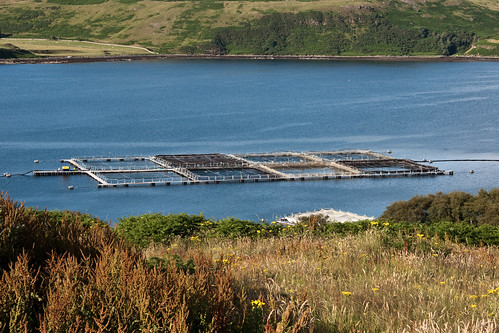
The Common Agricultural Policy (CAP) and the Common Fisheries Policy (CFP) of the European Union need reform, and with the informal meeting of EU ministers responsible for fisheries (see also: Euronews) and the data harvest of CAP subsidies for all member states - except Great Britain - there were two notable events on Monday and Tuesday that made the euroblogosphere talk about CAP and CFP.
Both reforms have already begun with public consultations but their outcomes are uncertain.
The fisheries policy consultations are already finalised, with over 300 reactions from the public and interested stakeholders as well as a statement by the EESC, the European Economic and Social Committee (a consultative body of the EU). In the light of these discussions, the European Movement in the UK also sees an urgent need to reform the fisheries policy and not to let the CFP slip back into the hands of the member states. (Update:) And the Commission seems to agree.
In the same business, but on the fields instead of on the sea, the EU Commission is inviting the public to participate in the CAP reform consultation. This is more necessary than ever seeing that the subsidies spent through the EU's agricultural policy are largely misdirected. Without a reform of the CAP, the whole "Europe 2020" reform will not be possible as Valentin notes, not least because most of the EU's budget is wasted for large-scale agriculture, to the disadvantage of the future of the EU and to the disadvantage of farmers all over the world, instead of investing it in future technologies and the brains of EU citizens.
And so, while the National Farmers' Union has reportedly issued its vision on the future of agriculture in the EU and while Commissioner Ciolos is already participating in different consultation meetings - e.g. in the EESC - it remains absolutely vital that people like the guys from Farmsubsidy.org keep track and follow the subsidy money to give a real basis for the debate - e.g. that the number of "CAP millionaires" continues to rise - both for us bloggers but also for the mainstream media.
Most eyes may be on Greece these days, but we should also keep our ears open and listen to the proposals for the fisheries and agriculture reforms because they will be as important for the future of the Union as the stability of the financial markets.
Picture: © marcs-album / CC BY-NC 2.0
Tuesday, 4 May 2010
Euroblogging journalist Prune Antoine wins two European young journalist awards
Sometimes people who actually deserve it win prizes, and this time it is fellow Euroblogger and Berlin-based French journalist Prune Antoine for her article "Pologne - Quand les parents sont partis" (English translation on page 28 of this booklet).
 I was really amazed when I read in her private blog this morning that she has won two prizes at once for her article, the European Young Journalist Award 2010 for France and also the Louise Weiss Award for European Journalism 2009 (category "Junior").
Here is the reasoning of the jury of the European Young Journalist Award:
She is a true European, combining French culture with the easy-going-ness of Berlin and a deep understanding of "the East", and she is brilliant because she can write incredibly serious articles like the one you read above as well as killingly funny blog posts commenting on life in Berlin, EU politics and discussions in other euroblogs.
I've just spoken with her on the phone to congratulate and she was still surprised and enthusiastic - but if there is anybody who deserved to win the prizes it was Prune! Congratulations!
PS: Prune is a freelance, so if you ever need good reporting (e.g. from Berlin or Central and Eastern Europe), you should really get in contact with her!
 I was really amazed when I read in her private blog this morning that she has won two prizes at once for her article, the European Young Journalist Award 2010 for France and also the Louise Weiss Award for European Journalism 2009 (category "Junior").
Here is the reasoning of the jury of the European Young Journalist Award:
"In France, it is the ”euro orphans” phenomenon, tackled by Prune Antoine, that held the attention of the jury. The article entitled ”Poland: children of no-one” distances itself by the originality of its subject. The migratory wave from Eastern Europe countries and its consequences on family are analysed through an in-depth analysis and a wide range of points of views. In Prune Antoine’s uncluttered style, sociologists, politicians, headteachers, ”orphans” and ”orphans’” parents lead the reader behind the scenes of this massive emigration “resembling an economic miracle”. The journalist’s well-structured argument is a true field investigation that offers a relevant debate with proper context and careful illustration."I had just met Prune - who writes the beautiful Euroblog "L'Europe en Blogs" and was part of my "20 women who run the EU (blogosphere)" - in Berlin in March and we ended up talking about Europe, blogging, journalism and life between the East and the West which we both share.
She is a true European, combining French culture with the easy-going-ness of Berlin and a deep understanding of "the East", and she is brilliant because she can write incredibly serious articles like the one you read above as well as killingly funny blog posts commenting on life in Berlin, EU politics and discussions in other euroblogs.
I've just spoken with her on the phone to congratulate and she was still surprised and enthusiastic - but if there is anybody who deserved to win the prizes it was Prune! Congratulations!
PS: Prune is a freelance, so if you ever need good reporting (e.g. from Berlin or Central and Eastern Europe), you should really get in contact with her!
Sunday, 2 May 2010
Sunday reading: The Week in Bloggingportal

It's worth flying with him!
Picture: © joachim_s_mueller / CC BY-NC-SA 2.0
Monday, 26 April 2010
Visualising EU decision-making: Council Regulation 1224/2009
Blogging about EU affairs has to move forward, and what I have realised is that one path to make it more attractive could be visualisation.
I have tried to start this yesterday in the overly long blog post on the decision-making process on Council Regulation 1224/2009 regarding the supervision of the Common Fisheries Policy of the EU.
If you have made your way until the end of that post you have discovered the following map:
On this map I have geo-located the amendments filed by different member states in the course of the decision-making process together with a link to the fish subsidies each country receives.
But I wasn't satisfied with the length and the visual appearance of the blog post, and so I continued searching for a tool to help me out.
Today I found what I was looking for: Xtimeline, a free tool to create timelines that you can embed in blog posts.
So look how the decision-making process on regulation 1224/2009 looks on a timeline (Remark: Xtimeline.com doesn't seem to be very stable, so if you don't see anything below it is because of their server. Try this link to see the timeline on their webpage.):
You can click on every event where I have linked the relevant document(s) connected to that event. It doesn't tell you the whole story, but it is an easy way to navigate in time and to find certain documents. But you can add a description to each event and thereby give more details to the story you are telling.
The good thing is - and I haven't experimented with this tool so far - that you can upload timelines via RSS feeds or CSV files, which could make it easy to quickly create timelines and to visualise data that wasn't easy to visualise before.
And with this kind of visualisation we could get to a new level of EU story-telling, maybe attracting new attentions to complex processes that were hard to follow in the past.
New blog on the European Court of Human Rights
There is a new euroblog out there: Strasbourg Observers.
It is written by legal academics from the faculty of law in Ghent who want to cover the jurisprudence of the European Court of Human Rights (ECtHR).
The Strasbourg court adjudicates for (almost) all European citizens - not just citizens of EU member states - and will be responsible to watch EU legislation as soon as the EU has joined the European Convention on Human Rights (see my coverage on the EU's ECHR accession process).
Welcome to the Strasbourg Observers!
(via ECHR Blog)
Thursday, 22 April 2010
Cecilia Malmström & transparency in the EU Commission
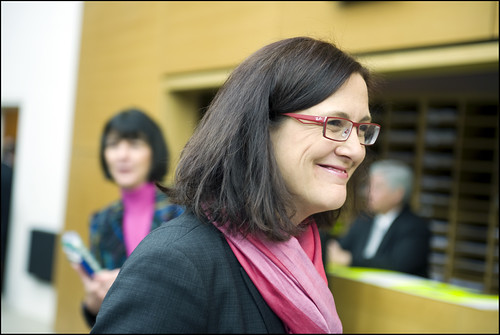
In the comments to the post I asked her:
Will you be able to convince your colleagues in the Commission to do the same?and her Cabinet assistant Love Berggren today gave me the following answer:
Cecilia Malmström’s would certainly welcome if other Commissioner’s were to follow, and hopes to provide a good example by making this register available. But the decision is up to each and every Commissioner.I want to thank her assistant Love for the answer - and I definitely hope that Ms Malmström will serve as an example for her colleagues, indeed!
PS.: This seems to be "Commissioners' Reactions Day", since fellow euroblogger Samuel just received a reaction to one of his blog posts from EU Commissioner for Agriculture Dacian Ciolos.
* You can use the following short link for direct access to all the correspondence of Commissioner Malmström: bit.ly/9H8ib8 - which can be helpful because in default it shows only the last ten letters.
Picture: © european_parliament / CC BY-NC-ND 2.0
Wednesday, 21 April 2010
The debate around the External Action Service (EAS)
In the video below you see MEP Elmar Brok (EPP), European Parliament rapporteur on the EAS, talking about the present problems in the establishement of the EU External Action Service.
More on the debate in Euroblogs: Matizandrea (Italian), L'Europe de la Défense (French) & EU at 50 (English).
PS.: Also take note of the summary of discussions presented by the Council Presidency in March (made public in April).
More on the debate in Euroblogs: Matizandrea (Italian), L'Europe de la Défense (French) & EU at 50 (English).
PS.: Also take note of the summary of discussions presented by the Council Presidency in March (made public in April).
How many MEPs made it to Strasbourg this week?
I'd like to positively mention Jean Quatremer (with whom I've been having a little dispute in the past about value of linking and blogosphere interaction) for his reactiveness.
In a blog post from Monday he informed readers that only some one hundred MEPs had shown up for the opening session of the plenary week of the European Parliament. On Tuesday, I read at @mvandenbroeke from the EP press unit that 408 MEPs had made it to Strasbourg.
I then wrote a little tweet mentioning the discrepancy to which Jean reacted quickly on Twitter explaining that his figure was from the opening of the session, the 408 was only reached at midnight.
Soon afterwards, he also updated his blog post mentioning both figures, (rightfully) adding that this doesn't undermine his argumentation regarding the ridiculousness of having a plenary meeting in Strasbourg under these conditions.
Update: The latest figure is 444 for Tuesday.
Tuesday, 13 April 2010
re:publica 10

As you may have noticed, the conference has kind of started already for me and my fellow Bloggingportal.eu editors with our collective translation experiment last week.
The little experiment was part of the preparations for a workshop eurosocialiste, Jon, Martin and I are organising under the modest title "How to reach one million Europeans" (which is a reference to the European Citizens' Initiative) at the conference on Thursday.
Today, I'll still have to do some organisational stuff in Berlin - my old home - and then tomorrow morning at 10 o'clock the conference will kick off. The organisers say that we will be 2,500 people which sounds pretty big. So hopefully I will find the time to write one or another blog post, sending live impressions from this crowd of "social mediatics".
I also hope to meet some of you who I just know virtually so far or who are interested in the eurosphere - so just comment on this post, send me an email or contact me on Twitter if you'd like to meet, even if it's at the sidelines of the conference in case you're not attending.
PS: You can also talk to me directly when you see me on the conference venue: I am young, male, white, and I use a laptop.
Sunday, 11 April 2010
The Week in Bloggingportal
This week it was my turn to write "The Week in Bloggingportal", the summary of Bloggingportal.eu activities and the euroblog posts we, the portal's editors, have promoted during the week.

Saturday, 10 April 2010
Europe in blogs - Euroblogs (16): Poland
As I have said in my previous post, "All Europeans are Polish citizens today", and Euroblogs from all over the continent are reacting to the Polish tragedy that has happened this morning.*
Danish: Anne Albinus
English: Stephen Spillane (Ireland) Gabriela Ionita (Romania), EU Referendum (UK), A Fistful of Euros, Eurotribune, Jaanika Erne (Estonia), Elina Makri (Greece), Erkan Saka (Turkey), Gideon Rachman, Charlemagne, Dániel Antal (Hungary), Hanna Sankowska (Poland), Alan Fisher (UK), @ribo, Nils W Frenzen (USA), Dave Keating
French: Guillaume Klossa, L'Europe de la Défense (several posts), Olivier Kempf, Prune, Pierre Rousselin, Samuel Faure
German: Günter Vetter, Sascha Götz
Italien: Andrea Matiz
Norwegian: Dag Yngland
Polish: Konrad Niklewicz
Romanian: Corina Cretu, Menaru
Swedish: Carl Bildt, Gunnar Hökmark
* The blog post will be continuously updated during the weekend.
Subscribe to:
Posts (Atom)


