
Diplomatically spoken: I took note of the Eurogroup statement issued Sunday evening.
I don't want to talk about the decision itself, it's big enough for the traditional media to notice, so why spend a blog post on the matter? Just wanted to leave a little comment regarding EU communication:
If I was responsible for the press releases at the Spanish EU Council Presidency, I wouldn't have written "110,000 million" when I could have written "110 billion" and I wouldn't have chosen a photo with smiling faces for a press release announcing an international aid package that should leave anybody involved sweating and crying.*
But luckily, I am neither responsible for the Spanish presidency's communication nor for financial decisions that are beyond human imagination.
* Alan Fisher at "The Europe Blog" has a much more appropriate picture for the news.
Showing posts with label EU Council Presidency. Show all posts
Showing posts with label EU Council Presidency. Show all posts
Monday, 3 May 2010


Monday, 19 April 2010
The tweets of the Swedes (unfinished)
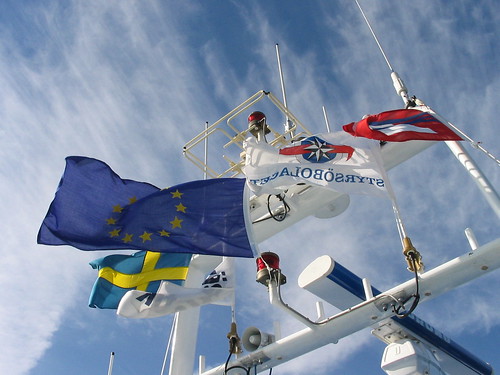
The Swedish EU Council Presidency has given us an incredible insight into their diplomatic work by allowing a number of its diplomats to use Twitter and to tweet from their work during the presidency semester.
Mårten Wierup (@M_Wierup), Deputy Antici at the permanent representation of Sweden to the EU, was one of these people to whom we, the interested public owe a great thank for their work in the name of openness and transparency.
I have chosen some interesting tweets of the almost 400 Mårten has published since May to exemplify what the public could learn (or could have learnt) by following him all this time.
I will quote a tweet and then comment on what this tells me:
May 9: Mårten Wierup "is at a human rights seminar with former czech communist dissidents at the czech foreign ministry, very very interesting"Me: Being at the Czech foreign ministry, the participation at such a seminar is inter alia a) a possibility to see the work of the previous presidency and b) an opportunity to hold preparatory meetings for one's own presidency.
May 12: Mårten Wierup "is happy that most of the date negotiations for the third country meetings during our presidency has started Finally..."Me: The "finally" shows that there has either been a delay or at least that the scheduling presure was becoming quite high 1 1/2 months before the start of the presidency.
May 15: Mårten Wierup "just came from a meeting about boking of rooms and interpretors and other practical and highly important issues for the presidency"Me: A presidency is not just about content and representation, it is a lot about logistics. I remember having had the same kind of meetings before the German EU Council presidency, trying to get to know all the technical details you'd have no time to find out when under stress during the presidency.
May 19: Mårten Wierup "just came back from the Antici meeting which indicated that tomorrows Coreper might be fairly simple"Me: This kind of short remarks on the "mood" of a meeting is probably the most valuable kind of background information you can get through tweets from people directly involved in EU politics, diplomacy, and administration. One might find an agenda of a meeting, but one will never be able to judge on how it went, although this can be absolutely important for the law- and decision-making of EU institutions. Transparency in this regard allows us to judge when and how certain issues were delayed, voted down, or where there have been problems that needed to be solved by one of the famous compromises.
May 22: Mårten Wierup "is once again on the council agendas for the coming 6 months"Me: There is almost no surprise in most EU politics, so knowing when certain things like agendas are fixed can be very helpful to be prepared very early...
May 27: Mårten Wierup "is back in the coreper room again. Soon a discussion on actions to tackle illegal migration in the Mediterranean"Me: Some hints on what is actually discussed in the Council, even when you didn't read the COREPER agenda ahead of the meeting.
June 4: Mårten Wierup "is on a meeting about crisis management during the presidency, very hard to imagine all the things that might occur"Me: I would love to know the content of such kind of meetings. A tweet like this is a good reason to ask for more details.
June 19: Mårten Wierup "is on my way to a pre meeting with the last draft of Council conclusions which came during the night, looks quite good from our horizon"Me: How often did you get this kind of indication on draft Council conclusions ahead of a meeting?
June 22: Mårten Wierup "On a pre meeting for Coreper - our ambassador is actually responsible for as many agenda points as the Czech ambassador"Me: Here you realise that the next presidency actually takes over responsibilities ahead of the formal "change of guards".
June 25: Mårten Wierup "is starting preparatory work for next weeks Coreper and writing back ground notes for our ambassador"Me: This is one of the tweets where one is reminded that diplomats or officials using Twitter actually show us how their work influences the work of those on the higher and highest levels - in this case that speaking points for the ambassadors are coming from Mårten (and others).
June 30: Mårten Wierup "Alright, 5 h to go. I suppose there isn't really that much to do about the things that aren't prepared now"Me: It's just natural and human that people are nervous before a presidency, but it is still nice to see this underlined by such kind of tweets.
July 01: Mårten Wierup "the first Antici meeting went well although I think I was the one who enjoyed the cinamon rolls the most"Me: There it goes, the presidency has started.
Here the draft ends, right before the actual start of the Presidency. It is worth reading back through Mårten Wierup's timeline to see how much insights he gave into the work of the Swedish Presidency - nothing of that could be seen with the Spanish. Will the Belgians be better?
Picture: © anaulin / CC BY-SA 2.0
Tuesday, 9 March 2010
Spanish embassy in Berlin invites bloggers to breakfast
Europaeum has just blogged about it: The Spanish ambassador in Berlin invites bloggers to a breakfast next Tuesday to "inform" about the work of the Spanish EU Council Presidency.
The move that appears to be a move towards transparency looks pretty much like a standard PR event. And a secretive one.
On the website of the Spanish embassy in Berlin there is no hint to this breakfast, not even in the news section. So what they did is sending out an invitation via email to some organisations hoping that this would replace a transparent announcement of the initiative.
And why do they want to "inform" about the work of their Council presidency when they are half-way through their term? Why should I go to a breakfast to be informed now in a closed room when the presidency isn't able to inform about their work publicly before?
I know that the Council is used to work in secret, and that diplomats are used to work in secret. They are used to give one-way information to the public, but only as much information as they think is appropriate:
"You come to us, we don't come to you!"
Since they didn't announce this big time - I didn't see any blog post in the German blogosphere showing awareness of the meeting - they show that they want to control this thing, they don't want to let this go public. What they want is a photo with a number of people who are then said to stand for "the blogosphere" or "the web". Symbolic transparency.
Afterwards they won't care about what bloggers write, because this would involve substantive interaction instead of symbolic interaction - but that is what our governments haven't understood about this web thing so far.
In advance, the "blogger breakfast" sounds like a big PR move, a story-teller on how transparent they are, while they actually don't change their intransparency, they just extend it to a bunch of citizens who then write a blog about a two-hour breakfast paid by taxpayer money.
PS.: Martin from Europaeum will go there to let himself convince from the contrary.
The move that appears to be a move towards transparency looks pretty much like a standard PR event. And a secretive one.
On the website of the Spanish embassy in Berlin there is no hint to this breakfast, not even in the news section. So what they did is sending out an invitation via email to some organisations hoping that this would replace a transparent announcement of the initiative.
And why do they want to "inform" about the work of their Council presidency when they are half-way through their term? Why should I go to a breakfast to be informed now in a closed room when the presidency isn't able to inform about their work publicly before?
I know that the Council is used to work in secret, and that diplomats are used to work in secret. They are used to give one-way information to the public, but only as much information as they think is appropriate:
"You come to us, we don't come to you!"
Since they didn't announce this big time - I didn't see any blog post in the German blogosphere showing awareness of the meeting - they show that they want to control this thing, they don't want to let this go public. What they want is a photo with a number of people who are then said to stand for "the blogosphere" or "the web". Symbolic transparency.
Afterwards they won't care about what bloggers write, because this would involve substantive interaction instead of symbolic interaction - but that is what our governments haven't understood about this web thing so far.
In advance, the "blogger breakfast" sounds like a big PR move, a story-teller on how transparent they are, while they actually don't change their intransparency, they just extend it to a bunch of citizens who then write a blog about a two-hour breakfast paid by taxpayer money.
PS.: Martin from Europaeum will go there to let himself convince from the contrary.
Monday, 1 February 2010
Success in Spanish: Everyone agrees that good things shall be done
I just came across a press release by the Spanish celebrating the success(es) of their first month as the rotating Council presidency."
"The institutions and our partners have given their full and unconditional backing for the fundamental objectives of our Presidency. It's been a good start", the Secretary of State said during a press conference."Okay, so success is when other people agree with you. That's great. But what do they agree on with you?
"Among these objectives, he emphasised economic recovery and the creation of quality employment, the strengthening of Europe's role in the world, further development of citizens' rights - above all in terms of equality between men and women - and security."It must have been really hard to convince the others about these fundamental objectives - because we all know how everyone else is against controversial goals like "economic recovery" or "security"...
Sunday, 31 January 2010
Social media, the EU-USA summit & the question who will be important
By chance I saw that there is a Facebook group supporting that the coming EU-USA Summit will not take place in Madrid but in Brussels.
This seems to be part of the power struggle between the institutions after the ratification of the Lisbon Treaty that foresees the weakening of the rotating Council presidency in favour of the permanent European Council President Herman van Rompuy.
I agree that a summit in Brussels might be more natural, but why having everything in Brussels - our Union is more diverse than the faceless Eurodistrict!
But there is more story to the EU-USA summit:
The main German online news Spiegel Online also reported yesterday that the summit in Madrid is seeing extreme diplomatic battles over who will shake Obama's hand first - Zapatero or van Rompuy - and who will sit next to the US President during the dinner later on.
According to the news, van Rompuy's team offered to Zapatero that he may have the first handshake while the European Council President will sit on the right side of Obama, Barroso will sit on the left and Zapatero will sit opposite to the US-President, a position without camera exposure.
If anyone from the Council or the Council presidency is reading this: I don't care where the summit is, but this kind of diplomatic bullshit that you spend your time (and thus our money) on is ridiculous!
Update: It seems to be confirmed as it has found its way into national media what Blaat has already written in the comments - that Obama apparently won't come to the summit which isn't much of a summit anymore if the president is missing. And there are sources quoted saying that it was exactly this kind of diplomatic comedy about who has the bigger ... that made the American side decide not to come on highest level.
This seems to be part of the power struggle between the institutions after the ratification of the Lisbon Treaty that foresees the weakening of the rotating Council presidency in favour of the permanent European Council President Herman van Rompuy.
I agree that a summit in Brussels might be more natural, but why having everything in Brussels - our Union is more diverse than the faceless Eurodistrict!
But there is more story to the EU-USA summit:
The main German online news Spiegel Online also reported yesterday that the summit in Madrid is seeing extreme diplomatic battles over who will shake Obama's hand first - Zapatero or van Rompuy - and who will sit next to the US President during the dinner later on.
According to the news, van Rompuy's team offered to Zapatero that he may have the first handshake while the European Council President will sit on the right side of Obama, Barroso will sit on the left and Zapatero will sit opposite to the US-President, a position without camera exposure.
If anyone from the Council or the Council presidency is reading this: I don't care where the summit is, but this kind of diplomatic bullshit that you spend your time (and thus our money) on is ridiculous!
Update: It seems to be confirmed as it has found its way into national media what Blaat has already written in the comments - that Obama apparently won't come to the summit which isn't much of a summit anymore if the president is missing. And there are sources quoted saying that it was exactly this kind of diplomatic comedy about who has the bigger ... that made the American side decide not to come on highest level.
Sunday, 3 January 2010
Spanish EU Council website is not secure?! (Updated 6x)
Update (Tuesday, 00:10): According to a statement of the Spanish government, there has been an XSS weakness in the presidency website.
However, this resulted not in a manipulation of the content of the site itself but in a manipulation of what the user was seeing on the screen (as you can see on the screenshots below). These manipulated websites are supposed to be only accessible through the specific URLs they are linked with and are thus no general threat for the users, the officials say in the statement. I hope I have translated this correctly; the original version applies.
There is also a very informative blog post in Spanish explaining the factual and technical background of this story (via a tweet of the Spanish state secretariat for communication), including the shortcomings and misinterpretations in the coverage of this story.
Update (20:10): The Spanish secretary of state for communication has been issuing a message on Twitter saying that the pictures below are photomontages.
However, these are original screenshots from subpages (not the frontpage!) of the presidency website (the links to these subpages are below in the text although they don't reproduce the original shots anymore). Other users on Twitter confirm this here and here.
More important than the Mr. Bean photo that has been taken up by many was the "hi there" window that opened in my browser when opening the second link provided below - this was definitely some kind of code because it triggered a direct browser activity, and I then had to close the little window that you see on the screenshot.
As I have said in my post, I am no technical expert and I cannot say how grave such kind of things are, but they happened in front of my eyes.
Update (11:30): It seems like the problem has been fixed, both the picture of Mr Bean and the "hi there" message have been removed, the links provided below just show ordinary "no results" pages now.
I am no expert in IT security, but it seems like the website of the Spanish EU Council Presidency is not secure, despite the fact that
At the following web discussions - here, here and here - people say that the site can be attacked due to XSS, and they provided two links - here and here - that brought the following two results on the actual web page of the presidency (though on sub-sites, not on the frontpage), apparently externally embedded code showing a picture of Mr Bean and a message saying "hi there" (both screenshots made at 03/01/2010 23:00):


I suppose that this is no minor problem and needs rapid fixing.
PS.: I was made aware of this problem by alvaromillan on Twitter.
Update: I tried to send an email informing about the issue to the contact address of the Telefonica web team - ue2010 [..at..] telefonica.es - as provided on the Contact site of the presidency website, but the email was returned as "Unknown user". Very, very strange...
Update: At around 10 am I have sent an email to the Communication Advisor of the Spanish Representation informing about the issue.
Wednesday, 30 December 2009
How the Spanish EU Council Presidency can be a success
In two days, the Spanish EU Council Presidency will take over from the Swedish Council Presidency, and the Spanish will be the first rotating presidency under the Lisbon Treaty system.
The new institutional setting will need some adaptation, people and institutions will need time to find their roles and their routines, and we shouldn't be too critical if some things don't work out perfectly at the beginning.
But in my point of view, the Spanish presidency can only be a success if they try to stay in the background, if they focus less on policy and put all their forces behind the new leadership trio - van Rompuy, Ashton, and (to some extend) Barroso - in order to make them look good.
If van Rompuy and Ashton are able to stand out positively throughout 2010, the acceptance of the Lisbon Treaty could be significantly raised, which is important both for the core EU institutions as well as for the member states, including future presidencies.
This doesn't mean that the Spanish need to reduce the power or influence of the member states, but just that this coming presidency should refrain from the typical instincts of large member state presidencies - try to heavily influence the EU agenda and to receive international attention. This will be in favour of the Council and the member states, letting them focus on the legislative work while giving van Rompuy and Ashton the freedom to get into their roles, both within the EU and on the international stage.
As a citizen, there is a second direction into which I would like to see the Spanish work: Openness and transparency.
I have major doubts that the Spanish are the right country to foster these two, but if they managed to bring in at least some more transparency and openness, this would be a major success for their presidency.
The Council is the second chamber of the political system of the EU, and most of its structures are law-making or law-interpreting in character. These laws are not made for that EU institutions or member state officials but for us, the citizens. We should thus be able to observe every important decision taken, including a more detailed insight into bargaining dynamics and the voting and drafting behaviour of our own and other EU countries.
Only if the Spanish are able to bring about changes into this direction, their presidency can be a real success.
And so at the end of June 2010 we shall ask: Were the Spanish able to communicate with us, the citizens? Did they manage to make decision-making in the Council more visible, more traceable, more understandable? Did they follow the Swedish in communicating on Twitter and in blogs or did they even find other innovative means get us, the interested public, involved in their work? And: Were they able, through their intelligent work, to support the implementation of the Lisbon Treaty changes?
In the last 1 1/2 years we had the "Ego-Presidency" of the French, the "Chaos-Presidency" of the Czechs, the "Efficency-Presidency" of the Swedes - what kind of over-simplifying label will we use for the Spanish after the coming semester?
The new institutional setting will need some adaptation, people and institutions will need time to find their roles and their routines, and we shouldn't be too critical if some things don't work out perfectly at the beginning.
But in my point of view, the Spanish presidency can only be a success if they try to stay in the background, if they focus less on policy and put all their forces behind the new leadership trio - van Rompuy, Ashton, and (to some extend) Barroso - in order to make them look good.
If van Rompuy and Ashton are able to stand out positively throughout 2010, the acceptance of the Lisbon Treaty could be significantly raised, which is important both for the core EU institutions as well as for the member states, including future presidencies.
This doesn't mean that the Spanish need to reduce the power or influence of the member states, but just that this coming presidency should refrain from the typical instincts of large member state presidencies - try to heavily influence the EU agenda and to receive international attention. This will be in favour of the Council and the member states, letting them focus on the legislative work while giving van Rompuy and Ashton the freedom to get into their roles, both within the EU and on the international stage.
As a citizen, there is a second direction into which I would like to see the Spanish work: Openness and transparency.
I have major doubts that the Spanish are the right country to foster these two, but if they managed to bring in at least some more transparency and openness, this would be a major success for their presidency.
The Council is the second chamber of the political system of the EU, and most of its structures are law-making or law-interpreting in character. These laws are not made for that EU institutions or member state officials but for us, the citizens. We should thus be able to observe every important decision taken, including a more detailed insight into bargaining dynamics and the voting and drafting behaviour of our own and other EU countries.
Only if the Spanish are able to bring about changes into this direction, their presidency can be a real success.
And so at the end of June 2010 we shall ask: Were the Spanish able to communicate with us, the citizens? Did they manage to make decision-making in the Council more visible, more traceable, more understandable? Did they follow the Swedish in communicating on Twitter and in blogs or did they even find other innovative means get us, the interested public, involved in their work? And: Were they able, through their intelligent work, to support the implementation of the Lisbon Treaty changes?
In the last 1 1/2 years we had the "Ego-Presidency" of the French, the "Chaos-Presidency" of the Czechs, the "Efficency-Presidency" of the Swedes - what kind of over-simplifying label will we use for the Spanish after the coming semester?
Saturday, 12 December 2009
EU & Latin America: The cautious approach by the EU Foreign Affairs Council
Now that we are approaching the Spanish Council Presidency, the first rotating EU Council presidency that will not lead the European Council, one of the main foreign policy issues for Spain - Latin America - is gaining importance on the agenda, yet without gaining importance.
Grahnlaw has already written some words on the coming Council presidency in November. And last week, the Spanish have presented their priorities, quite vague priorities as Eva notes, but it seems clear for analysts like Carlos Bohigas that the relations to Latin America will be one special colour of the next presidency's work.
However, if you read through the Council conclusions on EU - Latin America relations agreed upon this week at the Foreign Affairs Council (based on a Commission communication from October plus Annex), you will find a very hesitant and cautious approach by the foreign ministers that will not give much room for the Spanish in the first semester of 2010.
There are some details about possible fields of action in these conclusions, but the document is best summarised by its last paragraph:
And the foreign ministers consigned the European Council to decide on any further initiative - which is not much knowing that Latin America is not mentioned with a word in the European Council conclusions from yesterday's summit, the last one this year.
So anyone expecting the Spanish to be able to put Latin America higher on the agenda than this status quo consensus of EU member states as of today might be disappointed at the end of next June, especially since Spain will not be chairing the European Council (van Rompuy) or the Foreign Affairs Council (Ashton) to push the issue as much as previous presidencies were able to do with their own topics.
Grahnlaw has already written some words on the coming Council presidency in November. And last week, the Spanish have presented their priorities, quite vague priorities as Eva notes, but it seems clear for analysts like Carlos Bohigas that the relations to Latin America will be one special colour of the next presidency's work.
However, if you read through the Council conclusions on EU - Latin America relations agreed upon this week at the Foreign Affairs Council (based on a Commission communication from October plus Annex), you will find a very hesitant and cautious approach by the foreign ministers that will not give much room for the Spanish in the first semester of 2010.
There are some details about possible fields of action in these conclusions, but the document is best summarised by its last paragraph:
"The Council considers that the Madrid Summit [with the Latin American countries in May] should focus on reaffirming the common priorities, and concentrate on delivering concrete and tangible strategies and actions [...]. In this context the Council recognises the value of launching new initiatives at the Summit."In other words: We don't want anything new, let's try to work on agreed matters that haven't been functional until now.
And the foreign ministers consigned the European Council to decide on any further initiative - which is not much knowing that Latin America is not mentioned with a word in the European Council conclusions from yesterday's summit, the last one this year.
So anyone expecting the Spanish to be able to put Latin America higher on the agenda than this status quo consensus of EU member states as of today might be disappointed at the end of next June, especially since Spain will not be chairing the European Council (van Rompuy) or the Foreign Affairs Council (Ashton) to push the issue as much as previous presidencies were able to do with their own topics.
Thursday, 26 November 2009
Limiting Ashton's power: The role of the rotating Council Presidency in foreign policy
With the nomination of van Rompuy and Ashton for the two major top posts, it looked pretty clear that the coordination of the EU's foreign policy will now be handed over to these two persons and their administrations.
Yet, as I have explained earlier, the rotating Council Presidency will not disappear but will chair all Council configurations except for the Foreign Affairs Council that will be chaired by Ashton.
However, I just discovered a freshly published Council document regulating the role of the rotating Council Presidency in the preparatory work of the Foreign Affairs Council. This document is definitely limiting the powers of Ashton and is restricting her freedom to work freely with her own diplomatic service:
And even where Ashton can chose the chairpersons of the working groups, she is limited by the member states (own highlights):
I might be mistaken, but this looks like bringing further disorder into the European institutions that are already very hard to understand and control.
Supplement: Eurogeek has correctly pointed to the fact that this is not new but has already been discussed for some time, as shows this "L'Europe de la Défense" article from 31 October 2009.
Yet, as I have explained earlier, the rotating Council Presidency will not disappear but will chair all Council configurations except for the Foreign Affairs Council that will be chaired by Ashton.
However, I just discovered a freshly published Council document regulating the role of the rotating Council Presidency in the preparatory work of the Foreign Affairs Council. This document is definitely limiting the powers of Ashton and is restricting her freedom to work freely with her own diplomatic service:
The chairmanship of the preparatory bodies of the Foreign Affairs Council referred to in categories 1 to 4 in the table below shall be organised as follows:This means that although Ashton is going to chair every Foreign Affairs Council, the prepared documents coming into these meetings from the Working Parties won't have always been co-ordinated by the External Action Service but also by the rotating Council presidency.
1) Category 1 (preparatory bodies in the area of trade and development)
The preparatory bodies shall be chaired by the six-monthly Presidency.
2) Category 2 (geographic preparatory bodies)
The preparatory bodies shall be chaired by a representative of the High Representative.
3) Category 3 (horizontal preparatory bodies, mainly CFSP)
The preparatory bodies shall be chaired by a representative of the High Representative, except the following preparatory bodies, which shall be chaired by the six-monthly
Presidency:
- Working Party of Foreign Relations Counsellors (RELEX);
- Working Party on Terrorism (International Aspects) (COTER);
- Working Party on the application of specific measures to combat terrorism (COCOP);
- Working Party on Consular Affairs (COCON);
- Working Party on Public International Law (COJUR); and
- Working Party on the Law of the Sea (COMAR).
4) Category 4 (ESDP related preparatory bodies)
The ESDP related preparatory bodies shall be chaired by a representative of the High Representative.
And even where Ashton can chose the chairpersons of the working groups, she is limited by the member states (own highlights):
Where ... a preparatory body (PSC and relevant working parties) shall be chaired by a representative of the High Representative, the responsibility for appointing the chair shall belong to the High Representative. These appointments shall be made on the basis of competence, while ensuring adequate geographical balance and transparency. The High Representative shall ensure that the person he or she intends to appoint as chairperson will enjoy the confidence of Member States.Looking at this document one can see that the coherence in the European Union's foreign policy is unlikely to emerge, with the member states fighting to keep control over certain key areas, limiting the power(s) of the Foreign Minister.
I might be mistaken, but this looks like bringing further disorder into the European institutions that are already very hard to understand and control.
Supplement: Eurogeek has correctly pointed to the fact that this is not new but has already been discussed for some time, as shows this "L'Europe de la Défense" article from 31 October 2009.
Sunday, 4 October 2009
The Lisbon Treaty and the rotating Council Presidency
Because I have heard the contrary several times now: No, the rotating Council Presidency will not disappear with the Lisbon Treaty!
Although there will be a permanent President of the European Council under the Lisbon Treaty, and although the new "Foreign Minister" (called differently in the Treaty but will have this function) will chair the EU Council on Foreign Affairs, article 16, paragraph 9 (TEU) clearly states that the EU Council (the Council of Ministers) will still be chaired by the rotating presidency:
Although there will be a permanent President of the European Council under the Lisbon Treaty, and although the new "Foreign Minister" (called differently in the Treaty but will have this function) will chair the EU Council on Foreign Affairs, article 16, paragraph 9 (TEU) clearly states that the EU Council (the Council of Ministers) will still be chaired by the rotating presidency:
The Presidency of Council configurations, other than that of Foreign Affairs, shall be held by Member State representatives in the Council on the basis of equal rotation, in accordance with the conditions established in accordance with Article 236 of the Treaty on the Functioning of the European Union.And Article 236 of the Treaty on the Functioning of the European Union says only:
The European Council shall adopt by a qualified majority:So under the Lisbon Treaty we will still have a rotating presidency chairing most of the Council compositions, and the European Council President will not replace this.
(a) a decision establishing the list of Council configurations, other than those of the General Affairs Council and of the Foreign Affairs Council, in accordance with Article 16(6) of the Treaty on European Union;
(b) a decision on the Presidency of Council configurations, other than that of Foreign Affairs, in accordance with Article 16(9) of the Treaty on European Union.
Monday, 6 July 2009
The Swedish EU-Council presidency (2): Am I dreaming?
Not one week in office, and this Swedish EU-Council presidency manages to impress me more than the previous presidency did in six month.
Or have you ever seen a video interview with the presidency's ambassador after a COREPER-meeting...?
I think I am dreaming - and I will have to dig for negative news around the Swedish presidency in order not to make this blog become a pro-institutional PR instrument.
But Sweden, please, continue in this transparency direction - and make sure that everyone after you will keep this alive!
(via Anda on Twitter)
Or have you ever seen a video interview with the presidency's ambassador after a COREPER-meeting...?
I think I am dreaming - and I will have to dig for negative news around the Swedish presidency in order not to make this blog become a pro-institutional PR instrument.
But Sweden, please, continue in this transparency direction - and make sure that everyone after you will keep this alive!
(via Anda on Twitter)
Wednesday, 1 July 2009
The Swedish EU-Council presidency (1): It's a little like with Obama
Today, the Swedish take over the EU-Council presidency and you can feel relief all over the place.
After the presumptuous French presidency under Sarkozy and the [insert friendly but critical adjective that I don't find] Czech presidency, the Swedish taking over the lead among the EU member state is a bit like the change to Obama:
As a realist, I know that the change they can bring in practice is limited. But knowing that the spirit behind their actions is different to the previous presidencies, I have the hope that they will make a positive difference.
Carl Bildt, the Swedish foreign minister confirmed in his blog that he will continue blogging during the presidency because he thinks this is part of the transparency promise on which they run. I love to follow Mårten Wierup on Twitter because he gives insights into the diplomatic work at the Council in Brussels.
Can you imagine any other EU country's officials doing this?
I am also the glad that it will be the Swedish who will be responsible of the Council when it comes to the Copenhagen climate conference at the end of this year.
These were the three issues that marked the hopes connected to Obama:
There is neither fear that they will dominate the Union for their own interests nor that they are not prepared enough to lead the bloc of the 27. They are the perfect broker, and I hope that they will manage to realise some things that will make them remembered in this way.
Whether the hopes will come true has to be seen at the end of the chapter - but at least the book starts extremely promising!
After the presumptuous French presidency under Sarkozy and the [insert friendly but critical adjective that I don't find] Czech presidency, the Swedish taking over the lead among the EU member state is a bit like the change to Obama:
As a realist, I know that the change they can bring in practice is limited. But knowing that the spirit behind their actions is different to the previous presidencies, I have the hope that they will make a positive difference.
Carl Bildt, the Swedish foreign minister confirmed in his blog that he will continue blogging during the presidency because he thinks this is part of the transparency promise on which they run. I love to follow Mårten Wierup on Twitter because he gives insights into the diplomatic work at the Council in Brussels.
Can you imagine any other EU country's officials doing this?
I am also the glad that it will be the Swedish who will be responsible of the Council when it comes to the Copenhagen climate conference at the end of this year.
These were the three issues that marked the hopes connected to Obama:
- A new spirit compared to the previous presidency,
- a call for more transparency, and
- a clear stand on climate change.
There is neither fear that they will dominate the Union for their own interests nor that they are not prepared enough to lead the bloc of the 27. They are the perfect broker, and I hope that they will manage to realise some things that will make them remembered in this way.
Whether the hopes will come true has to be seen at the end of the chapter - but at least the book starts extremely promising!
Tuesday, 30 June 2009
The Czech EU-Council Presidency (16): The eurotechnocrat's summary
"Personally, it felt like 6 month lost, when we would have need[ed] a strong leadership in time of an major economic crisis and an important election. Really hope the Swedish do a better job."Source: The Eurotechnocrat
Friday, 19 June 2009
European Council on 18 & 19 June 2009: Presidency Conclusions
The June 2009 European Council has ended, and the Presidency Conclusions have been published.
The only positive word I can highlight:
Taking a look at the rest of the conclusions, it is remarkable that among the quite intensive coverage of the financial crisis and possible measures to counter its effects, the financial situation in Latvia has been particularly highlighted (para. 13) - that is not a good sign.
Interesting is also the following sentence:
And regarding the special declaration made for Ireland in the Annexes to the Conclusions one can only say that this is nothing but a clarification of the present Lisbon Treaty, that, no matter whether it has legal effects or not, will not change anything.
However, this Declaration is a confession of 27 heads of state and governments that the Lisbon Treaty is so unclear that it needs a special explanation so that the Treaty text can be put forward for a second vote in Ireland.
It is also an expression of the failure of the Irish government to explain the Treaty to its citizens and a sign of weekness of this government if it needs the backing for 26 member states to give these almost self-evident explanations enough political weight.
For the rest, the conclusions are not very interesting, and again written in a catastrophic bureaucratic way. I hope the Swedish Council presidency will have people that are able to formulate such texts more citizen-friendly!
The only positive word I can highlight:
"The Heads of State or Government agreed unanimously on the name of Mr. José Manuel DURÃO BARROSO as the person they intend to nominate as President of the European Commission for the period 2009-2014."Apart from this little word "intend", this decision is a catastrophe for the European Union, as mentioned so many times before.
Taking a look at the rest of the conclusions, it is remarkable that among the quite intensive coverage of the financial crisis and possible measures to counter its effects, the financial situation in Latvia has been particularly highlighted (para. 13) - that is not a good sign.
Interesting is also the following sentence:
"32. The European Council welcomes the intention of the incoming Presidency to develop, in close cooperation with the Commission, a work programme to ensure that there is sufficient time for internal EU coordination and decision-making prior to important international meetings which will prepare the December Copenhagen Conference."Does that mean that usually the presidency does not provide work plans that allow "sufficient time" for internal co-ordination?
And regarding the special declaration made for Ireland in the Annexes to the Conclusions one can only say that this is nothing but a clarification of the present Lisbon Treaty, that, no matter whether it has legal effects or not, will not change anything.
However, this Declaration is a confession of 27 heads of state and governments that the Lisbon Treaty is so unclear that it needs a special explanation so that the Treaty text can be put forward for a second vote in Ireland.
It is also an expression of the failure of the Irish government to explain the Treaty to its citizens and a sign of weekness of this government if it needs the backing for 26 member states to give these almost self-evident explanations enough political weight.
For the rest, the conclusions are not very interesting, and again written in a catastrophic bureaucratic way. I hope the Swedish Council presidency will have people that are able to formulate such texts more citizen-friendly!
Thursday, 23 April 2009
The Czech EU-Council Presidency (15): Czechs refuse to fulfil their role during Durban II conference
I haven't heard this until I read it on the Coulisses de Bruxelles blog:
The Czech Republic has rejected to fulfil the function of the Presidency during the United Nation's Durban II conference on racism. That is another shortcoming in a Council Presidency that has been marked by problems from its very first days.
Allow me just to quote Jean Quatremer (own translation):
Therefore, let me just say:
Dear Czech government, you are free to handle your internal affairs however you want, but while running the EU-Council Presidency, there is just one goal that should lead your actions on the international level: That our Union of 27 states is represented in the most credible, professional, and reliable way, and not like a Union of amateurism and national egos.
What has happened in Geneva is absolutely disgraceful!
On the topic: The Falling European Leadership by The European Citizen
The Czech Republic has rejected to fulfil the function of the Presidency during the United Nation's Durban II conference on racism. That is another shortcoming in a Council Presidency that has been marked by problems from its very first days.
Allow me just to quote Jean Quatremer (own translation):
"This story is incredible and without precedent: Monday evening, in Geneva, on the first day of the UN conference against racism, better known under its name Durban II, the Czech ambassador announces to his consternated European partners that he has received the instruction from Prague to withdraw from the conference after the anti-Semitic proposals of the Iranian President Mahmoud Ahmadinejad (during his speech, the Europeans have left the room like one single person, while Turkey, a candidate country, remained on his seat).This is a shocking story, and having seen EU co-ordination meetings on an international level from both sides, that of an upcoming and of an acting EU-Council Presidency, I can quite well imagine how this unfriendly act by the Czech representative (i.e. his government) might have been felt by his colleagues.
The 23 EU member states present are perplex: «you cannot do this unilaterally, you are exercising the Presidency of the Union» they are claiming towards him. «Let's discuss it first, it's not on Iran to chase us away». Without result. The Czech ambassador leaves the room. Everybody turns around to his Swedish colleague whose country will run the EU Council Presidency from the 1st of July. Right away, he accepts to take the lead from the Czech. «He has co-ordinated the European position and we have then been able to make a declaration in the name of the EU», tells a diplomate. [...]"
Therefore, let me just say:
Dear Czech government, you are free to handle your internal affairs however you want, but while running the EU-Council Presidency, there is just one goal that should lead your actions on the international level: That our Union of 27 states is represented in the most credible, professional, and reliable way, and not like a Union of amateurism and national egos.
What has happened in Geneva is absolutely disgraceful!
On the topic: The Falling European Leadership by The European Citizen
Sunday, 12 April 2009
Examples of law-making in the Council: Measures for the recovery of the stock of European eel
Law-making is very intransparent in the Council of the European Union; getting the preferences of the different actors in the process is very hard and extremely time-consuming.
One problem is that positions put forward by member states are not made public in time, and that the presentation of these documents is not at all citizen-friendly.
Take for example the Council Regulation establishing measures for the recovery of the stock of European eel which has been published in the Official Journal of the European Union on 18 September 2007.
If you wanted to see the opinions of your country on the proposal by the Commission from 6 October 2005, you had to wait until this weekend to find the respective documents published.
I have tried to assemble all those more than 70 documents made public now, so that you do not need to search on your own, just to show what you have "missed" so far.
Member states' comments in November 2005:
Working Party on Internal Fisheries Policies (January/February 2006)
COREPER meeting on 15 November 2006:
Compromise proposal 06 February 2007:
Positions in January & February 2007:
All these documents have been published only now. I am sure that these are not all documents, and that with a little research I would find a bunch more. And we are just talking about a minor issue - eel - and the situation is much worse for other policy areas and more sensitive topics.
The time it took to put together this blog post is already way to much.
How can you expect any citizens to do this, look for hours for two or three documents that concern the position of its country during a European law-making process, or even to put together the full set of positions of all member states?!
And so far, I haven't analysed a single document. I have just put them together. The next step would be to analyse the individual positions and to see how these figure in the different intermediary documents and in the final regulation. But this would implicate much more research, going well beyond these Council documents.
What I want to say is that we get relevant documents late, we get them in a bad presentation, and we need to enter into an almost scientific research process to understand who got what, which position came through, what was ignored, etc.
And since the regulation is already 1 1/2 years old: Who will involve in such an effort? - No journalist will take the time to do so, and my resources as an individual blogger are way to limited to do this on a regular basis.
In the end, most decision-making within the Council, even if well-documented and finally publicised, will never become truly public and transparent - just because this transparency demands retrospective efforts that the institutional side doesn't want to bear and that the democratic society cannot take on its shoulders alone.
One problem is that positions put forward by member states are not made public in time, and that the presentation of these documents is not at all citizen-friendly.
Take for example the Council Regulation establishing measures for the recovery of the stock of European eel which has been published in the Official Journal of the European Union on 18 September 2007.
If you wanted to see the opinions of your country on the proposal by the Commission from 6 October 2005, you had to wait until this weekend to find the respective documents published.
I have tried to assemble all those more than 70 documents made public now, so that you do not need to search on your own, just to show what you have "missed" so far.
Member states' comments in November 2005:
Working Party on Internal Fisheries Policies (January/February 2006)
- Commented draft regulation with positions of member states
- Austria
- Belgium
- Denmark
- Estonia
- Finland
- Germany 1, Germany 2
- Greece
- Latvia
- Lithuania
- The Netherlands
- Poland
- Portugal
- Slovenia
- Sweden
- United Kingdom
COREPER meeting on 15 November 2006:
Compromise proposal 06 February 2007:
Positions in January & February 2007:
- Finland
- France
- Latvia
- Poland I; Poland II
- Slovakia
- Sweden
- United Kingdom
- Summary of Working Party discussions
- Revised Presidency working document
- Denmark
- Lithuania
- The Netherlands
- Poland I, Poland II
- Sweden I, Sweden II
- United Kingdom
- Summary of negotiations
- Draft Proposal with comments from Working Party meeting
- Estonia
- Finland
- France
- Lithuania
- The Netherlands
- State of the play (Presidency)
- Presidency Working document
- Denmark
- Summary of COREPER discussions
- France
- Hungary
- The Netherlands
- Poland
- Portugal
- Lithuania
- Presidency compromise proposal
- Consolidated compromise proposal by the Presidency
- Latvia
- Poland
All these documents have been published only now. I am sure that these are not all documents, and that with a little research I would find a bunch more. And we are just talking about a minor issue - eel - and the situation is much worse for other policy areas and more sensitive topics.
The time it took to put together this blog post is already way to much.
How can you expect any citizens to do this, look for hours for two or three documents that concern the position of its country during a European law-making process, or even to put together the full set of positions of all member states?!
And so far, I haven't analysed a single document. I have just put them together. The next step would be to analyse the individual positions and to see how these figure in the different intermediary documents and in the final regulation. But this would implicate much more research, going well beyond these Council documents.
What I want to say is that we get relevant documents late, we get them in a bad presentation, and we need to enter into an almost scientific research process to understand who got what, which position came through, what was ignored, etc.
And since the regulation is already 1 1/2 years old: Who will involve in such an effort? - No journalist will take the time to do so, and my resources as an individual blogger are way to limited to do this on a regular basis.
In the end, most decision-making within the Council, even if well-documented and finally publicised, will never become truly public and transparent - just because this transparency demands retrospective efforts that the institutional side doesn't want to bear and that the democratic society cannot take on its shoulders alone.
Monday, 6 April 2009
Anyone but Blair: Stop Blair!
For those of you who have been celebrating the success of Anyone but Barroso! and for those of you still looking for a cause, you can now join a new anti-action:
The main and strong arguments of the petition are Blair's support of the Iraq war and his fight against the inclusion of the European Charter of Fundamental Rights and Freedoms into the Lisbon Treaty.
For more, read the petition of the initiative.
(via Kosmopolit on Twitter)
STOP BLAIR!This goes against proposals and rumours which see Tony Blair as first EU Council President who would take office for 2 1/2 years after the ratification of the Lisbon Treaty.
The main and strong arguments of the petition are Blair's support of the Iraq war and his fight against the inclusion of the European Charter of Fundamental Rights and Freedoms into the Lisbon Treaty.
For more, read the petition of the initiative.
(via Kosmopolit on Twitter)
Thursday, 26 March 2009
The role of ICT - or how to produce an irrelevant paper for the EU Council
In the most irrelevant "discussion paper" on ICT ever, the Czech EU Council Presidency - or whatever is left from it - is asking member states for the next Council meeting on 31 March 2009:
If this is what our ministers have to care about during a Council meeting, then maybe they should just join the desk officer on a coffee!
- In what ways do you see ICT and broadband promoting growth and competitiveness, especially in order to emerge from the economic crisis?
- What steps are you taking to encourage the take-up of broadband in your country?
- What are the aims of national strategies for broadband that you have launched or that are in preparation?
- In what form should the European policy for information society and the media (post-i2010) incorporate the fight against the crisis and the potential of the ICT?
If this is what our ministers have to care about during a Council meeting, then maybe they should just join the desk officer on a coffee!
Wednesday, 25 March 2009
The Czech EU-Council Presidency (14): Collapse!!!!
The Czech government yesterday lost a vote of no confidence by 101 of 200 votes. This means, more or less, that the EU presidency collapses.
What a mess: In times of crisis, a new EU member state loses its government and the EU its de lege leadership, although de facto I didn't see much in the last months.
EUobserver tells that this is not the first time an EU Council Presidency government falls during its term:
I don't have doubt in the capacities of the Czech diplomats and administrators on all levels, they will be able to keep up the working rhythm which dominates most activities during a presidency, but if they lack clear guidance and leadership, then important decisions might be delayed, cancelled or at least weakened.
In addition, this will give more power to the already too powerful EU Council secretariat, which will use the opportunity of a weak presidency to push through its own agenda.
All in all, an extremely bad day for the European Union!
Read also on this topic: Jon Worth, Coulisses de Bruxelles, EurActiv, Dr. Sean, European Union Law, Toni Straka.
What a mess: In times of crisis, a new EU member state loses its government and the EU its de lege leadership, although de facto I didn't see much in the last months.
EUobserver tells that this is not the first time an EU Council Presidency government falls during its term:
"This is not the first time that a country in charge of the rotating EU presidency has a change of government during its mandate. In 1996, Italy faced a similar situation when a centre-left coalition headed by Romano Prodi won parliamentary elections, ousting the centre-right government led by Lamerto Dini.But I this is maybe the worst timing one could imagine, in a time when efficient leadership is needed, and the European Parliament elections are coming closer every day.
In 1993, Denmark also faced a change of government while it was chairing the EU, with the government led by Poul Schluter falling and Social Democrat Poul Nyrup Rasmussen coming to power."
I don't have doubt in the capacities of the Czech diplomats and administrators on all levels, they will be able to keep up the working rhythm which dominates most activities during a presidency, but if they lack clear guidance and leadership, then important decisions might be delayed, cancelled or at least weakened.
In addition, this will give more power to the already too powerful EU Council secretariat, which will use the opportunity of a weak presidency to push through its own agenda.
All in all, an extremely bad day for the European Union!
Read also on this topic: Jon Worth, Coulisses de Bruxelles, EurActiv, Dr. Sean, European Union Law, Toni Straka.
Saturday, 21 March 2009
The Czech EU-Council Presidency (13): Absence in times of the crisis
From eurotopics:
And so it seems like the Czechs will not be remembered as the most active and relevant EU Council presidency...
"Martin Schulz, chairman of the Socialist group in the European Parliament, has called the Czech EU Council presidency a "total washout". The Prague business paper Hospodářské noviny can only agree: "It seems it's too much to ask of the Czech presidency that it participate in discussion on the crisis. [...]"Proof of its unimportance: In the International Harald Tribune report on the outcomes of the EU summit, there is just a short line mentioning the Czech presidency while focussing on Barroso and given similar space to Germany and Poland. Doesn't sound as if there has been much leadership from the Presidency.
And so it seems like the Czechs will not be remembered as the most active and relevant EU Council presidency...
Subscribe to:
Posts (Atom)


