Showing posts with label Brussels. Show all posts

Monday, 17 May 2010

Communication & the International Day Against Homophobia - updated

Every day is a day for or against something, and today is the International Day Against Homophobia.

There is no doubt that there is still a lot to do when it comes to fair and equal rights for people with a different sexual orientation all across Europe; the recent problems with the gay pride parade in Vilnius/Lithuania are just one example among many.

So today is the day when everybody is supposed to talk about the topic, including European Parliament President Jerzy Buzek.

A press release on the EP president's website says that there is a video of him addressing the public, but it is not there (there is just an ftp-link for broadcasters). So Buzek releases a video but it is not there when it should be, neither on his website nor on the website of the European Parliament. Great communication work, Mr. President!

Speaking of "great" communication work:

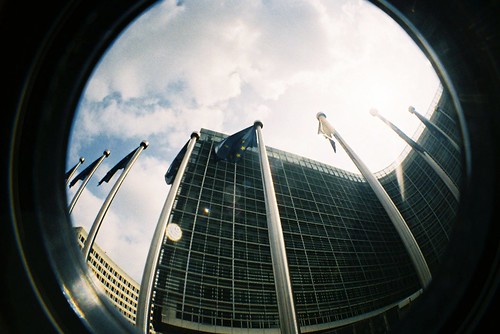
Passing by the main Commission building ('Berlaymont') here in Brussels I also came across the people from ILGA Europe who were campaigning for equal rights in front of a little tent with rather loud techno music between the Council and the Commission [will add a photo later on].

Why should I stop there and talk to anybody when there is music like at a garden party?

They handed me two leaflets - a map of the legal situation of gays, lesbians and bisexual people in Europe (rather well-done) and a flyer titled "BE BOTHERED" that is designed in so ugly colours that I didn't even bother to read it (it hurts the eyes!!). But apart from that they didn't try to catch my attention. I got a friendly "Bonjour" and that's it.

Later on they plan to let balloons fly in the air, but that's just buzz for the press - woooooo, balloons! They should rather stand on the central market of Brussels and convince the tourists from all over the world of equal rights and not waste time standing between big institution buildings.

This is another stone in the wall of my conviction that international/European Days and Years of/against Something are bureaucratic communication monsters regarding important topics but without any interest for the public.

Update: Via @soerenlandmann I just saw that the LGBT intergroup of the EP has uploaded the video with Buzek's speech to Vimeo (but there is still no link on the EP or the President's website):

President of the European Parliament on the International Day Against Homophobia from LGBT Intergroup on Vimeo.


Picture: © danielgreene/ / CC BY-NC-ND 2.0

Sunday, 16 May 2010

The travel

What a perfect European day was yesterday!

Getting up way too early in my home village, the day began cold and rainy. Not the perfect start, but who cares?! Since non of my family members was at home, one of the neighbours was so kind to get up early, too, and to bring me and my luggage to the train station in the neighbouring city (the bus goes there just once a day!). Big thanks again!

The only person that I came across in the regional train at that time was a man searching for empty bottles in the litter boxes. He turned to me asking very carefully whether I had a Euro for him. Which I had.

Later on, in the next train, a young mother and her young child were walking through the wagon in what was apparently a train discovery tour of the little child. Since the mother talked Russian to the infant, I said "privyet" (one of the few Russian words I know) to the girl when it discovered that it could fold down the seat next to me and climb on it.

This one Russian word made that the mother began speaking in Russian to me, so I had to interrupt her with two more words I know in Russian: "Nye panymayou..." ("I don't understand.") She then told me in German that they were on their way to grandma and grandpa, which reminded the child that there was still a lot to discover before the train arrived. And so it left, taking the mother with her.

In the next city where I had to change trains I used the time to drink a coffee and to read the regional newspaper. Interestingly, the first page of the cultural part of the newspaper was a full page about John Malkovich playing a serial killer on scene in Brussels. They seemed to know where I was heading...

Arriving in Cologne, I had to rush to get my connection train to Brussels.

A lady in front of me was also rushing, which her scarf didn't appreciate and so he decided to leave her in favour of the platform floor. I picked him up and had to rush even quicker behind the woman to catch her, which I only managed two wagons later when she was already entering the train. Handing the scarf over to her saying in German that I supposed that it belonged to her, she turned around, smiled, and thanked with a loud and cordial "Bedankt!" (which is Dutch). I think she and her pink scarf will be able to continue living a fulfilled life together!

The high speed train from Cologne to Brussels was packed, but I had reserved a seat and so I could relax after the rush and sit down at the table with three (still unknown) passengers after helping another lady with her luggage (I wouldn't mention that also if it wasn't part of the story, as you will see).

I was kind of tired but still tried to read the Spanish novel that I had taken with me to practice my Spanish (since I was moving in with a Spanish). But I realised that it's kind of hard to read a foreign language that you haven't used for a while, especially when you are tired and people around you chat in 4-5 different languages including Finnish (the woman on the other side of the corridor was reading a Finnish newspaper). So I plugged in my earphones and listened to spheric techno music provided by one of the train's radio channels.

At some point, the woman next to me and the man on the other side of the table started chatting, apparently in Spanish and soon later I became part of the conversation because my neighbour had concluded, seeing my novel, that I must also speak Spanish (she wasn't aware that I had just failed to concentrate on the book).

So the conversation continued for a moment in Spanish until we realised that he was actually an American who had just moved to Germany and she and me were Germans, so we changed to English which allowed the fourth passenger on the table, an Austrian living in Brussels, to also join the conversation.

Two main topics evolved for the rest of the trip: German culture and dialects (because the American wanted to visit Germany in the weeks to come and asked for advice) and Brussels sightseeing tips (because he wanted to visit Brussels but only had the rest of Saturday and Sunday).

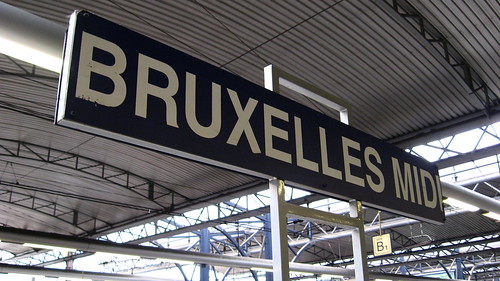
Arriving at Bruxelles-Midi the conversation ended and we wished us goodbye.

But the woman whom I had helped with her luggage when entering the train had heard that I was moving to Brussels and thus she asked where I would start working (probably assuming that I'd be heading into one of the EU institutions). I told her why I was coming.

She then grabbed into her pocket and handed me her business card - she is, as I learned, the assistant of a German MEP - and told me: "Here you see the first Brussels habit: Everybody will give you their business card. Contact me - we have all started small here in Brussels!"

I realised that I don't have business cards yet. I probably need some not to be regarded as an outcast here in Brussels.

The American and I left the train together and I walked through the train station with him. Since I still had time until I could move into my apartment in the evening and since the sun was shining I decided to join him for his sightseeing tour.

We left the metro at the stock exchange and were received by the loud techno music of the last wagon of the Brussels gay pride parade. We had a drink on the central place (yeah, like real tourists!), talked about Europe (he has been around for a while already) and then left towards the European Parliament where I gave a rapid tour in EU politics. Hardest question: Who is the most important person in the EU?

In front of the Spaak building of the European Parliament we met three Algerians, one from Belgium, one from France, and a senator from Algeria, who were also on a visiting tour, and entered into a friendly discussion (in French) about European history and intercultural relations with them, a discussion that went on for about 15 minutes. The Algerian from Belgium told that it was the first time in the 40 years he was living in Belgium that he came to see the institutions, but he wanted to show his friends what we Europeans were able to develop over the last decades, which he thought could be a model for the Arab world, too (though he had doubts that this was possible).

The American and I ended our tour on Place Jourdain with Belgian fries and a drink in one of the cafés before we finally separated.

I walked to my apartment not very far from the place and finally got to know my Spanish housemate (Bruxelloise for several years already), her cat and her parents who were on a visit here in Brussels. We spent the rest of the evening with tasty Spanish food and wine, talking in Spanish and French about life in Spain and Germany.

This was a truly European day with so may different facets, and honestly: If I had just come for this one day, my travel to Brussels would have already been worth it!

Picture: © renaissancechambara / CC BY-NC-SA 2.0

Saturday, 15 May 2010

Moving on

Sunday, 9 May 2010

My Europe (4): Brussels

In my Europe, I will be living in Brussels in one week.

Belgium will be the fifth European country in five years that I am living in, but I don't feel like I am going "abroad". I am going away from where I am now, and it will be different from where I have been in the past. But that is not important, this is life in Europe.

In fact, I move to Brussels as a political scientist, as somebody who is trying to understand social and political regularities of a system called "European Union". These regularities may not even be specific to the EU, but I am interested in studying them for this particular case, a supranational political system.

This is actually the first time I will live in Belgium and in Brussels, and it is the first time that I will try to take a look at EU politics from inside "the bubble" (except for my short visit last October).

I'm intrigued by the change of perspective, although I still hope that I can keep the view of an outsider while trying to adapt to the living conditions of a new city and a new country.

I'm not sure what this will do with my blogging, because I've always been euroblogging from an outsider perspective. But as I have said above: I come as a political scientist, not as a blogger. Blogging will move with me, but that is because it is part of my European citizenship, not my profession. There is no need to be in Brussels to euroblog, to the contrary, it might even be better not to be there.

What I know is that as a political scientist I want to meet as many people working in and around the EU institutions as possible and talk about their work, their thoughts, see how they interact and how this makes them part of EU decision-making.

So if you'd like to meet me as political scientist or as a (blogging) European citizen, don't hesitate to contact me, I'm interested in a lot of topics and perspectives related to EU politics or life and work in the EU "capital".

Until then, I wish you a Happy Europe Day 2010, a happy 60th anniversary of the Schuman Declaration - and see you around, whether in Brussels or elsewhere in our Europe!

Picture: © redvers / CC BY 2.0

Wednesday, 5 May 2010

Even the EU press corps...

... needs to rest from time to time.


It is already three years old but I discovered it only now thanks to @euonymblog.

Monday, 22 March 2010

My vision of journalism in Brussels

In my opinion, there should be no independent journalism in Brussels.

The EU institutions just need to create their proper press corps which produces favourable news for them. In addition, they should fund a group of about 30 bloggers who pretend that whatever the EU institutions are doing is interesting. To do so, they will usually link and comment the news coming from the institutional press.

From time to time, the bloggers will write something critical. One or two EU officials will agree with them through comments or tweets. Thereupon, the bloggers will be invited by the institutional TV station (broadcasting live on air and on the web) for an interview.

In the interview, the EU journalists will make the bloggers weaken their opinion so that it can be taken up by members of the European Parliament to be introduced in the proper decision-making process.

Afterwards, the bloggers will have drinks at Kitty O'Sheas at the expense of the EU institutions and will start one or two creative projects when they are drunk. With these projects they can be invited to international conferences where they will explain technology and Europe to local freelance journalists.

The local journalists will not understand everything properly and so the bloggers can make fun of their newspaper articles the next day in their blogs. These articles will be used by the EU Commission as basis to continue keeping independent journalists away from Brussels.

You see: Nobody needs independent journalism in Brussels when there are bloggers and some good news products funded by the institutions - and I hope the EU institutions will soon have understood!

PS.: This blog post is the translated and slightly adapted version of a comment I made to a related article by europaeum on the current debate of declining numbers of journalists in Brussels. I had to write down this vision to make sure that everyone knows that we eurobloggers are against independent journalism in Brussels. It's us against them. And in the end, we will win.

Thursday, 18 March 2010

Do Brussels reporters live in a fantasy land? - updated

Leigh Philips of the EUobserver has continued the story on the declining number of correspondents in Brussels, revealing a significant loss of reality of the API journalists.
"[T]he reporters considered calling on the institutions to make press releases available only to accredited Brussels journalists. Some in the room objected to the restrictions on access to information this would entail and the association ultimately voted to just request a wider use of the 'embargo' system, in which information is delivered to a journalist with enough time to prepare a story ahead of a document's full public release."
Journalist demanding information that are meant for the public exclusively or ahead of time is just ridiculous.

In the 21st century that has just started to make information a universal right, if journalists get embargo information from the institutions, I as a blogger will demand unlimited access to EU institution databases.

The reason: As we can see in the statement above, journalists can build a story out of press releases. We bloggers can build stories from raw material that we dig up from the web and databases (like this one regarding data security on EU government sites).

And different to what is written in the EUobserver article, the whole debate on declining numbers of journalists has not been started by Jean Quatremer on 13 March but in the EU blogosphere by Lacomeuropeene, two days before Quatremer's article. And this article was triggered by the Twitter remark of Paris-based [sic!] journalist LB2S on 11 March. At the same time, this was already in the online version of Le Monde.

UPDATE (21:20): Kosmopolit shows that the whole thing started even earlier with an article by European Voice in the morning of 11 March that astroehlein tweeted in the afternoon, retweeted by Kosmopolit only slightly later. END UPDATE

Two and a half hours after LB2S' tweet, lacomeuropeene had already written his article, the first euroblog post on the matter, which I responded to the same evening.

Still the same evening, lacomeuropeene even asked a related question to Quatremer who answered the next day, one day before he wrote his own article. Thus Quatremer was involved in online discussions close to the topic without crediting from where he was inspired - which brings me back to this debate I had with him.

Again two days later, on 15 March, Economist journalist Charlemagne reacted to Quatremer, four days after the topic appeared on Twitter and in the online version of Le Monde and without relating to anyone else but Quatremer. So the two top blogging EU journalists needed two and four days to join the debate without actually referring to it...

If this is the speed at which the Brussels press is acting, I prefer to get direct and biased information from the institutions which I can then counterbalance with critical background information from the web instead of waiting for the journos to wake up and report only half of the story.

PS.: There is also a nice reaction from Anita of the the Public Affairs 2.0 blog by Fleishman-Hillard.

PPS.: And just to say that the whole hysteria seems to be overrated seeing that the figures regarding the number of correspondents quoted in the EUobserver article are higher than the ones we have started with last week.

Thursday, 11 March 2010

Journalists in Brussels: Rats desert a sinking ship?

Journalists are fleeing Brussels, Michael from la com européene reports based on an article by the International Press Association (API).

The API report was also taken up by Le Monde (via @LB2S), and the figures reported there say that within five years, the number of journalists accredited at the Commission fell from 1300 in 2005 to 752 in 2010.

I am not sure whether these figures are necessarily just related to the Brussels environment. The general situation for the professional journalism over the last years hasn't been overly positive either.

I also don't share the critical remarks by Michael regarding the fact that the Commission isn't very friendly to journalists by providing free photos and live videos and by holding press conferences in its representations in the member states instead of centralising everything in Brussels.

These developments are positive.

These developments lead to a necessary decentralisation and eases it to follow EU politics on the national level, both for citizens, as well as for national journalists and national news outlets that do not have the budget to pay correspondents in Brussels. And I have the feeling the the amount of EU coverage, at least in Germany, both in print as on TV, has significantly boosted over the last year.

It doesn't mean that I don't think we need enough journalists in Brussels to have an eye on the backroom deals, interinstitutional power fights, and lobby influences that aren't visible without professional journalists keeping track of what is going on.

But let's be honest:

How much investigative reporting do we get from Brussels? How much interest have national editors-in-chief paid to the Brussels correspondents in the past? Isn't the fact that most of the standard reporting (press conferences, documents etc.) can now be done at distance thanks to the net a big advantage? Aren't those journalists back in Brussels now forced to concentrate on discovering what is not accessible instead of reporting the obvious?

In other words: Are less Brussels-based journalists really this bad as the figures suggest?

Sunday, 31 January 2010

Social media, the EU-USA summit & the question who will be important

By chance I saw that there is a Facebook group supporting that the coming EU-USA Summit will not take place in Madrid but in Brussels.

This seems to be part of the power struggle between the institutions after the ratification of the Lisbon Treaty that foresees the weakening of the rotating Council presidency in favour of the permanent European Council President Herman van Rompuy.

I agree that a summit in Brussels might be more natural, but why having everything in Brussels - our Union is more diverse than the faceless Eurodistrict!

But there is more story to the EU-USA summit:

The main German online news Spiegel Online also reported yesterday that the summit in Madrid is seeing extreme diplomatic battles over who will shake Obama's hand first - Zapatero or van Rompuy - and who will sit next to the US President during the dinner later on.

According to the news, van Rompuy's team offered to Zapatero that he may have the first handshake while the European Council President will sit on the right side of Obama, Barroso will sit on the left and Zapatero will sit opposite to the US-President, a position without camera exposure.

If anyone from the Council or the Council presidency is reading this: I don't care where the summit is, but this kind of diplomatic bullshit that you spend your time (and thus our money) on is ridiculous!

Update: It seems to be confirmed as it has found its way into national media what Blaat has already written in the comments - that Obama apparently won't come to the summit which isn't much of a summit anymore if the president is missing. And there are sources quoted saying that it was exactly this kind of diplomatic comedy about who has the bigger ... that made the American side decide not to come on highest level.

Monday, 12 October 2009

In the Brussels bubble (4): Blogging and the closeness trap

Being in the Brussels bubble has been a particularly interesting experience as you may have noticed by my coverage - here, here (re-published in this week's "New Europe" (PDF), page 47), and here - and I wanted to reflect on how being in the bubble might affect the blogging process, in particular since I think about moving there next year.

Let me start with a quote from Kristine Lowe's very recommendable article "How blogs transformed and challenged mainstream media coverage of the credit crisis" (found via Benteka on Twitter):
"[T]he vast majority of bloggers are private persons who start blogging for personal reasons. That means there are no time limits, no word limits and rarely any close ties to sources or public relations operators to pay heed to. This may also be a key to why specialist blogs often offer more thorough, in-depth coverage of issues."
One of the the most important characteristics of this blog, I have noticed, is the lack of close ties to sources. The sources I usually use are either original documents, public news sources, or content provided by persons who I mostly know through blogging or the use of Twitter. What is common to all these is that they are inherently public, although they might in many cases not be very visible to a wider audience.

So although some of the sources are based on social ties, they are still based on publicly visible relations, most of which are even grounded on the explicit open exchange of information or discussiosn about issues of joint interest between bloggers or Twitterers. Referring to such kind of information - even in a critical way - is an expected and well-established behaviour that characterises the spirit of the blogosphere/twittersphere.

What I experienced in Brussels is that while talking to people, while entering the "informality sphere", you get access to information that are not or only vaguely public. However, as a blogger used to publish most of what he finds interesting I realised that I lack the grid to classify which kind of information I may regard as public and which have to be kept as background knowledge.

Can you quote sources when you receive information through real-life social relations, and do I have to make it explicit before talking to somebody that anything said could find itself in my blog? Can I publish hearsay, or do I need to cross-check it journalistically? How does talking about what you heard in a not explicitly public meeting influence the future relation to the persons you were talking to?

Let me give you a true example:

I was in a bar speaking with journalists. A Commissioner enters, joins the round, and is then interviewed by one journalist, who is writing down the answers into his notebook. At some point, the journalist asks a question that the Commissioner does not want to answer. The journalists puts away his notebook, and the Commissioner is then answering the question, assuming that it is not quoted then.

The answer to this question would have been quite interesting for readers of this blog, but standing there I was not sure whether the two others were actually aware of the fact that I might have other standards than they assumed. Do I put away the notebook in my brain, too, or can I write it down virtually to make it public later on?

I was not sure whether writing about the situation would in some ways interfere with the work of the journalist, whether it would violate the (assumed) informality of the situation, and whether writing about it would influence the future behaviour of both, the journalist and the Commissioner, regarding third persons or even regarding the exchange of information among themselves.

And there were more situations in which I got to know extremely interesting things that I would like to write about but where I realise that the social nature of the information is somehow making me feel uncomfortable to blog about it.

What I conclude from my days in Brussels is that being in the bubble exposes you to much better information than you might ever find in public sources (including social media). However, getting this kind of information is not necessarily making your blogging better, because it is much more difficult to judge how to publish this kind of information compared to re-publishing what is already public.

I had the impression that blogging feels less transparent when you don't write about interesting things you get to know. But I realised that I still cannot write about everything, especially not as long as it is not absolutely clear that I regard everything I hear as public. And the latter might rather scare off those sources that could provide the most interesting information, reducing the added value of the presence in the bubble, at least for the blogging process.

Altogether, I think that there is a real advantage of not having close social relations to sources, of relying on public documentations, because you cannot spoil these. This seems to contradict what Mathew describes as the added value of the "European Offline Public Space", but being in the bubble and interacting with people in the city incorporates you into the "informality sphere" - and when being a part of it you might quickly lose your distance that is so desperately needed to critically follow the process, because very few people actually seem to do this in Brussels.

Wednesday, 7 October 2009

In the Brussels bubble (3): Are blogs and social media any useful?

On the long road to a common European Public Sphere, I used my short trip to the Brussels bubble (see my previous posts on this trip here and here) to discuss with different communication professionals about the role of blogs and other social media to advance EU politics.

First, I asked the journalists I met whether they'd find euroblogs helpful for their work and what kind of articles were most interesting for them. There seemed to be an agreement that euroblogs are part of their sources and that they read euroblogs to get new perspectives on certain topics and to find original information presented in an original way. Of most value were those posts that would make them aware of new things they hadn't come across so far. Blogs are seen as a kind of pre-filter for the mass of raw information available. Bloggers that screen, summarise, and discuss original information thus seem to be of most value for journalists.

I think that is a reasonable point, especially one that goes beyond the standard blogger vs. journalist dichotomy.

Others, like the lobbyists/PR consultants, European political party employees and also Commission officials seem to be screening both the euroblogosphere but also Twitter in order to be able to react to new developments, and the information they are getting in both spheres seem to be quite relevant for their work or are at least becoming more important. However, I have the feeling that there is much room for development, and that the use of social media both for information gathering as well as for active communication is in some ways at a very early stage of development, and the main developments are yet to come for these actors.

Thanks to the help of a fellow Twitterer from the European Parliament (thanks a lot again!), I was also able to talk to the European Parliament web editors, a meeting I hadn't foreseen before the trip but that was extremely fruitful, for both sides I hope.

Part of our discussion was on how one could advance the European Parliaments online communication in order to reach out to new audiences.

The point I was making very strong - not just with them but with most people I met - is that in order to make European politics more appealing, we have to leave the black box of EU decision-making and get to a stage where the whole process, not just the final result is more visible and traceable for the "outside world". To get there, we inter alia have to personalise EU policy-making, we have to show who is responsible at what stage, how the debates start and how they end. And social media are particularly able to do this.

But when they - blogs, Twitter, Facebook etc. - are employed, it has to be clear this does not only imply personalisation of one-way communication, but should also include the willingness to interact, to allow for the outside world to provide input that is then taken up by MEPs and others in a recursive process.

This seems to be standard knowledge to anyone involved in social media, but as one can witness from many social media communication efforts of politicians or institutions, the real understanding that this time it is not just a change in means but also in attitudes and behaviours still needs to reach out.

Just not to be mistaken: I saw that the web editors of the Parliament are actually having these discussions among themselves, that they are well aware of all this. But I also realised that changes in the (online) communication always have to be evaluated in the light of the teams responsibility for the communication of a collective organisation in which their impartiality and the balance between the political groups has to be guaranteed - which isn't as easy as it might look from the outside (which won't stop us, the outside, to be demanding... :-)).

But they looked really enthusiastic, interested and willing to get the visibility of the Parliament to a new level - and I can only ask all politically responsible persons within and outside the EP to support them in their endeavour!!

In the same line, I also told that I find their blog (as any open communication from inside institutions) extremely helpful, because you understand better what kind of considerations and thoughts are behind changes or new developments. The blog opens up the black box of the administration - the "bureaucracy" - and shows that there are human beings (with human smells) working together for us. And I hope my comments did not create extra work for some of the human beings...

But not only the institutions have to change, we - citizens willing to make the European Public Sphere a reality - also have to consider how we can actually contribute to bring things forward.

With Mathew, who has already written a number of extremely inspiring posts on the European Online Public Sphere, the added value of blogging, and the role of the EU institutions (e.g. here, here, and here), I intensively discussed how one could develop a European blogosphere that is intelligently specialised along policy areas and also reaches from and into the national blogospheres.

This was the real-life follow-up to what I started with my post on the creation of a "European blog discourse" earlier this year. I think we agreed that such a project is absolutely necessary but will face a number of challenges - who secures the translations, who filters information from the national blogospheres, who could fund necessary support structures, would external financing influence the credibility of the process, and who would administer possible funds - and that we should discuss these more in detail.

We will start doing this in a collective blog uniting interested (euro- and other) bloggers. The blog should be set up in the near future, maybe under the roof of Ideas on Europe, to unite our discussions in one public forum, not to disperse it over to many places and blogs, which makes it hard to follow for outsiders.

But to find an end to this post:

What I could see in all the meetings I had is that social media is changing institutions and actors in Brussels, and that most are trying to adapt, both out of necessity and out of conviction that these developments are actually good - and I think we as citizens can contribute by sharing our thoughts and by demanding that the changes are made in our interest and in the interest of a transparent European democratic system, whatever this might look like.

Where it will lead us is not so clear and will need a definition that won't be definite either, but that there needs to be something more is absolutely sure.

PS.: I realise by the length of this post that I took quite some food for thought from Brussels with me. In the next blog post on the Brussels bubble I will thus share some thoughts that came to my mind during these days on possible problems blogging faces when it goes local in Brussels.

Tuesday, 6 October 2009

In the Brussels bubble (2): The informality sphere

My trip to Brussels is over, and after my earlier article on my first impressions from Brussels (re-published on page 26 of the latest issue of the New Europe weekly newspaper) let's look at the human side of the bubble.

As I have told before, I wanted to use my first real trip to Brussels to meet a number of people involved in European affairs, in particular in EU communication, and I managed to speak with about three dozens of persons - alone or in groups, shorter or longer - over three working days and the Saturday evening (after the Irish referendum results where out).

I could meet several journalists, lobbyists and PR agency consultants, staff and activists of European parties, officials from the Commission and the Parliament, persons working in European NGOs as well as a number of persons I knew only from the euroblogosphere and eurotwittersphere before (some of the latter overlap with the former).

Surprisingly, and in contrast to what I have described in my first post on the Brussels bubble, the people I met were much more open than the eurodistrict architecture lets expect.

I had extremely interesting talks and discussions with everyone I met - and I am not exaggerating out of politeness - so I am thus extremely thankful for anyone who was willing to meet and was ready to discuss about EU communication issues from different angles.

The main thing I have learned is that, within the Brussels bubble, most information is available on an informal basis by anyone who is (professionally) working to get them. And if a direct contact does not know, he or she will have a contact that knows.

The problem is that much of this information is not sharable or not shared beyond personal relations, meaning that it remains in the hands of a limited audience instead of being spread into a wider public.

This "informality sphere" is probably a specific feature of the political system of Brussels in which human contacts seem to be the main channels to raise awareness; only through them you notice political processes that are actually ongoing but not yet or never covered by national and international media and their EU correspondents.

Different to national public spheres with a fully developed media scene that is able to cover even minor political events or to keep track of longer legislative projects, there is no such pendant in Brussels where most EU correspondents, small in numbers, report for very specific national audiences on anything EU-related. Due to these dispersed audiences and the lack of width and depth in reporting there is enough room for the "informality sphere", filling the gap of public information flows with private information exchanges.

This might not sound surprising for insiders - and maybe not even for outsiders - but talking to many of the people you see that they actually know quite well what is going on around them, that they have information they would like to share, but that there are no means to communicate publicly since there are no mechanisms in place beyond the informal personal meeting.

However, what I have realised by the readiness to meet me and to talk openly about work and EU politics with a blogger, including critical remarks about certain developments within or outside one's own institution, is that there is a lot of room for informed citizen journalism or insider reporting from people working with or within the institutions.

The bubble is ready for this kind of information dispersion, you just need some people who are ready to take on the challenge and do it. Some of the (probably true) rumours that are available in the cafés and bars of the eurodistrict could actually find a wider European audience, pressuring institutional actors to confirm or officially deny them.

In the end, the human face(s) hidden behind the walls of the eurodistrict buildings or behind cups of coffee in the bars of the Place Luxembourg only has to be made visible - and I will use my next post on the Brussels bubble to talk more about blogging and the use of social media to achieve this goal.

Saturday, 3 October 2009

In the Brussels bubble (1)

The third morning of my trip into the Brussels bubble has begun; it is a little grey but still not less promising than the days before.

What should I say, now that the first half of my time here in the self-referential centre of the European Union is over? Should one have an opinion on something like Brussels after so short of a time?

I think yes.

The first thing that comes to my mind is that the eurodistrict seems like the most undemocratic and intransparent place I could imagine. The architecture is either depressingly monolithic or bombastically modern. There is almost no colour and no life (beyond moving suits) in the area.

The street system between the institutions is completely counterintuitive, and to my remembrance there are no signs guiding the way from one institution to the other. The lack of intuitiveness, the lack of logic of why some administrative or political body is where it is, and the depressing architectural system perfectly represent the political system of the Union:

Citizens are supposed to stay out, and the only ones quickly finding their way are the EU insiders and experts.

However, leaving the eurodistrict, Brussels is fascinatingly multi-cultural, multi-ethnic, and shines with many different architectural facets.

I've been having one of the best dinners in my life in a Lebanese-Israeli restaurant yesterday. I love the many colours and styles in the metro when driving through the city. It is beautiful to have breakfast in a french-style restaurant with classical jazz music on a quiet morning. It's energising to sense the weekend's vibrations in the student district. Eating a fresh nectarine while walking through provincial streets of Elsene/Ixelles feels like being on holidays.

And I suppose I could prolong the list after today when I'll have done some sightseeing with a friend of mine.

If the political system of the Union was able to breeze in this life outside the eurodistrict - where, by the way, the multi-cultural face of Brussels disappears almost completely - it could become more human, more vibrant, more open to changes and the needs of the society of the 21st century.

In the Brussels bubble, however, there seems to be not much room for this kind of life or political openness - if you don't consider lunches between mostly white, highly educated professionals on the Place Luxembourg in front of the European Parliament an expression of openness and diversity.

PS.: More on the Brussles bubble and the people I've met in some days, after I've come back and have a full picture.

Sunday, 6 September 2009

Brussels

I've already been telling it to some of you, but since I am quite busy these days - thus probably not much blogging this week - let me shorten the process a little:
I will come to Brussels.
This may not sound revolutionary for someone writing a blog that has become focused on the European Union. But it will be the first time in two years and thus the first time during the life of this blog that I set foot into the bubble.

I am also a complete Brussels outsider, my last visits being connected to pre-scheduled short-term events with limited amounts of time to really discover the political scene of the city.

So I'll probably arrive in the evening of the 30th of September and stay for a week. And in this week I'd like to meet with as many people as possible, starting from breakfast and ending with the last glass in the evening.

I want to discuss EU politics, life in Brussels, and maybe possible projects that one can set up to get closer to an EU democracy 2.0.

I'll still contact some of you (as soon as I know that the date is definite), readers and commentators of this blog, whom I want to meet, but if you're already interested in meeting you can also email me and I can then try to get my schedule right.

Oh, and be aware that I come as both, political blogger and political scientist researching on EU decision making, so you may face questions that concern both interests...

PS.: One question: Does anyone know a nice and simple place to stay? Like a cheap but central hotel/pension where I get a single room and wireless internet? (No breakfast needed.)

Monday, 24 August 2009

Welcome back, Brussels!

All over the European Union, citizens are celebrating with spontaneous fireworks and street festivals, people are hugging each other and little children laugh - Brussels is back from summer holidays!

Welcome back, city of our dreams, filled with open-minded officials, innovative institutions, self-conscious superiors, creative consultants, lively lobbyists, elusive experts!

We are looking for your guidance, for your inspiration, for your love, and your caring hands - don't disappoint us!

Friday, 7 August 2009

10 months of democracy: On the summer break

After reading an article on a German euroblog that covered the Brussels summer break from a failed satirical perspective (sorry, Jochen), I feel like I should say something on this summer break thing.

I have never really understood why democracy has a summer break. Especially one that takes almost two months.

We are living in a world that is more and more complex, with more communication, more meetings, more everything. But every year, large parts of our democracies go on halt for about 15% of the year. In this time, things move slowly or not all. As if live would stop during this time.

Sure, many people go on holidays during this time, schools are out, universities rather empty, and it's usually warmer outside which is not always helpful to foster an atmosphere for work. But I don't see why our elected and non-elected officials should go on the leave for such a long time.

I don't say they are not working during that time, or that they have holidays during two months, but since everybody is out of office at different times during this break, interactive and collaborative work, not to speak of collective decisions, are not really possible meanwhile.

For the rest of the year, the schedules are tight, and decisions have to be taken under enormous time pressure, which you can see regularly by their low quality. All because there are these two month of vacation time.

What I want to say is that I am not sure that the long summer break is of advantage for the democratic process. It disrupts continuity, heightens pressure during the rest of the year, and gives the impression that you can put democracy on a break for quite a long time without problems.

Therefore, and although I am aware that this would mean an important change in routines all over the continent, I think the summer break should be shortened significantly, because I don't want democracy to "disappear" for more than two weeks in a row!

Tuesday, 14 July 2009

Brussels Sunshine: More effort needed for the Commission's lobby register

From a freshly published article by Brussels Sunshine on the currently ongoing review of the Commission's lobby register:
"[T]he Commission’s job is to make whatever changes necessary to ensure the transparency register fulfils its goals: securing visibility around who lobbies EU decision-makers, on whose behalf and with what financial means. Aiming for "the middle ground" between the positions of different lobby groups will not result in a quality outcome. Instead it leads to a lowest common denominator approach that effectively gives the anti-transparency lobbyists victory."
I totally agree!

Friday, 5 June 2009

The Financial Times Europe: Serving the European elite sphere?

I have come across a scientific article covering the role of the Financial Times (FT) Europe in the EUsphere.

In the freely accessible and primarily descriptive - but not less interesting - article titled
"Exploring the European elite sphere: The role of the Financial Times"
written by Farrel Corcoran & Declan Fahy and published in Journalism Studies (Volume 10, Issue 1; 2009), the FT is depicted as the central press organ in Brussels.

Its journalists receive privileged access to low-, mid-, and high-level officials, leaving their jealous colleagues working for national newspapers behind.

Its news coverage also encompasses seemingly unimportant details of EU law-making, because these details are particularly interesting for the specific audience of the Financial Times: European political and business elites, those who care for bureaucratic details for a living.

The authors conclude that the role of the FT Europe is not that of a contributor to a general European public sphere. Precisely spoken, the FT is part of the European "elite sphere", the unaccountable network of EU administrators, specialists, and lobbyists.

Its exposed position in the wider Brussels system is grounded on this particular role and on the particular interests of its readers.

Based on these findings, Corcoran & Fahy come to much wider conclusions:
European identity may develop along two very separate tracks. One is a continuation of the ‘‘banal nationalism’’ [...] [t]he other track is towards a cosmopolitanism embedded in the transnational culture of European elites, whose material interests stretch beyond national boundaries and whose social imaginary is nourished by elite media such as the FT.
This is, to a large extend, also a theme of this blog.

The question for me is, whether we are able to find a middle way, a communicative bridge between our individual elitist cosmopolitanism and the wider public, or whether there is no choice: We either have to be part of the EU elite sphere or to remain in the lows of the "banal nationalism".

I am afraid I know the answer, but I am still looking for another on.

Friday, 22 May 2009

What will I do after the European Parliament elections 2009?

One fifth of all articles written in this blog over the last eleven months have been dedicated to the European Parliament election 2009.

Inevitably, the special category created for this purpose will come to an end pretty soon.

Then, I will have to find another continuous story I can cover, because it was probably the most interesting thing to follow such a story - it was like swimming down a river, knowing that at some point you would reach the sea. Or like being a piece of litter on its journey to the dump, now hoping to be recycled instead of being burned.

If I could, I would like to follow a group of completely new MEPs, women and men moving from the member states into Brussels, from different ages and political backgrounds, and to see how they become Members of the European Parliament, how they become part of the institutions, how they integrate into the existing structures, and how they get socialised into what some think is evil and others think is the best that has ever evolved on the European continent.

It's a pretty improbable idea, because I don't think I would find such a group. I even have doubts that there would be any MEP ready to let a blogger get more than a short look into her/his life as an MEP. Because I'd be interested in much more than just analysing press releases. Maybe I should directly go for a group of new EU Commissioners...

Nevertheless, I think about moving to Brussels in early Spring 2010 to do some research. I am still not sure whether I will have the finances to support living there continuously, but I will probably know over the next months.

If this will happen, this might ease some of this blogging because I would be able to work more with first-hand information and to create a series of articles that evolves from the direct "touch" to the scene. But it could also spoil the more personal and pan-European approach of a blog now written from an informed outsider perspective (since I have never lived in Brussels or worked directly in the institutions).

In any case, I want to find a new post-election theme that will replace the "European Parliament elections 2009" series, no matter where I live or what I do.

So if any of you has an idea, I'd be ready to listen.

Wednesday, 22 April 2009

What was going on at the ECOSY Congress?

Last weekend, the Young European Socialists (ECOSY) gathered for their congress in Brussels, where a new leadership was about to be elected.

Looking on Twitter, I found the following messages:
  • Ilia Markov (Bulgaria): "Back home from Brussels after a devastating ECOSY Congress. But it was interesting to witness such a historic event :)
  • Villu Viidul (Estonia): "back in estonia after very strange ECOSY Congress in Brussels"
  • Sebastiaan Van der Vliet (Netherlands): "Back from the (maybe last) ecosy conference in Brussels. Friday bizarre, but great weekend" (translated)
  • Christophe Schiltz (Luxembourg): "elected vice-president of ECOSY - Young European Socialists at a messy congress in Brussels.
Couldn't find more on the web, so it would be interesting to hear what was going on?

Just the typical post lobbying or other things going on, too?

Update: According to letzi, "ECOSY is right now facing an internal clash between the social-democrats and the leftist parts."

Update 2:: Polish blog post on the Congress (Google translated)