Showing posts with label Germany. Show all posts

Monday, 31 May 2010

German President Köhler resigns - Will it impact German EU policy?

Today, the German President Horst Köhler has resigned over a controversial interview he gave 9 days ago.

In the interview he said that an export-heavy economic power like Germany would need to be able to use the military to defend its economic interest, inter alia by keeping international trade routes free or by preventing regional destabilisation.

Because of the context these remarks are made, they have been interpreted as related to the German presence in Afghanistan (very unpopular in Germany) and may sound close to support of unconstitutional use of military forces (the German constitution only allows defensive use the army or actions within the UN framework).

Köhler feels that he has been misunderstood and that the public criticism regarding his remarks is damaging his office. I don't agree and rather think that his resignation is more of a damage than his remarks or the debate.

It shows that Köhler, in office since 2004 and re-elected in 2009 by the Federal Assembly, a joint body of the German Parliament and the representatives of the 16 federal states' parliaments, has never been a politician used to public debate. He went through a largely bureaucratic career that lead until his function as Director of the International Monetary Fund (IMF) before becoming German President.

How will this affect German EU policy?

In principle, the president doesn't have strong constitutional powers except for external representation and the signing of laws or the ratification of international treaties. These functions will now be taken over by the (rotating) President of the Bundesrat, the second chamber in which the governments of the federal states are represented. This is, right now, the mayor of the Free Hanseatic City of Bremen, the social democrat Jens Böhrnsen. The Constitution foresees a maximum 30 day period until the Federal Assembly has to elect a new president, so the transition will not be very long.

The resignation will thus not have much substantive influence on anything Germany does on the European level.

But the resignation means that, during the next month, Germany will be heavily dominated by an internal debate over who will be Köhler's successor. So far, Merkel's governmental coalition also holds a majority in the Federal Assembly, so the prospect for a Christian Democrat (Merkel's party) are not bad. But the question who will get this semi-political but still highest German office will lead to internal and public struggles within the political parties and within the governing coalition.

This may not be totally favourable to a concentrated German leadership in European and international fora, but I don't expect that this will pose real problems beyond the diversion of political and media attention from certain issues that may seem more important internationally or for the EU.

In summary, my conclusion is that we have seen a not-so-important German president resign unnecessarily over remarks that touched a very sensitive area in the German political system - international military presence - which, in my opinion, will lead to a short perturbation of the German political landscape but no to a political shift or mayor problem with European relevance.


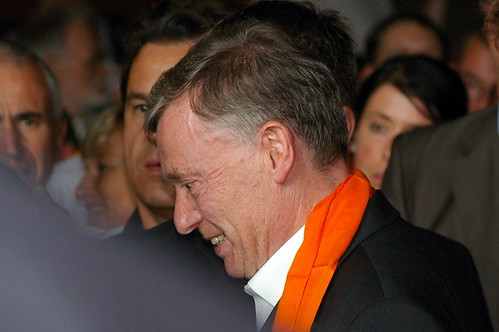
Picture: tgoldkamp (flickr) / CC BY-NC-SA

Tuesday, 18 May 2010

ECI, transaction tax & the details of EU policy-making

The German and Austrian Social Democrats have decided today that they want to initiate a European Citizens' Initative (ECI) on the introduction of a financial transaction tax.

The way their press release is formulated makes it sound like they are calling for a referendum (cf. last sentence that reads: '... for that 500 million Europeans can decide over the taxation of financial market speculation'), not mentioning that all they can do with an ECI is make the Commission consider the issue.

They should also mention the timeframe of an ECI and that once they had a successful ECI, the proposal needed to be taken up by the Commission (where there is no social-democratic majority) and it had to be passed (probably according to Art. 113 TFEU) by the Council with unanimity. The European Parliament would only be consulted (if the decision was taken under Art. 113 TFEU).

And only the EU experts - those who know that the ECI regulation is not yet in place and that you cannot even start an ECI right now - will notice that the last paragraph of the press release is actually just a demand that the ECI regulation will be put in place until autumn, so that the Social Democrats can begin their ECI. For the rest of the readers this sounds like the Social Democrats demand an EU transaction tax until autumn.

And if they knew the present state of the ECI discussions, they would also know that 500 million Europeans (as formulated in the last sentence) will not decide about an ECI because the participation age for the ECI is proposed to be the election age of EU citizens which will exclude some 100 million Europeans from this agenda setting instrument. But they anyway only need 1 million signatures.

It is thus nice that the German and Austrian Social Democrats want to make use of the new democratic element given to EU citizens, but the way they treat this issue is far from realistic and thus merely a PR instrument - but the press will surely buy it.

PS.: German social democratic MEP Matthias Groote is aware of that and thus focuses on his demands regarding the implementation of the ECI which seems much more reasonable at this point.

Friday, 14 May 2010

Never again

When I read about this news from Hungary today, I remembered a video made by Hungarian artists:


I've got nothing to add.

Monday, 3 May 2010

German minister against Three-Strikes & website blocking

The German Minister of Justice Leutheusser-Scharrenberg has published a long article (Google translated) in which she defends a free internet against demands to block websites or to introduce Three-Strikes-Legislation in case of copyright violations.

She underlines that she will fight against those proposals both on the EU level as well as during the ACTA negotiations.

Friday, 19 March 2010

Europe 2020 - Partial delay after Bundesrat complaint

After Germany's second chamber, the Bundesrat, complained on Tuesday that the schedule for the Europe 2020 strategy was against the Lisbon Treaty rules, European Council President van Rompuy now has postponed parts of the decision.

According to EurActiv, those parts of the 2020 plan dealing with education will not be decided at the European Council next week. This is necessary because the German federal states represented in the second chamber are responsible for education according to the German constitution.

It's exactly this kind of strange compromise I have expected: How can you pass the 2020 strategy partially next week and agree to the educational parts later this year? Isn't this meant to be an integrated strategy that can be agreed to as a whole or not?

And if the Bundesrat could complain that it didn't have enough time to consider the plan, how could all the other national parliaments? Did they receive the documents earlier than the Bundesrat? This would be odd. Or don't they care for their new rights, having eight weeks to consider European legislation? This would be bad.

What this affair shows is that the Lisbon Treaty has actually triggered changes and might have strengthened not just the European Parliament but also national legislatures - if they are conscious of their rights and if the take them seriously.

Wednesday, 17 March 2010

Germany's second chamber: Europe 2020 timetable violates Lisbon Treaty

In a freshly published press release the European Chamber of the German Bundesrat has criticised the timetable of the Europe 2020 process foreseeing a decision at the European Council on 25-26 March 2010 as violating the rights of national legislatures under the Lisbon Treaty. It also dismisses parts of the 2020 strategy as violating the Treaty.

The Bundesrat is the second chamber of the German legislative branch uniting representatives of the 16 federal states. It claims it has had less than three weeks between the formal reception of the Europe 2020 document and the European Council next week where a decision on the strategy is planned (see agenda, p.2).

What is remarkable is that the European Chamber of the Bundesrat - a body able to take constitutionally binding decisions on behalf of the Bundesrat set up to react quickly to EU developments when urgently needed - has almost never met in its history.

Thus, the fact that the European Chamber of the Bundesrat now issues a decision on behalf of the full institution shows the seriousness of the matter for the German federal states.

One has to remind that under the Lisbon Treaty, national and subnational legislatures must have eight weeks to react to European policy proposals under the subsidiarity clause, as was explained in a letter by Barroso sent to the parliaments in December.

To my knowledge, this is the first time that a national legislature is claiming that the Lisbon rules have been violated.

The question is now: How will the Commission and the European Council President react?

Update: Although the press release on the website of the Bundesrat has a time stamp from today, 17:29, the decision must have been taken yesterday because some newspapers published the story in today's printed versions.

Wednesday, 24 February 2010

German power struggles in EU politics & the next Secretary General of the EU Council

Yesterday, the German business newspaper Handelsblatt titled "Chancellery snatches EU policy away from Westerwelle", an issue that should not be regardes as just an internal affair.

The article told that in the future the chancellery of Angela Merkel, led by the Christian Democrat Ronald Pofalla, might coordinate EU policies, taking this competence away from Liberal foreign minister Westerwelle and his State Minister for European Affairs, Werner Hoyer, who is so far responsible for the committee of state secretaries for European affairs.

At first sight, one can interpret this as a simple intra-coalition power struggle in which the smaller coalition partner loses ground in an important political field to the larger coalition partner and to Chancellor Merkel. One could also see this as a consequence of the Lisbon Treaty reform that empowers the Chancellor within the European Council and excludes the foreign minister from these meetings.

But there is a third notion to this possible change in German EU coordination:

In June 2011, Uwe Corsepius will become the next Secretary General of the EU Council. Right now, he is the head of the European Policy Division in the German Chancellery, and transferring the coordinating power to this institution will mean a considerable strengthening of his role in German EU politics. If everything will have to go through his division, he will not only be better involved substantially but he could also become a much more central figure in the power distribution of German EU policy-making.

Consequently, if the transfer of EU coordination competence to the Chancellery will actually take place (this is already questioned by liberal MPs), a strengthened Corsepius will go to Brussels, while Merkel and Pofalla will keep the important European Policy division with excellent contacts to the new EU Council Secretary General who will probably also know very well his successor in the Chancellery.

What a "nice" way to raise German influence in Brussels that would be...

PS.: This is pure speculation, I know, but there is a good chance that in case the Handelsblatt's information are correct, Uwe Corsepius will be a much stronger figure than he is already now when he goes to Brussels.

Thursday, 11 February 2010

Kücükdeveci - A European case

If you believe the comments of bloggers from all over Europe, the Kücükdeveci case (C-555/07) in front of the European Court of Justice might have been both, another milestone in the legal primacy of EU law over national law and a precedent for the importance of the Charta of Fundamental Rights after the ratification of the Lisbon Treaty.

The case in itself is already a European case with a lot of European topics:

Seda Kücükdeveci, a German citizen (apparently a (Turkish) immigration background) in her twenties has been dismissed (youth unemployment) by a company that calls itself a European supplier (internal market) of communication materials. She has been going to court because she claims that the conditions of her dismissal were discriminatory (anti-discrimination).

Funny enough, the discrimination did not come on grounds of her gender or her immigrant background, but based on her age, based on the fact that she was younger than 26.

According to German law, her employer was right, according to EU law, the conditions were discriminatory, so the EU court found that:
"[T]he principle of non-discrimination on grounds of age as given expression by Directive 2000/78, must be interpreted as precluding national legislation"
and the judges went even further and became more clear:
"By reason of the principle of the primacy of European Union law, which extends also to the principle of non-discrimination on grounds of age, contrary national legislation which falls within the scope of European Union law must be disapplied"
But the case is not only a European case because it involves the EU court and European legal principles, it is also dealt with by European and national bloggers from different member states.

The main players are the bloggers from Adjudicating Europe who did not only pre-warn readers that an important ruling was about to come up - which prompted a direct reaction by the German Verfassungsblog - but they also follow-up with a brilliant series of articles discussing the effects as well as the pros and cons of the ruling:

Blogger Eurostein concludes in his article "Mangold II":
"I am afraid Kücükdeveci is Mangold II: an even bolder, but simultaneously also more porously argued decision. At least for me this is not the right way of redefining the very fundamentals of EU law. Just wait and see."
Pescatories, referring to the fact that the Court used the Charta of Fundamental Rights for his reasoning although the case is pre-Lisbon underlines in his article "Making History, Making Law":
"[T]he Court has interpreted that Lisbon has reinforced its authority in a way that it has never enjoyed in the past. After all, a Charter of fundamental rights is not the ordinary type of thing you run into every day.

Maybe the Charter is a momentous text that has given the Court the will and drive to legitimize its decision-making process and reinforce thus its judgments. And if so, the Court can not afford to simply look towards the future. In that circumstance, the Court MUST apply the Charter even when the cases are coming from the distant (and not so distant) past.
"
and he ends his post with the bold statement
Long live Kücükdeveci. And long live (very long, please) the European Court of Justice.
And in the third post of the series titled "In Defence of Paragraph 22", Cartesio also underlines the new importance of the Charta of Fundamental Rights in the EU's legal system:
"We have now the Kücükdeveci scenario in which a national horizontal situation fall within the scope of EU law when a non-implemented Directive contains a general principle/ EU fundamental rights. This is very far-reaching…. Kücükdeveci will be both hated and glorified…"
The bloggers from EU Law (Typepad), who link to the three articles mentioned above, summarise the ruling, starting from the conclusion that
"The Court of Justice has handed down a major judgment on the horizontal direct effect of directives."
and also Bulgarian euroblogger Viharg in his blog EU Law (Wordpress) finds that
"[t]his is really interesting, because the ECJ actually says that any directive can “give expression” to a general principle of EU law, and thus have horizontal direct effect."
(there is also a Bulgarian version of the article)
At the bloggers of The European Journal, Margarida took the time to write an extensive article about the case, highlighting that
"[t]his is another example of the ECJ expanding the scope of EU law.

In this case, a Directive giving expression to a general principle of EU law, prohibition of discrimination on the grounds of age, applies to a national horizontal situation binding not only the Member States but also individuals and due to the primacy doctrine national courts must not apply the national provision contrary to the general principle as expressed in the directive.

Hence, the provisions of directives expressing general principles of European Union law have full direct effect, even in horizontal situations.
"
As I have noted short after the ruling was published some weeks ago, Verfassungsblog predicted that this ruling will cause an "arms race" between the German Constitutional Court and the European Court of Justice. The seriousness of this argument is taken up by the Kartellblog, checking how the case of Kücükdeveci could effect cartel adjudication.

Other German blogs, like Das letzte Wort have critically noted that Kücükdeveci is another example of the idiosyncratic jurisprudence of the EU court. Michael Rahe in his blog also seems to be mildly critical, putting the case into the context of the rather negative perception of the Mangold II case.

But the case has not only been noticed by eurobloggers and German bloggers, but also received notice in the Dutch Belgian Sociaalrecht Blog as well as in the Romanian Antidiscriminare Blog. The Eurosceptic UK blogger The Boiling Frog doesn't "hold much hope" that the German Constitutional Court will be able to withstand the European court's powers. And the discussions at Adjudicating Europe and European Union Law summarised earlier are even noted in the Hungarian blog Jogvélemény.

French blog Combats pour les droit de l'homme also published a short article on the case, and in a post by the Journal du Marché Intérieur there is an interesting comment by Romain who challenges all those who see this case as an example of "direct effect" of EU law, claiming that it is "just" an example of the primacy of EU law:
"De mon point de vue, cet arrêt reconnaitrait plutôt l'invocabilité d'exclusion d'un directive dans un litige entre particuliers. Il n'est absolument pas certain qu'il soit question ici d'effet direct. Le principal apport serait alors que la Cour généralise l'hypothèse posée dans son arrêt Unilever s'agissant de "l'effet procédural" des directives. Il s'agirait alors d'une preuve supplémentaire de la distinction entre effet direct et invocabilité..."
So we have European and national blog reactions (plus the comments to all these posts) from more than eight countries on a case that is European in content and European in scope - a strong example of an emerging European public sphere and the existence of a European blogosphere as well!

Update: Magdalena from ECJ Watch published an article on Kücükdeveci this evening and, as many others, she shares the view that this case is exceptional:
"Kucukvedeci is about so much more than age disrimination. It is also about the effect of directives containing fundamental principles of EU law [...]. As we know, directives do not have horizontal direct effects. Or do they now? Here we are dealing with a Directive establishing a Fundamenal Principle of EU law, and this one WAS HELD TO BE DIRECTLY EFFECTIVE IN A HORIZONTAL SITUATION!"
That was more than explicit...!

Update 2: The Blog aproximativ juridic continues the debate, putting Kücükdeveci and the idea of direct effect into the Romanian legal context.

Update 3: Via @vihargg I found this comment on the case in the German Law Journal.

Update 4: Humanrights.ie discusses the effects of the Kücükdeveci case on the legal impact of the Charta of Fundamental Rights.

Tuesday, 19 January 2010

ECJ: European legislation on anti-discrimination precludes national legislation


UPDATE: See the summary of blog reactions on Kücükdeveci from all over Europe that I have collected.


In what Adjudicating Europe prescribed as an important ruling on Sunday, the European Court of Justice (ECJ) has today decided in the case of Kücükdeveci that EU legislation on anti-discrimination on the grounds of age precludes any contradictory national legislation.

Here is what the Court decided:
"1. European Union law, more particularly the principle of non-discrimination on grounds of age as given expression by Council Directive 2000/78/EC of 27 November 2000 establishing a general framework for equal treatment in employment and occupation, must be interpreted as precluding national legislation, such as that at issue in the main proceedings, which provides that periods of employment completed by an employee before reaching the age of 25 are not taken into account in calculating the notice period for dismissal.

2. It is for the national court, hearing proceedings between individuals, to ensure that the principle of non-discrimination on grounds of age, as given expression in Directive 2000/78, is complied with, disapplying if need be any contrary provision of national legislation, independently of whether it makes use of its entitlement, in the cases referred to in the second paragraph of Article 267 TFEU, to ask the Court of Justice of the European Union for a preliminary ruling on the interpretation of that principle.
"
The German constitutional law blog Verfassungsblog.de, referring to the Adjudicating Europe blog post, had predicted that this ECJ ruling (the case is from Germany) would turn out differently, arguing that the ECJ would not like enter into a conflict with the German Constitutional Court.

Just to remember (a little simplified but valid): In his ruling on the Lisbon Treaty last year, the German Constitutional Court had made clear that it reserves itself the right to have a final word on EU legislation of whatever kind, and the ruling of the ECJ today is a clear attack on these self-proclaimed powers.

The Verfassungsblog today admits that the prediction was wrong and that we might now see an arms race between the two courts.

Looks like legal experts in EU law both on the European and national level will have some fun discussions over the time to come - but for EU citizen Seda Kücükdeveci it means that her rights have been violated and that she thus should get adequate compensation.

Sunday, 13 December 2009

Merkel's coup: Uwe Corsepius will become the next Secretary General of the EU Council

According to the Frankfurter Allgemeine Zeitung, the German Uwe Corsepius will become the next Secretary General of the Council of the European Union.

Corsepius, who was mentioned as a candidate among others, has been confirmed by the heads of state and government at the European Council meeting on Friday, following agreements made on 19 November as Jean Quatremer knows. He will take over from Pierre de Boissieu in 1 1/2 years, as Angela Merkel informed at a press conference after the summit on Friday.

(UPDATE:) The formal approval of this decision was made on 22 December 2009 by the Council meeting (see the press release that uses parts of this blog post). According to this decision, Corsepius will serve as Secretary General from 26 June 2011 until 30 June 2015.

Economist Uwe Corsepius is 49 years old and is the head of the European Policy Division in the German Chancellery - he is thus the EU advisor of Angela Merkel and was, inter alia, responsible the for negotiations ahead of the Berlin Declaration during the German EU Council Presidency that led to the Lisbon Treaty. Jan Seifert wrote about him at the time as being one of the "sherpas" of Angela Merkel (here's a photo of him at the time).

On the website of the German politics and history channel Phoenix it is noted that he started his career in the Chancellery under Helmut Kohl and climbed up in the hierarchy under Gerhard Schröder. In 2005, Merkel made him head of the EU division in the Chancellery.

Three weeks ago, several German online news magazines published a short portrait (produced by DPA) about him, in which he is quoted with the words: "I am no visionary.", which would fit into the choices made with van Rompuy and Ashton, but which fits much better for the job he will have to do at the Council.

Actually, it seems that, according to several sources like EurActiv, Corsepius was also a possible candidate for Ashton's job, but didn't get it - probably for balance reasons as we know how Ashton was chosen. Therefore it is mentioned in the Frankfurter Rundschau that despite the choice of Corsepius for Council Secretary General, Merkel might still demand that a German becomes head of the European Central Bank - a clear sign that she is showing muscles after renouncing to get one of the three top posts (filled with Barroso, van Rompuy, and Ashton).

The amount of background information on Corsepius on the net is limited, but interesting to note is that Cecilia Malmström, Swedish Minster for EU Affairs and candidate for the next EU Commission, mentions Corsepius first in an a blog post about a visit to Berlin in April of this year. Usually he is described as "descrete", or as a person having relevant influence in German EU politics, for example preventing advancements in the negoations around the new anti-discrimination directive, as ZEIT online notices. In the Financial Times Germany, he is described as having a "boyish" face, with moments of "dash" behaviour. His only direct international experience, according to the FT, was his work at the IMF in the early 90s.

All in all, the choice of a national high level bureaucrat like Corsepius instead of an EU insider like de Boissieu is another clear indicator of the "Coup des Etats" I have criticised recently - member states are trying to secure their influence in the EU by the choice of personalities to counterbalance the new provisions of the Lisbon Treaty.

PS.: And if there are doubts, I'd just like to say that this choice is as bad as any other choice made by national leaders to secure their individual interests instead of promoting the good for all European citizens. These posts should be distributed according to merit, not according to geography and power considerations.

(Updated: 17 Dec 09; 12:30; 23 Dec 09 17:30)

Wednesday, 9 December 2009

The new European Commission: Günther Oettinger in the German Bundestag

After looking at Joaquín Almunia yesterday, there is news on Günther Oettinger.

According to the agenda of the EU affairs committee of the Bundestag (the German parliament), Günther Oettinger who is proposed as EU Commissioner for energy will stand questions of German members of Parliament next Wednesday (16 december). The agenda item that does not look final in the agenda linked above has just been confirmed by German MEP Eva Hoegl on Twitter.

It is a pity that the Committee doesn't meet in public...! But at least German MEPs have the right to participate in the EU affairs committee meetings, so they can hear him before he appears in the European Parliament in January.

And via Wolfgang Wettach (also on Twitter) I found the video of the speech of Oettinger at the German (federalist) Europa-Union, a meeting that took place last weekend, and that has also been covered and commented by Europaeum. This is the first part in German (without subtitle), but if you understand the language it might still be worth watching:


So what will MPs learn from Oettinger? Will he present his visions of a European strategy on energy policy or will he meander in vagueness? We won't probably know...

(Substantive changes to original version of the post: 9 Dec, 12:59)

Political science blogging: Why Germans support EU membership

This post is based on the conclusion - following a short exchange of views with Kosmopolit some weeks ago - that I should not only contribute as a European citizen to European debates, but also as a political scientist with an interest in EU affairs.

Whenever I will find interesting analyses I will thus try to provide you with latest results and debates from academic journals and other publications:

In a freshly published article titled "Sources of EU Support: The Case of Germany" from the political science journal "German Politics" (issue 4/2009), authors Angelika Scheuer and Hermann Schmitt have presented their analysis on why Germans support EU membership.

In their study based on independent aggregate data sets for a period of 39 years they analyse how the economic situation, the amount of EU legislation implemented, and the general satisfaction with democracy in Germany affects the support of Germans for EU membership.

Their main findings are that although all three factors have an impact, the economic factor is the least relevant; a higher GDP only has a small positive affect on satisfaction with EU membership.

More important seems to be that they find that the stronger the impact of EU policy making, the lower the support for EU membership, and that the more satisfied Germans are with their own political system, the more supportive they are of EU membership. Both effects have a similar strength, with the latter being slightly stronger.

I won't go into possible critiques of the analysis - because there would be some - but the findings are still interesting enough for further political and scientific debate.

And so, although these findings, according to the authors, are not generalisable for other EU countries, they still show that satisfaction with EU membership is not just influenced by how citizens view the work and concrete impact of the Union, but also by the perception of and satisfaction with their own country's system, still the main political arena for most.

Sunday, 8 November 2009

Erika Steinbach, leave us alone!

Erika Steinbach is the head of the German Federation for Expellees, and for years she is ruining German relations to our Polish neighbours.

Her confrontative course regarding the representation of interests of Germans (and their children) who were expelled from what would become Poland at the end and after World War II is a disgrace for us Germans who are working for a united Europe with where nobody needs to be afraid of neighbouring countries.

Steinbach has now repeated her claim that she wants to sit in the Board of the new Polish-German Foundation for Expellees that will try to retrace the fate of expellees at the end of World War II, in a way that doesn't put the emphasis on blaming each other or bringing up the idea of restitution but that focuses on the tragic stories in order to allow a proper culture of remembrance.

Yet, somebody like Steinbach who is not interested in good relations but in confrontation is embarrassing, and I can only hope that our new government will manage to keep her out of the new foundation in order to show to our Polish neighbours that in the European Union of the 21st century we Germans don't support those who live in the past but that we look ahead and look forward in expanding good relation to Poland - something foreign minister Westerwelle has made clear when he spent his first visit in office to Poland.

I am glad that although Erika Steinbach is often presented in Poland as the voice of Germans, she doesn't have much room in our own media - and I hope that our government will make clear that she would be the wrong choice for the new foundation and against the whole idea of the creating such an organisation!

Monday, 26 October 2009

Werner Hoyer: Return to EU politics in the new German government

While all eyes are on the inexperienced new German foreign minister Guido Westerwelle (with no European profile) and the proposed German EU-Commissioner Günther Oettinger, let's have a look at the second row of German EU politics under the new government.

Werner Hoyer, liberal member of the German parliament (the 'Bundestag'), will return into the Foreign Office as "State Minister" (that is a special title for a state secretary of the Foreign Office having a seat in the Bundestag), a function he already served from 1994-98 in the last government of Helmut Kohl under foreign minister Klaus Kinkel.

As State Minister responsible for Europe (assisting or replacing the foreign minister in important European meetings), the new foreign minister Westerwelle will have an experienced and - as far as I can see - convinced European on his side.

In 1996, Hoyer was the main responsible in the preparation of the Intergovernmental Conference to revise the Maastrich Treaty (which would later be the Amsterdam Treaty), and already at that time he supported a smaller Commission, a stronger co-ordination of the European foreign policy while demanding that the Commission would need to initiate legislation on the demand of the European Council.

But he continued his European activities even after the victory of the Schröder government ended his term in the foreign ministry:

Vice-president of the ELDR from 1997 to 2000, he became president of the European Liberals in 2000 and remained in office until 2005. Consequently, one can expect that he still holds good contacts to the political scene in Brussels, proven by the fact that during a visit to Brussels in May he was able to meet representatives of the Commission and the Council or by his participation in the post-election analysis of the European Liberals in June.

Looking at his policy profile one finds a convinced European with clear liberal attitudes and a transatlantic orientation: In 2007, he supported the Lisbon Treaty, although criticising that the Charta of Fundamental Rights and the clear support of a free internal market were not included in the Reform Treaty. And in an interview published in September, he underlines (from minute 10) that we tend to take the European Union as something given, while forgetting that it needs work. He then demands that politicians should develop a future vision for Europe.

And although he will just be a state minister, Hoyer's role in determining the future German work and positions in Brussels should not be underestimated, in particular since earlier this year, he demanded a stronger role of the German foreign ministry in the coordination of German EU politics (by now this role is shared with the finance ministry and the ministry of the economy)

So, from what I could find, it looks like the German foreign policy, despite its inexperienced new foreign minister, will get a reasonable but determined State Minister for Europe who, as an EU insider, won't need much time to get back to work in Brussels and elsewhere in the Union.

PS.: Please, if you have critical remarks on Hoyer or if you can share links to sources that paint a more critical picture of him, I'd be most glad to include them in the article.

Saturday, 24 October 2009

Günther Oettinger will be the German EU-Commissioner: A catastrophe!

The Christian-democratic minister president of the German federal region of Baden-Württemberg, Günther Oettinger, will become the next German EU-Commissioner.

The man, here on a photo with Barroso, isn't known for much in the Federal Republic of Germany (despite the way he speaks), but his promotion for EU-Commissioner proves the trust Chancellor Merkel has in him.

The German TV news told that he seemed to have underlined his abilities in economic policies during the coalition negotiations, but apart from that he does not really have a strong policy profile on the national scale. From his CV you can see that his main policy qualification was in media policies, but nobody would mention this when asked about Oettinger.

For the first time he appeared on the national sphere in 2005 when he became minister president, and the only time he became really seen on this level was when he defended former Nazi Hans Filbinger, an affair in which he lost much credibility in the country.

When you look at his CV (or here), there are neither hints to any international or European experience nor any information about his language skills. And from all televised appearances of Oettinger I have got the impression that he is unable to communicate, something that would be most needed in a European Commission that wants to reach out to the people and peoples of the Union.

I think that is one of the worst choices one could have made for EU-Commissioner, and the Twitter reactions are also mainly negative. Even people who voted for the Christian Democrats or who support the present coalition seem to largely share this opinion.

So the only reasons to promote him for this position could be his technocratic skills and the trust Angela Merkel seems to have in him - or they want to get rid of him from Baden-Württemberg, one of the two economically most successful federal regions of Germany, with relevant power in the German second chamber.

Sorry, European Union, but Germany is sending a failure to Brussels - I hope he will not get an important portfolio (which is an unlikely hope, though...)!

The issue in euroblogs and German blogs: Kosmopolito, Europa-transparent, Lars Haise, Grahnlaw, Jean Quatremer, student86

Sunday, 27 September 2009

The German election results and their implication for EU politics - updated

The German parliamentary elections are over, and although the results are not yet final, the political game will move on quickly.

The results (see the provisional results), however, are clear:

The Grand Coalition of Merkel's Christian Democrats (CDU/CSU) and the Social Democrats (SPD) is over, due to an expected but still painful historic loss of the SPD (23%) with its candidate, foreign minister Frank-Walter Steinmeier.

Nevertheless, Angela Merkel will remain the chancellor of Germany, thanks to only small losses of the CDU/CSU (33.8%) and the strongest results of the Liberals (FDP) - lead by Guido Westerwelle - in their history (14.6%), with whom Merkel will form a coalition for the next four years. The Christian Democrats will be even stronger than their overall election result suggests, because the will receive many overhang seats because of their strong results in the constituency votes, a particularity of the German election system.

The other two parties in the Bundestag (the German parliament) will be DIE LINKE (the Left Party; 11.9%) and the Greens (10.7%). The Pirate Party received 2% in their first participation in national elections, the extreme-right NPD got 1.5%, both missing the 5% threshold to enter into the parliament but still qualified for the party financing for the next 5 years (85 Euro Cents per vote for the first 4 million votes, 70 Cents for every further vote).

How will this effect EU level politics?

In my last post I have already talked about implications of these results for EU politics, and I'd like to become even more clear about what the future coalition CDU/CSU-FDP coalition might imply for European politics:

1. The German EU Commissioner:

After these results, it is pretty sure that the next German Commissioner will be Christian Democrat (EPP). Due to the strength of the Liberals in the new coalition, I don't think that it will be Wolfgang Schäuble but rather a more moderate candidate like Peter Hinze. In any case, the victory of Merkel will thus also strengthen Barroso.

2. The German positions in the EU Council and the European Council

Due to the rather market-liberal shared profiles of Christian Democrats and Liberals, I also expect that Germany's positions in the Council will be more market liberal than before. In the European Council I do not expect major changes since Merkel will continue to be a dominant figure profiting from her already existing networks to other European and international leaders.

3. The German behaviour on the EU level

Despite the previous argumentation, there is also a possibility that the German behaviour on the EU level will be characterised by internal veto points. Different to the last four years where due to the Grand Coalition the opposition was divided and weak, the joint left-wing opposition of SPD, the Left Party, and the Greens will use all the powers it has - including creating veto points in the second legislative chamber, the Bundesrat, where the federal states are represented - to slow down German decision making on the EU level. This is particularly relevant after the recent changes of the participatory rights of the legislature in EU decision making.

And although this sounds rather negative, it could also mean that EU politic could become more visible due to more active debates on the position(s) of the German government on the EU level. But this will have to be seen.

4. A side-note

The new government will most likely see a combination of two leading personalities that are unprecedented in the EU and probably also beyond: A woman (Angela Merkel) will be leading the government and the foreign minister will be a homosexual man (Guido Westerwelle). But more interesting will be that neither the one nor the other have played any role in the campaigns - and it won't play any role in the future government because both is not considered very special in Germany at the end of the first decade of the 21st century. But I think that this will still be a sign for an EU where equal rights - both for women and for sexual minorities - are still not respected all over the place.

Altogether, German politics will see continuity in its main leadership, but it will face major changes in the political dynamics with more pro-economic policies, a stronger polarisation between the political camps and probably also an intensive politicisation of the multilevel politics between the national institutions, the federal states, and the EU level.

Other Euroblogs on the same topic: Grahnlaw (excellent summary), Europe & You, Stephen Spillane, Jonathan Fryer, Alpha.Sources, Gavin Hewitt, Carl Bildt, Eurozone Watch, Andre Feldhof, Géopolitique, eToile.

Saturday, 26 September 2009

Parliamentary elections in Portugal and Germany

National elections in EU member states concern the lives of citizens not only in the respective countries but in all countries of the Union.

Through the policy-making power of the EU Council and the guiding weight of the European Council, governments influence the European political agenda as well as the outcome of negotiations on the European level, possibly even including the level of the working groups in which administrators and diplomats prepare and discuss future legislation.

So tomorrow, the parliamentary elections in Germany and Portugal might or might not change the lives of European citizens. In both countries, the polls predict a win by the leading governing party, but the way they can govern is unsure:

In Portugal, the latest poll foresee that the Socialists will remain the strongest power, although they won't be able to hold the absolute majority and might be forced into a minority or coalition government.

Since I am no expert in Portuguese politics, let me focus on the German case:

In Germany, Angela Merkel's Christian Democrats (CDU) will very likely win the elections (see the latest opinion polls) while the unwished present coalition partner, the Social Democrats with their candidate foreign minister Frank-Walter Steinmeier, might receive the worst result in the history of the Federal Republic.

The question will be whether Merkel's CDU (together with its Bavarian sister party CSU) will have a majority together with Guido Westerwelle's Liberals (FDP) - the polls are very tight - to form a coalition of the economic right led by Merkel or whether Merkel will have to continue with the Social Democrats.

The two other parties likely to enter into the Bundestag, the Left Party (DIE LINKE) and the Greens (Bündnis 90/Die Grünen) don't seem to have a power option because all likely (triple) coalitions that include them have either been categorically ruled out by the other three parties or by the two themselves.

The most likely result of tomorrow will thus be that Angela Merkel remains the Chancellor of Germany, not matter what the election result.

However, a renewed but shrunk Grand Coalition (Christan Democrats and Social Democrats) will be less stable than it was in the previous term, risking not to hold for another four years.

A "Tiger Duck Coalition" (term created during this campaign because the two colours of the tiger duck represent the Christian Democrats and the Liberals) in return will mean a shift in policies towards the economic right, but it will also create a stronger opposition of the then concentrated left and centre-left that might slow down German decision making in crucial policy areas, especially through the counter-balance of the second chamber, the Bundesrat, in which the federal states co-legislate and in which the CDU/FDP coalition would only have a tight majority that might change after regional elections in one or another major federal state (two minor federal states - Brandenburg and Schleswig-Holstein - are voting tomorrow, too).

Both scenarios would influence the German government's ability to act - in substance or speed - on the European level in the next 2-4 years, not least because of the strengthened position of the legislative branch after the Lisbon Treaty ruling of the Constitutional Court and the subsequent adaptation of the by-laws regulating the involvement of the two legislative chambers, Bundestag and Bundesrat.

The only small surprise factor in tomorrow's result might be the Pirate Party, probably the first party movement boosted by European dynamics (especially in Sweden), that could gain a visible part of the (extended) youth vote. The party running mainly on new technology, file sharing, and data protection issues was able to create considerable attention during the early stages of the campaign but wasn't able to keep up the pace of the traditional media (although the overall campaign was extremely boring and low key, not too far away from the European Parliament election campaigning). So I expect that they will reach the 2-3 percent tomorrow, not crossing the electoral threshold of five percent.

I myself won't be able to report during the day tomorrow because I'll be working in a polling station, but for anyone who wants to get a glimpse at the debates and who is able to speak German, I recommend following the #btw09 hashtag (short for: "Bundestagswahl 2009") on Twitter.

I'll then try to give a summary when I return late in the evening on Sunday, or at least to link the most interesting reports of others.

Read also on the topic: A Fistful of Euros.

Monday, 21 September 2009

German Lisbon Treaty by-laws pass second chamber

Just in case you didn't notice:

On Friday, the Bundesrat, the second legislative chamber of the German federation in which the 16 federal regions ('Länder') are represented, has passed the German Lisbon Treaty by-laws that were necessary after the Constitutional Court decision in June ruling that the by-laws were unconstitutional.

In the televised news on Friday they told that the president (who needs to sign the law) will wait for a hint by the Court whether he can sign it or not since it seems that some (unnamed) individuals have again brought an action before the Court.

But since neither the political group of the Left nor the deputies from the Christian Socials, who were the main complainants last time, are opposing the law - which they'd make very clear during an election campaign - I don't see any substantive problems for the President's signature.

The only question will be whether he'll be able to do it before the Lisbon referendum in Ireland...

Tuesday, 1 September 2009

Being German 70 years after the beginning of World War II

I suppose this is a topic on which so much has been written and so much could be written that a blog post is the least appropriate thing to write.

Yet, if you ask me how it is being a German 70 years after the beginning of World War II, I can only say that the concept of war is so unreal, so unthinkable for me due to the way I have been raised as a German citizen and thanks to the way in which I have become a European that I can only be grateful to be a German born into this generation.

We do not celebrate any military victory of ours, we have no stories of war heroes, no great minds and fighters, brave and strong in the face of the enemy. What we have are murderers and cowards, simple people drawn into the army, and young boys forced to fight for nothing at the end of the war. We have destruction and death, disgust and disgrace.

For me as a German, war is nothing but evil - and I am glad it is this way, because there is no single reason or anecdote in our socialisation that makes us like war, weapons, or the killing of others.

When the war started 70 years ago, my grandparents were young children or not even born. When my parents were born, over a decade had past since the end of this most murderous of all wars. When I was born, several decades had past since this 1st of September 1939 in which the myth of the nation, the ideal of the gun, the predominance of horror started to dig their own grave into which millions and millions of human beings were pulled before it was finalised.

70 years later, being German for me doesn't mean to feel guilty for the past, it means to feel responsible for the future.

If my ancestors and their friends and families were ready to go into such a war and to execute the atrocities of the Holocaust, then it could be that people like me would do it again, unless we use this pain deeply fixed into our minds to prevent this from ever happening again - not just here, not just in Europe, but anywhere where people invest most of their time, and money, and effort, and human lives to kill others for the sake of a horrible higher good, be it the nation, the race, or the religion.

70 years later, we as Germans cannot make the past undone, but we can use our collective memory to tell our story, a story in which we win by losing, in which we are happy not to be the winners, feeling ashamed for what has been done in "our" name in the past.

70 years later, I am European because I was raised as a post-war German in a Europeanised and re-unified Germany, and I live in the hope that anyone coming after me will still be post-war and never pre-war again.

Wednesday, 26 August 2009

The discussions on the German Lisbon Treaty by-law: My Twitter coverage

Below you find my Twitter coverage of the first round(s) of the Bundestag discussions (first reading) around the the four German draft Lisbon by-laws and the adaptation of the constitution (find all five documents in PDF below):

(Discussion starts at the bottom)
  • Pirate Party (@tauss): The parliament actually didn't want to be stronger, it is just a by-result of the Court decision. #pirateparty
  • #CSU: #EU should not be free to negotiate on #WTO questions that affect #Germany without the participation of the #Bundestag
  • #CSU: Finally the #Bundestag gets the rights that the #Bundesrat has received ever since the Single European Act (1986)
  • #SPD: We want to send a positive signal to #Ireland and to the the presidents of #Poland and the #Czechrepublic
  • #SPD: Against new nationalism that says: Not "Germany in Europe", but "Europe has to follow Germany"
  • #SPD: The Lisbon Treaty is the result of 10 years open and public discussions and strengthens European democracy.
  • #SPD: As long as die #LINKE holds their positions on Europe as it does, there will be no coalition on the national level with the #SPD
  • #SPD: While the Constitutional Court has underlined "national sovereignty",while this term does not exist in the #Grundgesetz (constitution)
  • #Grüne: Against an imperative (=binding) mandate for the German government in #EU negotiations
  • #Grüne: We have to figth against new forms of "executive democracy", and the Constitutional Court has strengthened us parlamentarians.
  • #Grüne: It seems as if we cannot separate nation state and European level, so we have to strengthen national parliaments against governments
  • #Grüne: This is a sign of the working #democracy. But we should have done this much earlier.
  • #Grüne (#Greens): This is a good day for the German #Bundestag, because we have agreed on law during an election campaign. #eu
  • #LINKE: We want referenda for important treaty changes. #eu #lisbontreaty
  • #LINKE: Against giving the government the right to deviate from Bundestag decisions in #EU negotiations
  • #LINKE: All other four parliamentary factions want a Europe of the elites, which we reject.
  • #LINKE: Talks about topics of the election campaign, not about #Lisbon
  • #LINKE: This debate was fostered by our complaint before the German Constitutional Court. Thx to us,#Bundesrat & #Bundestag have more rights
  • #CDU: Like this, the German parliament can become the engine of European integration. We want a Europe of citizens, not of governments. #eu
  • #CDU: The new law will allow an early information of the German #Bundestag,so that the parliament can actively influence #EU policy-making
  • #CDU: Europe is not far away, but it is part of our internal (!) politics. #eu
  • #CDU: We don't discuss enough about European politics and law-making, which would be part of our national interest.
  • #CDU: nation states are basis for cultural identity and democratic legitimacy of the #EU.
  • #CDU: Europe and the national state are mutually dependent; neither can exist alone. #eu
  • #CDU: This is all about the basic question of the relation between the nation state and the European level which may not be ignored #eu
  • #FDP: We as parliament will not only get new rights, but also new duties;we will have to care more for European law-making in the committees
  • #FDP: Good cooperation between #SPD, #CDU, #Grüne, #FDP in the preparation of the new law.
  • #FDP: We want to make Europe better, not to harm it. Against a limited understanding of the German pro-European identity. #eu #lisbontreaty
  • #FDP: underlines that Court agreed that the Treaty is constitutional
  • SPD: Criticises CSU (Christian Social Union, Bavaria) for its anti-EU positions that would lead to a blockage of the #EU
  • SPD: Government may deviate from Bundestag position in EU decision, but needs to give full account of reasons
  • SPD: What was a simple agreement between Bundestag and government before (on cooperation in EU matters) becomes a full law now
  • SPD: If new competencies are given to EU,legislator needs to be involved
  • SPD: Success of EU is based on internal market, and German industry/economy profits from this market.
  • SPD: European integration is a basic reason of the German federal state. EU strongest force against war and nationalism.
  • Now (!) livestream on the discussions around the German Lisbon Treaty by-law in the #Bundestag: http://tr.im/x9fv (German)