
Yesterday, Slovakians voted against the ruling social democrats and elected a centre-right majority into the Parliament.
Today, Belgium also tries to vote a new government, and, luckily for the politicians, voting is obligatory over here - because what I heard during last week was that politicians are tired of campaigning and voters tired of voting in Belgium after years of crisis. That is democracy how we love it!
And at the end of next week, Finnish prime minister Vahanen will be replaced by the 41 year old Mari Kiviniemi, bringing some young blood into the European Council in the near future.
Showing posts with label elections. Show all posts
Showing posts with label elections. Show all posts
Sunday, 13 June 2010


Thursday, 6 May 2010
UK elections: What's at stake for the citizens of the EU?
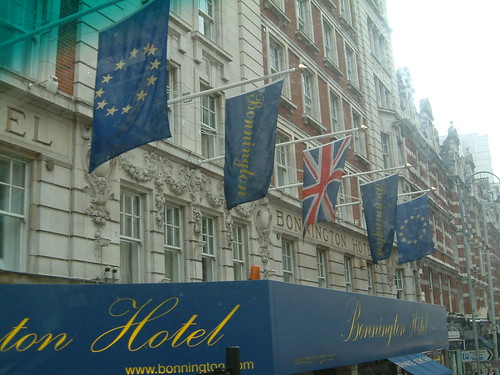
Whether or not there will be significant policy changes - which can be the case if the Liberal Democrats will gain enough seats to be part of a coalition government and which will be the case if the Conservatives win an absolute majority - these elections determine how and by whom the UK is represented in the EU institutions.
You don't think it is important who represents the United Kingdom and which policy programme is advocated by these personalities in the EU Council and the European Council?
Well, then you don't think that the regulation of financial institutions is an issue that concerns you. You don't think that it is relevant whether the UK will push for reforms in the Common Agricultural Policies of the EU or not.
You don't think that it makes a difference whether a Labour government, a Conservative government or a coalition of one of the two other with the Liberal Democrats will determine the new EU internal security strategy or the shape of the EU's External Action Service, including the precise nature of its tasks (e.g. regarding military capacities).
All these are issues which are discussed right now in the different EU institutions, and the British government is an important part of these discussions. And all these policies have direct impact on the lives of all EU citizens.
In short, if you don't care for the election results in England, Wales, Scotland and Northern Ireland, you don't think that the EU has any impact on your life.
Different to how some might want to frame the debate, the question of these elections is thus not so much about staying in the EU or leaving it. It is not the question: Will the Royal Union stay a Loyal Union to the European Union?
No, it's more profane: The UK elections partially determine the outcome of concrete future policies of the European Union. British citizens vote for the direction of their country today, but they also vote for a fraction of the direction the EU will take in the years to come.
So, EU citizens, take a look to the UK today and notice who will win - because this will affect your lives in the years to come!
Picture: © prasenberg / CC BY-NC 2.0
Saturday, 9 January 2010
The lost MEPs: France and the European Parliament after Lisbon
According to an article in Le Monde, the French parliament will not choose the two additional Members of European Parliament that the country will get under the Lisbon Treaty rules before summer.
The vote foreseen in the Assemblée nationale has been postponed from 13 January 2010 without setting a new date.
In the newspaper article, the Spanish EU Council Presidency is blamed for not pushing quick enough for the the reform of the of Protocol 36 on transitional provisions to the Treaties. A ratification of this reform by the member states would be necessary to enlarge the European Parliament to the Lisbon Treaty size of 754; so far just 736 deputies sit in the Parliament according to the Nice Treaty rules under which the EP was elected last year.
For more details on the proposed reform see the respective Council document from 04 Decembery 2009 which I found via the German Bundesrat, the second chamber, there the document is dated 7 January 2010. The fact that one month has passed before this reached the German second chamber maybe is an indication of the speed with which the reform has been pushed...
However, it is also pointed out in Le Monde that France is the only country that hasn't set out internal provisions to chose the addition MEPs according to the rule of direct universal suffrage, and the decision to select the two additional MEPs, due to the complex French general election system, through a national parliament vote has been judged problematic in December already (e.g. here and here).
It needs to be noted that the term "direct universal suffrage" is also included in the Council document linked above, on page 6 (first paragraph).
This matter is yet another proof that the European and national institutions aren't yet prepared for the provisions of the Lisbon Treaty and that they take way too much time to find acceptable solutions - and as so often, it is the member states and the Council causing the trouble.
The vote foreseen in the Assemblée nationale has been postponed from 13 January 2010 without setting a new date.
In the newspaper article, the Spanish EU Council Presidency is blamed for not pushing quick enough for the the reform of the of Protocol 36 on transitional provisions to the Treaties. A ratification of this reform by the member states would be necessary to enlarge the European Parliament to the Lisbon Treaty size of 754; so far just 736 deputies sit in the Parliament according to the Nice Treaty rules under which the EP was elected last year.
For more details on the proposed reform see the respective Council document from 04 Decembery 2009 which I found via the German Bundesrat, the second chamber, there the document is dated 7 January 2010. The fact that one month has passed before this reached the German second chamber maybe is an indication of the speed with which the reform has been pushed...
However, it is also pointed out in Le Monde that France is the only country that hasn't set out internal provisions to chose the addition MEPs according to the rule of direct universal suffrage, and the decision to select the two additional MEPs, due to the complex French general election system, through a national parliament vote has been judged problematic in December already (e.g. here and here).
It needs to be noted that the term "direct universal suffrage" is also included in the Council document linked above, on page 6 (first paragraph).
This matter is yet another proof that the European and national institutions aren't yet prepared for the provisions of the Lisbon Treaty and that they take way too much time to find acceptable solutions - and as so often, it is the member states and the Council causing the trouble.
Monday, 7 December 2009
Presidential elections: Close results Romania and no result in Moldova
After yesterday's presidential elections in Romania, this morning the winner has been announced: President Traian Băsescu was re-elected with a minimal majority of 50.43%, winning over the Social Democrat Mircea Geoană whose victory's consequences had been prescribed by A Fistful of Europe, although they won't happen now.
On the other side of the river Prut, in Moldova where the state language "Moldovan" is in fact a Romanian dialect and where many citizens also hold Romanian passports, the political crisis continues with today's failure to elect a new president, and the announcement of early elections.
Background on Moldova:
After the parliamentary elections in Moldova in early April which the governing Communist Party won with 60 seats in Parliament, yet without having the presidential majority (61 out of 101), riots in the capital Chisinau, and several failed attempts to elect a Communist Party president, the country went into early elections in July, that the rather pro-Western four-party "Alliance for European Integration" (AIE) won, but having just 53 seats in parliament.
This majority of the AIE coalition was based on the Democratic Party led by Marian Lupu, parliament president for the Communist Party until April, who had left the CP and joined the Democratic Party (member of PES) afterwards. Today, in a repeated attempt to elect a president, Lupu was proposed for the post of President of the Republic, but since the Communist Party holding a blocking minority refused to vote for him (leaving the plenary), Moldova will see early elections again, the third parliamentary elections in one year.
On the other side of the river Prut, in Moldova where the state language "Moldovan" is in fact a Romanian dialect and where many citizens also hold Romanian passports, the political crisis continues with today's failure to elect a new president, and the announcement of early elections.
Background on Moldova:
After the parliamentary elections in Moldova in early April which the governing Communist Party won with 60 seats in Parliament, yet without having the presidential majority (61 out of 101), riots in the capital Chisinau, and several failed attempts to elect a Communist Party president, the country went into early elections in July, that the rather pro-Western four-party "Alliance for European Integration" (AIE) won, but having just 53 seats in parliament.
This majority of the AIE coalition was based on the Democratic Party led by Marian Lupu, parliament president for the Communist Party until April, who had left the CP and joined the Democratic Party (member of PES) afterwards. Today, in a repeated attempt to elect a president, Lupu was proposed for the post of President of the Republic, but since the Communist Party holding a blocking minority refused to vote for him (leaving the plenary), Moldova will see early elections again, the third parliamentary elections in one year.
Sunday, 27 September 2009
The German election results and their implication for EU politics - updated
The German parliamentary elections are over, and although the results are not yet final, the political game will move on quickly.
The results (see the provisional results), however, are clear:
The Grand Coalition of Merkel's Christian Democrats (CDU/CSU) and the Social Democrats (SPD) is over, due to an expected but still painful historic loss of the SPD (23%) with its candidate, foreign minister Frank-Walter Steinmeier.
Nevertheless, Angela Merkel will remain the chancellor of Germany, thanks to only small losses of the CDU/CSU (33.8%) and the strongest results of the Liberals (FDP) - lead by Guido Westerwelle - in their history (14.6%), with whom Merkel will form a coalition for the next four years. The Christian Democrats will be even stronger than their overall election result suggests, because the will receive many overhang seats because of their strong results in the constituency votes, a particularity of the German election system.
The other two parties in the Bundestag (the German parliament) will be DIE LINKE (the Left Party; 11.9%) and the Greens (10.7%). The Pirate Party received 2% in their first participation in national elections, the extreme-right NPD got 1.5%, both missing the 5% threshold to enter into the parliament but still qualified for the party financing for the next 5 years (85 Euro Cents per vote for the first 4 million votes, 70 Cents for every further vote).
How will this effect EU level politics?
In my last post I have already talked about implications of these results for EU politics, and I'd like to become even more clear about what the future coalition CDU/CSU-FDP coalition might imply for European politics:
1. The German EU Commissioner:
After these results, it is pretty sure that the next German Commissioner will be Christian Democrat (EPP). Due to the strength of the Liberals in the new coalition, I don't think that it will be Wolfgang Schäuble but rather a more moderate candidate like Peter Hinze. In any case, the victory of Merkel will thus also strengthen Barroso.
2. The German positions in the EU Council and the European Council
Due to the rather market-liberal shared profiles of Christian Democrats and Liberals, I also expect that Germany's positions in the Council will be more market liberal than before. In the European Council I do not expect major changes since Merkel will continue to be a dominant figure profiting from her already existing networks to other European and international leaders.
3. The German behaviour on the EU level
Despite the previous argumentation, there is also a possibility that the German behaviour on the EU level will be characterised by internal veto points. Different to the last four years where due to the Grand Coalition the opposition was divided and weak, the joint left-wing opposition of SPD, the Left Party, and the Greens will use all the powers it has - including creating veto points in the second legislative chamber, the Bundesrat, where the federal states are represented - to slow down German decision making on the EU level. This is particularly relevant after the recent changes of the participatory rights of the legislature in EU decision making.
And although this sounds rather negative, it could also mean that EU politic could become more visible due to more active debates on the position(s) of the German government on the EU level. But this will have to be seen.
4. A side-note
The new government will most likely see a combination of two leading personalities that are unprecedented in the EU and probably also beyond: A woman (Angela Merkel) will be leading the government and the foreign minister will be a homosexual man (Guido Westerwelle). But more interesting will be that neither the one nor the other have played any role in the campaigns - and it won't play any role in the future government because both is not considered very special in Germany at the end of the first decade of the 21st century. But I think that this will still be a sign for an EU where equal rights - both for women and for sexual minorities - are still not respected all over the place.
Altogether, German politics will see continuity in its main leadership, but it will face major changes in the political dynamics with more pro-economic policies, a stronger polarisation between the political camps and probably also an intensive politicisation of the multilevel politics between the national institutions, the federal states, and the EU level.
Other Euroblogs on the same topic: Grahnlaw (excellent summary), Europe & You, Stephen Spillane, Jonathan Fryer, Alpha.Sources, Gavin Hewitt, Carl Bildt, Eurozone Watch, Andre Feldhof, Géopolitique, eToile.
The results (see the provisional results), however, are clear:
The Grand Coalition of Merkel's Christian Democrats (CDU/CSU) and the Social Democrats (SPD) is over, due to an expected but still painful historic loss of the SPD (23%) with its candidate, foreign minister Frank-Walter Steinmeier.
Nevertheless, Angela Merkel will remain the chancellor of Germany, thanks to only small losses of the CDU/CSU (33.8%) and the strongest results of the Liberals (FDP) - lead by Guido Westerwelle - in their history (14.6%), with whom Merkel will form a coalition for the next four years. The Christian Democrats will be even stronger than their overall election result suggests, because the will receive many overhang seats because of their strong results in the constituency votes, a particularity of the German election system.
The other two parties in the Bundestag (the German parliament) will be DIE LINKE (the Left Party; 11.9%) and the Greens (10.7%). The Pirate Party received 2% in their first participation in national elections, the extreme-right NPD got 1.5%, both missing the 5% threshold to enter into the parliament but still qualified for the party financing for the next 5 years (85 Euro Cents per vote for the first 4 million votes, 70 Cents for every further vote).
How will this effect EU level politics?
In my last post I have already talked about implications of these results for EU politics, and I'd like to become even more clear about what the future coalition CDU/CSU-FDP coalition might imply for European politics:
1. The German EU Commissioner:
After these results, it is pretty sure that the next German Commissioner will be Christian Democrat (EPP). Due to the strength of the Liberals in the new coalition, I don't think that it will be Wolfgang Schäuble but rather a more moderate candidate like Peter Hinze. In any case, the victory of Merkel will thus also strengthen Barroso.
2. The German positions in the EU Council and the European Council
Due to the rather market-liberal shared profiles of Christian Democrats and Liberals, I also expect that Germany's positions in the Council will be more market liberal than before. In the European Council I do not expect major changes since Merkel will continue to be a dominant figure profiting from her already existing networks to other European and international leaders.
3. The German behaviour on the EU level
Despite the previous argumentation, there is also a possibility that the German behaviour on the EU level will be characterised by internal veto points. Different to the last four years where due to the Grand Coalition the opposition was divided and weak, the joint left-wing opposition of SPD, the Left Party, and the Greens will use all the powers it has - including creating veto points in the second legislative chamber, the Bundesrat, where the federal states are represented - to slow down German decision making on the EU level. This is particularly relevant after the recent changes of the participatory rights of the legislature in EU decision making.
And although this sounds rather negative, it could also mean that EU politic could become more visible due to more active debates on the position(s) of the German government on the EU level. But this will have to be seen.
4. A side-note
The new government will most likely see a combination of two leading personalities that are unprecedented in the EU and probably also beyond: A woman (Angela Merkel) will be leading the government and the foreign minister will be a homosexual man (Guido Westerwelle). But more interesting will be that neither the one nor the other have played any role in the campaigns - and it won't play any role in the future government because both is not considered very special in Germany at the end of the first decade of the 21st century. But I think that this will still be a sign for an EU where equal rights - both for women and for sexual minorities - are still not respected all over the place.
Altogether, German politics will see continuity in its main leadership, but it will face major changes in the political dynamics with more pro-economic policies, a stronger polarisation between the political camps and probably also an intensive politicisation of the multilevel politics between the national institutions, the federal states, and the EU level.
Other Euroblogs on the same topic: Grahnlaw (excellent summary), Europe & You, Stephen Spillane, Jonathan Fryer, Alpha.Sources, Gavin Hewitt, Carl Bildt, Eurozone Watch, Andre Feldhof, Géopolitique, eToile.
Saturday, 26 September 2009
Parliamentary elections in Portugal and Germany
National elections in EU member states concern the lives of citizens not only in the respective countries but in all countries of the Union.
Through the policy-making power of the EU Council and the guiding weight of the European Council, governments influence the European political agenda as well as the outcome of negotiations on the European level, possibly even including the level of the working groups in which administrators and diplomats prepare and discuss future legislation.
So tomorrow, the parliamentary elections in Germany and Portugal might or might not change the lives of European citizens. In both countries, the polls predict a win by the leading governing party, but the way they can govern is unsure:
In Portugal, the latest poll foresee that the Socialists will remain the strongest power, although they won't be able to hold the absolute majority and might be forced into a minority or coalition government.
Since I am no expert in Portuguese politics, let me focus on the German case:
In Germany, Angela Merkel's Christian Democrats (CDU) will very likely win the elections (see the latest opinion polls) while the unwished present coalition partner, the Social Democrats with their candidate foreign minister Frank-Walter Steinmeier, might receive the worst result in the history of the Federal Republic.
The question will be whether Merkel's CDU (together with its Bavarian sister party CSU) will have a majority together with Guido Westerwelle's Liberals (FDP) - the polls are very tight - to form a coalition of the economic right led by Merkel or whether Merkel will have to continue with the Social Democrats.
The two other parties likely to enter into the Bundestag, the Left Party (DIE LINKE) and the Greens (Bündnis 90/Die Grünen) don't seem to have a power option because all likely (triple) coalitions that include them have either been categorically ruled out by the other three parties or by the two themselves.
The most likely result of tomorrow will thus be that Angela Merkel remains the Chancellor of Germany, not matter what the election result.
However, a renewed but shrunk Grand Coalition (Christan Democrats and Social Democrats) will be less stable than it was in the previous term, risking not to hold for another four years.
A "Tiger Duck Coalition" (term created during this campaign because the two colours of the tiger duck represent the Christian Democrats and the Liberals) in return will mean a shift in policies towards the economic right, but it will also create a stronger opposition of the then concentrated left and centre-left that might slow down German decision making in crucial policy areas, especially through the counter-balance of the second chamber, the Bundesrat, in which the federal states co-legislate and in which the CDU/FDP coalition would only have a tight majority that might change after regional elections in one or another major federal state (two minor federal states - Brandenburg and Schleswig-Holstein - are voting tomorrow, too).
Both scenarios would influence the German government's ability to act - in substance or speed - on the European level in the next 2-4 years, not least because of the strengthened position of the legislative branch after the Lisbon Treaty ruling of the Constitutional Court and the subsequent adaptation of the by-laws regulating the involvement of the two legislative chambers, Bundestag and Bundesrat.
The only small surprise factor in tomorrow's result might be the Pirate Party, probably the first party movement boosted by European dynamics (especially in Sweden), that could gain a visible part of the (extended) youth vote. The party running mainly on new technology, file sharing, and data protection issues was able to create considerable attention during the early stages of the campaign but wasn't able to keep up the pace of the traditional media (although the overall campaign was extremely boring and low key, not too far away from the European Parliament election campaigning). So I expect that they will reach the 2-3 percent tomorrow, not crossing the electoral threshold of five percent.
I myself won't be able to report during the day tomorrow because I'll be working in a polling station, but for anyone who wants to get a glimpse at the debates and who is able to speak German, I recommend following the #btw09 hashtag (short for: "Bundestagswahl 2009") on Twitter.
I'll then try to give a summary when I return late in the evening on Sunday, or at least to link the most interesting reports of others.
Read also on the topic: A Fistful of Euros.
Through the policy-making power of the EU Council and the guiding weight of the European Council, governments influence the European political agenda as well as the outcome of negotiations on the European level, possibly even including the level of the working groups in which administrators and diplomats prepare and discuss future legislation.
So tomorrow, the parliamentary elections in Germany and Portugal might or might not change the lives of European citizens. In both countries, the polls predict a win by the leading governing party, but the way they can govern is unsure:
In Portugal, the latest poll foresee that the Socialists will remain the strongest power, although they won't be able to hold the absolute majority and might be forced into a minority or coalition government.
Since I am no expert in Portuguese politics, let me focus on the German case:
In Germany, Angela Merkel's Christian Democrats (CDU) will very likely win the elections (see the latest opinion polls) while the unwished present coalition partner, the Social Democrats with their candidate foreign minister Frank-Walter Steinmeier, might receive the worst result in the history of the Federal Republic.
The question will be whether Merkel's CDU (together with its Bavarian sister party CSU) will have a majority together with Guido Westerwelle's Liberals (FDP) - the polls are very tight - to form a coalition of the economic right led by Merkel or whether Merkel will have to continue with the Social Democrats.
The two other parties likely to enter into the Bundestag, the Left Party (DIE LINKE) and the Greens (Bündnis 90/Die Grünen) don't seem to have a power option because all likely (triple) coalitions that include them have either been categorically ruled out by the other three parties or by the two themselves.
The most likely result of tomorrow will thus be that Angela Merkel remains the Chancellor of Germany, not matter what the election result.
However, a renewed but shrunk Grand Coalition (Christan Democrats and Social Democrats) will be less stable than it was in the previous term, risking not to hold for another four years.
A "Tiger Duck Coalition" (term created during this campaign because the two colours of the tiger duck represent the Christian Democrats and the Liberals) in return will mean a shift in policies towards the economic right, but it will also create a stronger opposition of the then concentrated left and centre-left that might slow down German decision making in crucial policy areas, especially through the counter-balance of the second chamber, the Bundesrat, in which the federal states co-legislate and in which the CDU/FDP coalition would only have a tight majority that might change after regional elections in one or another major federal state (two minor federal states - Brandenburg and Schleswig-Holstein - are voting tomorrow, too).
Both scenarios would influence the German government's ability to act - in substance or speed - on the European level in the next 2-4 years, not least because of the strengthened position of the legislative branch after the Lisbon Treaty ruling of the Constitutional Court and the subsequent adaptation of the by-laws regulating the involvement of the two legislative chambers, Bundestag and Bundesrat.
The only small surprise factor in tomorrow's result might be the Pirate Party, probably the first party movement boosted by European dynamics (especially in Sweden), that could gain a visible part of the (extended) youth vote. The party running mainly on new technology, file sharing, and data protection issues was able to create considerable attention during the early stages of the campaign but wasn't able to keep up the pace of the traditional media (although the overall campaign was extremely boring and low key, not too far away from the European Parliament election campaigning). So I expect that they will reach the 2-3 percent tomorrow, not crossing the electoral threshold of five percent.
I myself won't be able to report during the day tomorrow because I'll be working in a polling station, but for anyone who wants to get a glimpse at the debates and who is able to speak German, I recommend following the #btw09 hashtag (short for: "Bundestagswahl 2009") on Twitter.
I'll then try to give a summary when I return late in the evening on Sunday, or at least to link the most interesting reports of others.
Read also on the topic: A Fistful of Euros.
Tuesday, 14 July 2009
Jerzy Buzek new European Parliament President - vice presidents' election a disaster
Not at all surprisingly - it had been predicted by a blogger three month ago -, Jerzy Buzek has been elected as new President of the European Parliament, with 555 votes against the 89 votes for Eva-Britt Svensson (GUE).
I have already voiced my opinion why I think Buzek is the wrong choice for the EP presidency. Still, I have to admit that he made a rather good impression today, and I like the determination in his eyes while he leads the session. He has they eyes of an experienced boy, lively but knowledgeable. Let's see what he makes out of this.
In contrast, the election of the 14 vice presidents was a disaster and a clear sign of collective distrust of MEPs against each other.
Only three candidates got elected in the first round:
These are the MEPs that got elected into the EP's bureau:
The catastrophic results for most of the candidates - one has to remember that the European Parliament has 736 members by now - are no good sign, and to a certain extend it is sad that the last three bureau members could be elected with just around or less than one third of the votes of the whole Parliament.
This was no good day for the European Parliament, and it shows that the horse trades before today were not of help for the European democracy but rather counter-productive.
PS: In some ways, this is the continuation of the catastrophic European Parliament election process - the same MEPs that ran this process were sitting in the plenary today...
I have already voiced my opinion why I think Buzek is the wrong choice for the EP presidency. Still, I have to admit that he made a rather good impression today, and I like the determination in his eyes while he leads the session. He has they eyes of an experienced boy, lively but knowledgeable. Let's see what he makes out of this.
In contrast, the election of the 14 vice presidents was a disaster and a clear sign of collective distrust of MEPs against each other.
Only three candidates got elected in the first round:
- PITTELLA Giovanni (Socialists & Democrats, Italy) 360 votes
- KRATSA-TSAGAROPOULOU Rodi (EPP, Greece) 355 votes
- LAMBRINIDIS Stavros (Socialists & Democrats, Greece) 348 votes
These are the MEPs that got elected into the EP's bureau:
- MARTÍNEZ MARTÍNEZ Miguel Ángel (Socialists & Democrats, Spain) 327 votes
- VIDAL-QUADRAS Alejo (EPP, Spain) 308 votes
- ROTH-BEHRENDT Dagmar (Socialists & Democrats, Germany) 287 votes
- ROUČEK Libor (Socialists & Democrats, Czech Republic) 278 votes
- DURANT Isabelle (Greens/EFA, Belgium) 276 votes
- ANGELILLI Roberta (EPP, Italy) 274 votes
- WALLIS Diana (ALDE, United Kingdom) 272 votes
- SCHMITT Pál (EPP, HU) 257 votes
- McMILLAN-SCOTT Edward (European Conservatives and Reformists, United Kingdom) 244 votes
- WIELAND Rainer (EPP, Germany) 237 votes
- KOCH-MEHRIN Silvana (ALDE, DE) 186 votes
The catastrophic results for most of the candidates - one has to remember that the European Parliament has 736 members by now - are no good sign, and to a certain extend it is sad that the last three bureau members could be elected with just around or less than one third of the votes of the whole Parliament.
This was no good day for the European Parliament, and it shows that the horse trades before today were not of help for the European democracy but rather counter-productive.
PS: In some ways, this is the continuation of the catastrophic European Parliament election process - the same MEPs that ran this process were sitting in the plenary today...
Wednesday, 3 June 2009
Moldova's president not elected in second round - re-elections!
Through contacts from Moldova and Moldovan news sources I learned that the Parliament of Moldova failed to elect the president in the second round, with the same result as in the first round (60 votes out of 101; presidential majority 61).
Consequently - and the president in office has already confirmed it - the parliament will be dissolved and re-elections should be scheduled in the country now hit by the financial crisis, something that should not have happened according to the campaign of the governing communists before the previous elections that led to violent protests.
I have already read messages of young Moldovans that see this result - a united, non-corruptible opposition preventing the election of the Communist president and forcing the subsequent re-elections - as a second chance. But doubts are advisable in a country that isn't known for its media freedom and its political culture.
I'll be following the process.
Consequently - and the president in office has already confirmed it - the parliament will be dissolved and re-elections should be scheduled in the country now hit by the financial crisis, something that should not have happened according to the campaign of the governing communists before the previous elections that led to violent protests.
I have already read messages of young Moldovans that see this result - a united, non-corruptible opposition preventing the election of the Communist president and forcing the subsequent re-elections - as a second chance. But doubts are advisable in a country that isn't known for its media freedom and its political culture.
I'll be following the process.
Wednesday, 20 May 2009
Moldova's president not elected in the first round
According to Moldovan news sources, Moldova's parliament failed to elect a new president, with the former prime minister Zinaida Grecianâi receiving the full 60 votes of the communist party faction, while the unknown second candidate didn't receive a single vote.
Since the presidential majority is 61 of 101 votes, the communists can thus not reach it on their own. The opposition did not vote, and so a second round will be held on 28 May. If there will be no president elected, there will have to be anticipated parliamentary elections.
Since the presidential majority is 61 of 101 votes, the communists can thus not reach it on their own. The opposition did not vote, and so a second round will be held on 28 May. If there will be no president elected, there will have to be anticipated parliamentary elections.
Council of Europe chairman criticises Moscow Gay Pride abatement / Moldova under scrutiny
Slovenia has taken over the Chairmanship of the Council of Europe, which has celebrated its 60th anniversary on the 5th of May, from Spain last week.
And the new Chairman has already reacted in his function, criticising the abatement of the Gay Pride in Moscow last weekend.
But for those of you who might think that this is a good sign: Not really!
Since this statement is put out only in the name of the Chairman and not in the name of the whole Committee of Ministers, this means that the 47 member states of the Council of Europe (including Russia) have not agreed on this.
Only if in today's weekly meeting of the Ministers' Deputies (= the ambassadors representing the member states) the 47 member states agreed on a joint declaration put out in the name of the whole Committee, this would be a strong sign.
But I suppose that at least Russia will have something against this...
Yesterday and today, there is also a Council of Europe delegation in Moldova, investigating the post-electoral incidents that stroke the country in early April.
This coincides with the first attempt to elect a new president taking place today. There are two candidates, the former Prime Minister and an unknown doctor. The presidential majority is 61 of 101 seats, but the ruling Communists only have 60.
The question is: Will they be able to get one or several oppositional votes (some commentators have said: "buy the votes"), or will the opposition, for once, be strong enough to stick together, if only for the negative?
If there is no president elected, there will be a second round within 15 days. And then maybe a third one. If there is no president elected after the third round, there will have to be new elections.
Moldova, where are you going?
And the new Chairman has already reacted in his function, criticising the abatement of the Gay Pride in Moscow last weekend.
But for those of you who might think that this is a good sign: Not really!
Since this statement is put out only in the name of the Chairman and not in the name of the whole Committee of Ministers, this means that the 47 member states of the Council of Europe (including Russia) have not agreed on this.
Only if in today's weekly meeting of the Ministers' Deputies (= the ambassadors representing the member states) the 47 member states agreed on a joint declaration put out in the name of the whole Committee, this would be a strong sign.
But I suppose that at least Russia will have something against this...
Yesterday and today, there is also a Council of Europe delegation in Moldova, investigating the post-electoral incidents that stroke the country in early April.
This coincides with the first attempt to elect a new president taking place today. There are two candidates, the former Prime Minister and an unknown doctor. The presidential majority is 61 of 101 seats, but the ruling Communists only have 60.
The question is: Will they be able to get one or several oppositional votes (some commentators have said: "buy the votes"), or will the opposition, for once, be strong enough to stick together, if only for the negative?
If there is no president elected, there will be a second round within 15 days. And then maybe a third one. If there is no president elected after the third round, there will have to be new elections.
Moldova, where are you going?
Monday, 27 April 2009
Parliamentary Assembly debates next Secretary General of the Council of Europe and celebrates the CoE's 60th anniversary
---------------------------------------------------------------------------
Update (29. April 2009)
Parliamentary Assembly rejects shortlisting of only two candidates for the post of Secretary General by the governmental side.
---------------------------------------------------------------------------
 No, the Council of Europe is not the Council of the European Union, the Council of Europe is an independent international organisation with 47 member states from all over the European continent.
The Council of Europe is a European Union light, it is like the intelligent older brother who was expected to become the pride of the family, but the younger brother studied business, became rich (steel and coal business), was able to buy presents for everyone, and thus became the preferred child of the family. The older brother studied philosophy, he always had more true friends, wrote the better books, new the better answers and was respected among his colleagues and everyone who knew him personally.
This older brother, the Council of Europe celebrates its 60th anniversary this year.
This week, the Parliamentary Assembly of the Council of Europe (PACE) - a body that is similar to the Consultative Assembly, the predecessor of the European Parliament - meets for the second of four annual sessions. Parliamentarians from the 47 member states' parliaments discuss issues of relevance and urgency.
For sure, the anniversary of the Council of Europe plays an important role at this session. In his speech on these last 60 years - a history summarised in this video, Lluís Maria de Puig, the President of the Parliamentary Assembly, summarised the work of the Council of Europe like this:
The second topic is an "old" history, ongoing for four years already: 46 out of 47 member states (and thus signatories to the European Convention for Human Rights (ECHR)) have signed and ratified Protocol 14 to the ECHR, for years already. Only Russia, which has signed it, refuses to ratify this Protocol that would change and ease the working procedures of the European Court of Human Rights, which is overloaded with cases and which needs better and quicker working methods to fulfil its functions. But since Russia would not benefit from more cases (against it) at the European Court for Human Rights, it is blocking the reform that can only enter into force after all 47 members have ratified the Protocol.
The third topic might have been unnoticed by most of you. This year, the Council of Europe will get a new Secretary General. The old one, Terry Davis, is not allowed to be re-elected, and so member states were asked to present candidates.
According to several sources (like this one and this one), there were four candidates (the deadline for submission of proposals was closed in March) of which, after an internal vote (unconfirmed results published here) at diplomatic level last week, only the first two have been shortlisted and will be proposed to the Assembly at its next session in June for a final vote.
The candidates are (and were):
This seems to become an interesting week, which will include speeches by Mrs Tarja Halonen, President of Finland, and Mr José Luis Rodríguez Zapatero, President of the Government of Spain.
So I have a pledge: I know that the Council of Europe is ignored by most and disregarded by some, but the topics it discusses and the range of country it covers, makes it one of the three main European organisations, besides the European Union and the OSCE, and I can only recommend noticing what is going on in its institutions, because the political impact might not always be visible - but in many cases, especially in eastern and south-eastern Europe, and whenever the Court of Human Rights issues a judgement, it plays a central role for the core values of this continent, especially regarding the protection of human rights.
I therefore wish you happy birthday, old brother Council of Europe, and good luck for the future!
(This is the 500th post of this blog. I think it is only consequent to dedicate it to a pan-European organisation older than the European Union, mother of the European flag and the European anthem, reaching out to almost all parts of this continent, and dedicated to the values that guide my personal, political, and professional work: Human rights, democracy, and the rule of law.)
Update (29. April 2009)
Parliamentary Assembly rejects shortlisting of only two candidates for the post of Secretary General by the governmental side.
---------------------------------------------------------------------------
 No, the Council of Europe is not the Council of the European Union, the Council of Europe is an independent international organisation with 47 member states from all over the European continent.
The Council of Europe is a European Union light, it is like the intelligent older brother who was expected to become the pride of the family, but the younger brother studied business, became rich (steel and coal business), was able to buy presents for everyone, and thus became the preferred child of the family. The older brother studied philosophy, he always had more true friends, wrote the better books, new the better answers and was respected among his colleagues and everyone who knew him personally.
This older brother, the Council of Europe celebrates its 60th anniversary this year.
This week, the Parliamentary Assembly of the Council of Europe (PACE) - a body that is similar to the Consultative Assembly, the predecessor of the European Parliament - meets for the second of four annual sessions. Parliamentarians from the 47 member states' parliaments discuss issues of relevance and urgency.
For sure, the anniversary of the Council of Europe plays an important role at this session. In his speech on these last 60 years - a history summarised in this video, Lluís Maria de Puig, the President of the Parliamentary Assembly, summarised the work of the Council of Europe like this:
"The Council of Europe is primarily a moral force. This force is exercised in manifold ways to the same end, through the judgments of the European Court of Human Rights which is celebrating its 50 years of existence this year, the Committee of Ministers representing the governments, the institution of the Commissioner for Human Rights, the Venice Commission and the European Youth Centre to name but a few, and of course through this Assembly which conveys the voice of 800 million Europeans via their elected representatives."The important topics of this week will be the three urgent debates on
- the situation in Moldova;
- the non-ratification of Protocol 14 to the European Convention for Human Rights; and
- the election of the next Secretary General of the Council of Europe.
The second topic is an "old" history, ongoing for four years already: 46 out of 47 member states (and thus signatories to the European Convention for Human Rights (ECHR)) have signed and ratified Protocol 14 to the ECHR, for years already. Only Russia, which has signed it, refuses to ratify this Protocol that would change and ease the working procedures of the European Court of Human Rights, which is overloaded with cases and which needs better and quicker working methods to fulfil its functions. But since Russia would not benefit from more cases (against it) at the European Court for Human Rights, it is blocking the reform that can only enter into force after all 47 members have ratified the Protocol.
The third topic might have been unnoticed by most of you. This year, the Council of Europe will get a new Secretary General. The old one, Terry Davis, is not allowed to be re-elected, and so member states were asked to present candidates.
According to several sources (like this one and this one), there were four candidates (the deadline for submission of proposals was closed in March) of which, after an internal vote (unconfirmed results published here) at diplomatic level last week, only the first two have been shortlisted and will be proposed to the Assembly at its next session in June for a final vote.
The candidates are (and were):
- former Polish Prime Minister Włodzimierz Cimoszewicz;
- former Norwegian Prime Minister and President of the Parliament Thorbjorn Jagland;
- former Head of the Flanders Government (Belgium) and present president of the Committee of the Regions of the EU, Luc Van den Brande;
- Hungarian MP Mátyás Eörsi.
This seems to become an interesting week, which will include speeches by Mrs Tarja Halonen, President of Finland, and Mr José Luis Rodríguez Zapatero, President of the Government of Spain.
So I have a pledge: I know that the Council of Europe is ignored by most and disregarded by some, but the topics it discusses and the range of country it covers, makes it one of the three main European organisations, besides the European Union and the OSCE, and I can only recommend noticing what is going on in its institutions, because the political impact might not always be visible - but in many cases, especially in eastern and south-eastern Europe, and whenever the Court of Human Rights issues a judgement, it plays a central role for the core values of this continent, especially regarding the protection of human rights.
I therefore wish you happy birthday, old brother Council of Europe, and good luck for the future!
(This is the 500th post of this blog. I think it is only consequent to dedicate it to a pan-European organisation older than the European Union, mother of the European flag and the European anthem, reaching out to almost all parts of this continent, and dedicated to the values that guide my personal, political, and professional work: Human rights, democracy, and the rule of law.)
Thursday, 9 April 2009
Human rights and the rule of law in Moldova under attack after the protests
Without quoting particular sources, Nicu Popescu writes about the situation in Chisinau today:
(In between, the official final results have been announced: Communists 49.48%, Liberal Democrats 12.43%, Liberals 13.14% and Alliance "Our Moldova" 9.77% have made it into parliament; with these figures the Communists won't have the 61 seats they need to elect the president on their own, but will need one or two opposition votes. If they don't manage to do so, there will have to be new elections.)
An update on today from Chisinau: “No protests today. However, there have been lots arrests, principally of young people. Police are going to homes, asking for student lists at university. Procedures are apparently not respected – no arrest warrants, no special treatment for juveniles, not clear if distinctions are made between protestors and spectators. Families and lawyers do not have access to people who’ve been arrested. They are told by the police that no such person is in custody. Even the ombudsman has been denied access.This doesn't sound like a state that respects human rights and the rule of law. This doesn't sound like a democratic society where European values are respected. This sounds like the hard reaction of a state that is not interested in the respect for its citizens, no matter how negative the events of the last days have been.
Many of the principal members of civil society have drafted a declaration, to be published today. It contains the following elements: Information on the situation on the ground; Asks authorities to keep within the law, to respect freedom of movement and others rights, and refrain from inflammatory acts; Makes public a partial list of people who’ve been arrested.
Moldovan Ombudsman suspects police is torturing arrested children.
(In between, the official final results have been announced: Communists 49.48%, Liberal Democrats 12.43%, Liberals 13.14% and Alliance "Our Moldova" 9.77% have made it into parliament; with these figures the Communists won't have the 61 seats they need to elect the president on their own, but will need one or two opposition votes. If they don't manage to do so, there will have to be new elections.)
Wednesday, 8 April 2009
The Moldovan case: Some backgrounds on the political situation
Many of you might have been wondering about what is going on in Moldova these days.
You might have been realising by now that after Sunday's elections that resulted in a landslide victory of the ruling Communist Party, yesterday demonstrations and riots started in Chișinău (spoken: Kee-shee-now).
But what is the background of the story?
Moldova has been a semi-presidential republic until 2000. Until then, the president was elected directly by the people. The present President Vladimir Voronin (Communist Party) was the first president to be elected under the new constitution which requires a 3/5 majority of the parliament's votes (61 out of 101). Nevertheless, the institution of president under Voronin remained the most visible and most influential political post in the country, no matter if constitutionally the parliament incorporates the highest constitutional powers.
Still, after two terms in office, Voronin needs to step down as president now, whatever the results of the elections will be. Speculations before the elections were saying that after the elections Voronin might change his formal position and become, for example, speaker of the parliament or prime minister, which in practice would mean a shift of power to whatever institution Voronin would chose to go to, since not the formal position but the backing of the Communist Party, the important financial assets of his son and other unclear connections were the basis for his power.
The story of these elections starts, to a certain extend, with the local elections of 2007 where the Communists lost their power in many municipalities, towns, and also rayons (the Moldovan regions). Possibly in consequence of realising this defeat, the electoral law was changed in April 2008, the three major changes being:
Constitutionally, the elections had to take place between early March and early June, but were only called officially on 2 February 2009 for April 5. Over the course of the registration period 15 parties (out of 28 officially registered) were applying to run in these elections, plus 8 independent candidates of which 2 were rejected due to lack of valid signatures.
I won't go into details, because the interim reports by the OSCE/ODIHR election observation mission (linked here) give quite a good overview over the details of the pre-electoral campaigns.
Some words on the opposition: The three parties that have made it into the parliament now were the most likely competitors to pass the 6% threshold: The Liberal Democratic Party of Moldova (PLDM), the Liberal Party, and the Alliance "Our Moldova" (AMN).
The PLDM with its leader Vlat Filat was one of the main players during the election campaign. The party has been founded in 2007 and evolved quickly as a "new" opposition force, highly visible and able to dominate the agenda from the opposition side, in particular through its positively charismatic leader and a diverse team of advisors. They were able to organise two large demonstrations with more than 10,000 demonstrators on the large central place in Moldova that has gained international attention under the hashtag #pman (Piaţa Marii Adunări Naţionale, the Place of the Great National Gatherings).
The PL is led by Mihai Ghimpu, but more important is the very young Dorin Chirtoacă, his nephew, who has been elected Mayor of Chisinau in the third round of the local elections of 2007. He represents the young generation, those who have not been in powerful or administrative positions in the Soviet period. However, as a Mayor of Chisinau he was not able to fulfil the hopes of the young generation.
AMN is lead by Serafim Urecheanu, the former Mayor of Chisinau. This party, the rests of an electoral bloc that entered the last parliament in 2005 and fell apart quick after the elections, was the big winner of the 2007 regional elections. It managed to have a decent regional and local structure, something only the Communists had at the time and which was still their biggest advantage during the campaigning for these elections. AMN is also member of the European Liberals and Democrats, which is why AMN's youth organisation received some European attention during the campaign.
Already before the election day it was clear that the election process could not be regarded as completely free and fair.
This concerned, from the very early stages, in particular the media situation in the country, with the National Radio and Television (TeleRadio Moldova, TRM), the only Moldovan broadcaster that can be received by everyone in the country, being hardly accessible for the opposition forces apart from the participation in electoral debates and the broadcasting of two minutes of electoral spots per day during the two month (minus the time until registration) of the election campaign. Observers also noted the use of administrative resources by the president and the government for the electoral campaign as well as intimidation of campaigners, observers, and voters.
Another dimension is adding up to the present situation: the relations with Romania. The independent statehood of Moldova was contested by certain political forces from the beginning - and it is still a contested in issue in Moldova today. The Moldovan language is in fact a Romanian dialect and at the beginning the "state language" (which is the diplomatic/administrative term for the Moldovan Romanian) was clearly named as "Romanian" but erased from the constitution later, in particular because of the large Russian minority and the practice of Russian being a second lingua franca in Moldova.
Yet, there are still forces in Moldova who consider the country part of the larger Romanian state, and the Moldovan government has accused the Romanian authorities several times that they would foster these movements, inter alia by issuing Romanian citizenship to Moldovans with ancestors in the former greater Romania (which is why the double citizenship clause was included into the electoral law; see above).
Border controls to Romania had already been tightened before the elections, in connection to claims that Romanians were planning a coup - which the Moldovan authorities now see confirmed by the raising of Romanian flags during the demonstrations yesterday, and which is why the Romanian ambassador has been asked today to leave the country and Romanian citizens will need a visa to go to Moldova from today.
In addition, since many students from Moldova are studying in Romania - among other things because of the corruption in the Moldovan education system - there were more issues at the border stations where several students who wanted to join the protests in the home country were stopped and not allowed to enter their country.
I will stop here. Altogether, this is a pretty tricky situation, and I am watching carefully what is going on there.
You might have been realising by now that after Sunday's elections that resulted in a landslide victory of the ruling Communist Party, yesterday demonstrations and riots started in Chișinău (spoken: Kee-shee-now).
But what is the background of the story?
Moldova has been a semi-presidential republic until 2000. Until then, the president was elected directly by the people. The present President Vladimir Voronin (Communist Party) was the first president to be elected under the new constitution which requires a 3/5 majority of the parliament's votes (61 out of 101). Nevertheless, the institution of president under Voronin remained the most visible and most influential political post in the country, no matter if constitutionally the parliament incorporates the highest constitutional powers.
Still, after two terms in office, Voronin needs to step down as president now, whatever the results of the elections will be. Speculations before the elections were saying that after the elections Voronin might change his formal position and become, for example, speaker of the parliament or prime minister, which in practice would mean a shift of power to whatever institution Voronin would chose to go to, since not the formal position but the backing of the Communist Party, the important financial assets of his son and other unclear connections were the basis for his power.
The story of these elections starts, to a certain extend, with the local elections of 2007 where the Communists lost their power in many municipalities, towns, and also rayons (the Moldovan regions). Possibly in consequence of realising this defeat, the electoral law was changed in April 2008, the three major changes being:
- the electoral threshold for parties was raised from 4% to 6%
- electoral blocs, that is joint lists of different parties, were forbidden
- candidates with double citizenship (which mostly means: Moldovan and Romanian) were not able to enter parliament
Constitutionally, the elections had to take place between early March and early June, but were only called officially on 2 February 2009 for April 5. Over the course of the registration period 15 parties (out of 28 officially registered) were applying to run in these elections, plus 8 independent candidates of which 2 were rejected due to lack of valid signatures.
I won't go into details, because the interim reports by the OSCE/ODIHR election observation mission (linked here) give quite a good overview over the details of the pre-electoral campaigns.
Some words on the opposition: The three parties that have made it into the parliament now were the most likely competitors to pass the 6% threshold: The Liberal Democratic Party of Moldova (PLDM), the Liberal Party, and the Alliance "Our Moldova" (AMN).
The PLDM with its leader Vlat Filat was one of the main players during the election campaign. The party has been founded in 2007 and evolved quickly as a "new" opposition force, highly visible and able to dominate the agenda from the opposition side, in particular through its positively charismatic leader and a diverse team of advisors. They were able to organise two large demonstrations with more than 10,000 demonstrators on the large central place in Moldova that has gained international attention under the hashtag #pman (Piaţa Marii Adunări Naţionale, the Place of the Great National Gatherings).
The PL is led by Mihai Ghimpu, but more important is the very young Dorin Chirtoacă, his nephew, who has been elected Mayor of Chisinau in the third round of the local elections of 2007. He represents the young generation, those who have not been in powerful or administrative positions in the Soviet period. However, as a Mayor of Chisinau he was not able to fulfil the hopes of the young generation.
AMN is lead by Serafim Urecheanu, the former Mayor of Chisinau. This party, the rests of an electoral bloc that entered the last parliament in 2005 and fell apart quick after the elections, was the big winner of the 2007 regional elections. It managed to have a decent regional and local structure, something only the Communists had at the time and which was still their biggest advantage during the campaigning for these elections. AMN is also member of the European Liberals and Democrats, which is why AMN's youth organisation received some European attention during the campaign.
Already before the election day it was clear that the election process could not be regarded as completely free and fair.
This concerned, from the very early stages, in particular the media situation in the country, with the National Radio and Television (TeleRadio Moldova, TRM), the only Moldovan broadcaster that can be received by everyone in the country, being hardly accessible for the opposition forces apart from the participation in electoral debates and the broadcasting of two minutes of electoral spots per day during the two month (minus the time until registration) of the election campaign. Observers also noted the use of administrative resources by the president and the government for the electoral campaign as well as intimidation of campaigners, observers, and voters.
Another dimension is adding up to the present situation: the relations with Romania. The independent statehood of Moldova was contested by certain political forces from the beginning - and it is still a contested in issue in Moldova today. The Moldovan language is in fact a Romanian dialect and at the beginning the "state language" (which is the diplomatic/administrative term for the Moldovan Romanian) was clearly named as "Romanian" but erased from the constitution later, in particular because of the large Russian minority and the practice of Russian being a second lingua franca in Moldova.
Yet, there are still forces in Moldova who consider the country part of the larger Romanian state, and the Moldovan government has accused the Romanian authorities several times that they would foster these movements, inter alia by issuing Romanian citizenship to Moldovans with ancestors in the former greater Romania (which is why the double citizenship clause was included into the electoral law; see above).
Border controls to Romania had already been tightened before the elections, in connection to claims that Romanians were planning a coup - which the Moldovan authorities now see confirmed by the raising of Romanian flags during the demonstrations yesterday, and which is why the Romanian ambassador has been asked today to leave the country and Romanian citizens will need a visa to go to Moldova from today.
In addition, since many students from Moldova are studying in Romania - among other things because of the corruption in the Moldovan education system - there were more issues at the border stations where several students who wanted to join the protests in the home country were stopped and not allowed to enter their country.
I will stop here. Altogether, this is a pretty tricky situation, and I am watching carefully what is going on there.
Monday, 6 April 2009
Elections in Moldova: Governing Communists win, opposition demands re-elections - updated (3x)
The election results in Moldova are not fully in by now, but the counting of almost 98% of the votes shows the following results:
If the results are confirmed in these exact proportions, the Communist Party would have exactly reached the needed 61 seats majority (out of 101) to elect a new president. If this changes to below 61 seats, and if the opposition block keeps its statement from yesterday, this could mean the need for repeated elections. However, all deputies from the three "liberal" opposition parties would need to stick to the party line.
Now, I see great disappointment among my Moldovan friends, disappointment over these election results that have confirmed an autocratic government that is massively favoured by the public newscaster, the only TV and Radio that can be received by all citizens in the Republic of Moldova.
I am waiting to see whether the observers - national and international - have found any frauds on election day yesterday, but I suppose that only minor incidents will be reported. The disfavouring conditions for the opposition were already existing before yesterday, especially given the media situation and the large Diaspora that was unable to vote. In the reports issued in the pre-electoral phase by national and international observers, also incidents intimidating opposition politicians and the usage of administrative resources during the election campaign have been brought up.
I'll follow the developments of this country on the border - on the border of the EU and on the border to democracy - which it should cross better sooner than later!
Update: The opposition parties have announced not to accept the election results and to follow-up with actions. A Facebook event inviting young people to protest on the main street of Chisinau (Moldova's capital) has been created. Indeed, several thousand young people are demonstrating in central Chisinau.
And I spoke with an insider on the ground who told that some remote voting stations were showing strange turnout curves over the day, although there is no proof for irregularities (yet).
Also: Video of international observers' press conference and preliminary report
(Updated 11:47; 12:35; 16:10, 17:55)
- 50% for the Communist Party (PCRM)
- 12.75% for the Liberal Party (PL)
- 12.26% for the Liberal Democratic Party (PLDM)
- 9.81% for the Alliance "Our Moldova" (AMN)
- no other party passes the 6% threshold
If the results are confirmed in these exact proportions, the Communist Party would have exactly reached the needed 61 seats majority (out of 101) to elect a new president. If this changes to below 61 seats, and if the opposition block keeps its statement from yesterday, this could mean the need for repeated elections. However, all deputies from the three "liberal" opposition parties would need to stick to the party line.
Now, I see great disappointment among my Moldovan friends, disappointment over these election results that have confirmed an autocratic government that is massively favoured by the public newscaster, the only TV and Radio that can be received by all citizens in the Republic of Moldova.
I am waiting to see whether the observers - national and international - have found any frauds on election day yesterday, but I suppose that only minor incidents will be reported. The disfavouring conditions for the opposition were already existing before yesterday, especially given the media situation and the large Diaspora that was unable to vote. In the reports issued in the pre-electoral phase by national and international observers, also incidents intimidating opposition politicians and the usage of administrative resources during the election campaign have been brought up.
I'll follow the developments of this country on the border - on the border of the EU and on the border to democracy - which it should cross better sooner than later!
Update: The opposition parties have announced not to accept the election results and to follow-up with actions. A Facebook event inviting young people to protest on the main street of Chisinau (Moldova's capital) has been created. Indeed, several thousand young people are demonstrating in central Chisinau.
And I spoke with an insider on the ground who told that some remote voting stations were showing strange turnout curves over the day, although there is no proof for irregularities (yet).
Also: Video of international observers' press conference and preliminary report
(Updated 11:47; 12:35; 16:10, 17:55)
Thursday, 26 March 2009
Election fraud through voting machines
In the USA, on of the first proven cases of election fraud through voting machines has been documented.
This is a very relevant finding, since many European countries are using those machines or are discussing their usage. The example above shows that fraud through those devices is actually possible, and quite easy if you get someone into the system who is helping to execute the fraud.
I'd like to remind that quite recently the German Constitutional Court banned a certain type of voting machines, in particular because they were not in line with transparency standards.
(via Heise.de)
This is a very relevant finding, since many European countries are using those machines or are discussing their usage. The example above shows that fraud through those devices is actually possible, and quite easy if you get someone into the system who is helping to execute the fraud.
I'd like to remind that quite recently the German Constitutional Court banned a certain type of voting machines, in particular because they were not in line with transparency standards.
(via Heise.de)
Monday, 23 March 2009
Peaceful elections in Macedonia will go into second round (updated by: Slovakian elections)
From BBC:
The conduct of these 2009 elections are seen as a mayor indicator for the continuation of the step-by-step integration of Macedonia into the European Union.
Update: I almost didn't notice that there were also presidential elections in Slovakia which will go into a second round on 04 April!
"Partial results showed Mr [Gjorgje] Ivanov - the candidate of Prime Minister Nikola Gruevski's VMRO-DPMNE party - to be ahead with more than 35% of the vote.This result means that there will be a second round on 05 April 2009, the day of the Moldovan elections. Observers called these elections peaceful, remarkably after the electoral violence in 2008.
The race for second place was between Ljubomir Frckoski, who is backed by the Social Democratic SDSM, and former Interior Minister Ljube Boskoski, who was acquitted by the UN war crimes tribunal in The Hague last year.
The conduct of these 2009 elections are seen as a mayor indicator for the continuation of the step-by-step integration of Macedonia into the European Union.
Update: I almost didn't notice that there were also presidential elections in Slovakia which will go into a second round on 04 April!
Friday, 20 March 2009
Some words for the weekend: Elections, elections, elections
You know that one of my favourite topics for this blog are the European Parliament elections.
But for the next three weekends, my eyes will be on the three South-eastern "M"s: Macedonia, Montenegro, Moldova.
This weekend, there will be presidential elections in Macedonia (22 March; see also A Fistful of Euros), next weekend we will see early parliamentary elections in Montenegro (29 March), and in the third week we'll get parliamentary elections in Moldova (5 April), which in the latter case also means presidential elections because the Moldovan president is elected by the parliament.
Beside the fact that all these elections are crucial for the further democratic development of these three European countries, the almost parallel elections put a lot of political weight and logistical pressure on OSCE/ODIHR and other international organisations like the Council of Europe, which have to co-ordinate three election observation missions at the same time.
All interim reports regarding the three elections are published on the ODIHR homepage, and I can only recommend reading them.
When it comes to me, I will now start to enjoy my last weekend in this country, meet friends, enjoy life, and don't care (much) about politics and administration, international organisations, and whatever else kept me busy all these weeks.
Have a nice weekend - and see you next week, everyone!
But for the next three weekends, my eyes will be on the three South-eastern "M"s: Macedonia, Montenegro, Moldova.
This weekend, there will be presidential elections in Macedonia (22 March; see also A Fistful of Euros), next weekend we will see early parliamentary elections in Montenegro (29 March), and in the third week we'll get parliamentary elections in Moldova (5 April), which in the latter case also means presidential elections because the Moldovan president is elected by the parliament.
Beside the fact that all these elections are crucial for the further democratic development of these three European countries, the almost parallel elections put a lot of political weight and logistical pressure on OSCE/ODIHR and other international organisations like the Council of Europe, which have to co-ordinate three election observation missions at the same time.
All interim reports regarding the three elections are published on the ODIHR homepage, and I can only recommend reading them.
When it comes to me, I will now start to enjoy my last weekend in this country, meet friends, enjoy life, and don't care (much) about politics and administration, international organisations, and whatever else kept me busy all these weeks.
Have a nice weekend - and see you next week, everyone!
Tuesday, 3 March 2009
Quick news: German Constitutional Court bans voting machines for German elections
The German Constitutional Court ('Bundesverfassungsgericht') has just decided (German source) that the voting machines used for the German parliamentary elections of 2005 were not in line with democratic standards, especially the publicity of the counting.
This means that for the 2009 elections - European Parliament in June and Bundestag (the German parliament) in September - voting machines cannot be used.
(via Spiegel Online)
This means that for the 2009 elections - European Parliament in June and Bundestag (the German parliament) in September - voting machines cannot be used.
(via Spiegel Online)
Friday, 27 February 2009
Watching the ape (for Nosemonkey) - updated with a video
During dinner with some election experts yesterday, a (now retired) professor answered to the question why he has never thought of running for office although his activities have put him in an excellent position to do so:
Maybe Nosemonkey could use this metaphor to decide what to do in the future...
I have always preferred to stand in front of the cage and watch the apes jump up and down.He said that he was perfectly independent as a professor and never saw the need to put himself into the "cage" of political limitations, and contented himself by remaining a visitor to the zoo of politics.
Maybe Nosemonkey could use this metaphor to decide what to do in the future...
Wednesday, 25 February 2009
Moldova's parliamentary elections in April: One fourth of electorate left aside?
---------------------------------------------------------------------------------------------
Update (6 April): Election results and election observation reports
---------------------------------------------------------------------------------------------
On 5 April this year, the Republic of Moldova (a landlocked country between Romania and Ukraine) will hold parliamentary elections.
Nico Popescu has written an article on this subject, and the main paragraph is:
Whether these people living abroad will be able to vote is unclear, but seeing this petition from the Moldovan diaspora it seems as if only Moldovan embassies and consulates will be providing polling stations - not enough for the masses of emigrants.
This could mean that up to one fourth of the electorate will not be able to participate in the elections, a considerable and rather worrying figure!
Update (27 February): See also the OSCE/ODIHR election observation mission website!
Update 2 (09 March): The Parliamentary Assembly of the Council of Europe (PACE) remarked the following in a press release on a pre-electoral visit to Moldova:
Update 3 (16 March): The OSCE/ODIHR election observation mission has issued its first interim report giving a general assessment of the present situation. Very interesting read with a lot of helpful backgrounds.
Update 4 (02 April): The second OSCE/ODIHR report has been issued, and it raises a number of critical issues, especially regarding the use of power by the governing party to intimidate the oppositions. A number of other organisational shortcomings are mentioned, too.
Update (6 April): Election results and election observation reports
---------------------------------------------------------------------------------------------
On 5 April this year, the Republic of Moldova (a landlocked country between Romania and Ukraine) will hold parliamentary elections.
Nico Popescu has written an article on this subject, and the main paragraph is:
Perhaps the best news is that the outcome of the elections is not known. That is a huge achievement for a post-Soviet state. Pretty much everywhere in the region (with the exception of Ukraine, and to some extent Georgia) election results are known well in advance, and elections do not really matter. While the big picture for Moldova is good, zooming in on the electoral process is less reassuring. The elections are marred in irregularities. Harassment of opposition parties, NGOs and media is wide-spread and more systematic than ever before in Moldova’s short history of elections.What is not mentioned in this article is that these elections have a true pan-European dimension: According to the statistics (e.g. from IOM), more than 500,000 Moldovans (out of a population of 4.5 million and around 2.5 million voting age citizens) live abroad, especially due to labour migration (which means: voting age population) to CIS and EU countries.
Whether these people living abroad will be able to vote is unclear, but seeing this petition from the Moldovan diaspora it seems as if only Moldovan embassies and consulates will be providing polling stations - not enough for the masses of emigrants.
This could mean that up to one fourth of the electorate will not be able to participate in the elections, a considerable and rather worrying figure!
Update (27 February): See also the OSCE/ODIHR election observation mission website!
Update 2 (09 March): The Parliamentary Assembly of the Council of Europe (PACE) remarked the following in a press release on a pre-electoral visit to Moldova:
More precisely, the pre-electoral delegation was informed of the following issues: use of administrative resources for the campaign, cases of pressure or intimidation, accuracy of voters’ lists.
The delegation welcomes the pluralism of opinions in the print media but is preoccupied by the problem of equal access of all political parties to the broadcast media, particularly those TV channels with nationwide coverage.
Update 3 (16 March): The OSCE/ODIHR election observation mission has issued its first interim report giving a general assessment of the present situation. Very interesting read with a lot of helpful backgrounds.
Update 4 (02 April): The second OSCE/ODIHR report has been issued, and it raises a number of critical issues, especially regarding the use of power by the governing party to intimidate the oppositions. A number of other organisational shortcomings are mentioned, too.
Subscribe to:
Comments (Atom)

