Showing posts with label Council of Europe. Show all posts

Thursday, 24 June 2010

The EU's accession to the European Convention on Human Rights (ECHR): EU fails proper coordination in the Council of Europe

It is rare that public EU documents actually give an insight into failures at diplomatic or bureaucratic level, and so the publishing of this Council document regarding the negotiations of the EU accession to the European Convention on Human Rights (ECHR) is one of the few valuable exceptions.

The document makes clear that while the EU Council in Brussels has been deciding upon a negotiation mandate for the EU Commission regarding the EU accession to the European Convention on Human Rights (for the background see all posts on this blog under the label "ECHR"), co-ordination outside Brussels seems to be bad.

The EU member states' experts of a major Council of Europe* steering committee (similar to a Working Party in the EU Council), the CDDH, seemed to be so poorly co-ordinated that some of them, if I read the above-mentioned document correctly, voiced positions in a committee meeting that were even against the EU negotiation mandate:
"[I]t should be noted that individual delegates of EU Member States at the CDDH meeting openly questioned in statements in particular the following negotiating directives (to be noted that the Ministers had adopted them 12 days before the meeting of the CDDH):

a) The principle contained in 1 e) – that the Union should be allowed to participate in the ECtHR as well as other Council of Europe bodies to the extent that their activities are linked to the purpose of the ECtHR on an equal footing.

b) Directive 6 that the EU should have its own judge with the same status and duties of the other Contracting Parties.

c) That an appropriate number of members of the EP should be allowed to participate in sessions of the Parliamentary Assembly of the CoE when the latter exercises functions related to the application of the Convention (especially elections) (directive 7).

d) That the Union should be allowed to participate in meetings of the Committee of Ministers and to vote when the latter exercises its role in relation to the Convention (directive 8).

e) The necessity of having a co-respondent mechanism (directive 10 b).
Funny enough, this document thereby also reveals more details about the negotiation mandate that is kept secret by the EU.

And, when you read the rest of the text, you can also see that the Spanish EU Council presidency who has issued the document doesn't seem to understand the kind of special structure that is supposed to be created within the Council of Europe to sort out the legal questions linked to the EU's accession to the ECHR, which shows that the Presidency was unable to build or maintain proper information relations to its own national experts who are sitting in the respective committee in the Council of Europe.

In short, this special structure will be an informal sub-committee of the CDDH steering committee with 14 members, 7 from the EU and 7 from other Council of Europe member states plus someone from the EU Commission. Some more details are explained in paragraph 11 of this meeting document of the Bureau of the CDDH and the composition of the group is mentioned in the EU Council document.

For the Spanish presidency it seems to be unclear how this special committee will function in practice. I wonder why they only realise this now as the CDDH bureau meeting document is already from 7 April 2010, and the composition and tasks of the group are clearly mentioned in there. Spain should have had enough time to figure everything out - but apparently they are not able to manage this properly.

Now I suppose that for many of you this will have sounded like Chinese, but I assure you that if we knew more stuff of this kind through public documents we would actually understand why the EU and international organisations are often unable to deliver good results:

They have become so complex that a proper co-ordination is almost impossible - and let's not even speak about democratic control!

* Note: the Council of Europe is based in Strasbourg and is not part of the EU system but is the 47 member states strong international organisation built around the European Convention on Human Rights

Tuesday, 25 May 2010

The EU's accession to the European Convention on Human Rights: European Parliament resolution

Last week, the European Parliament has voted on a resolution regarding the EU's accession to the European Convention on Human Rights (ECHR).

The resolution is horrible to read (Rapporteur: Ramón Jáuregiu Atondo) and although I'm pretty interested in the subject it was no pleasure to go through the document. I will thus focus on the more practical, cooperation-related elements of the resolution.

Three paragraphs seem to be most important regarding the political interaction of the EU and the Council of Europe (paragraphs 7, 31 & 34) as a result of the EU's accession to the ECHR. The three paragraphs portray how the European Parliament sees the participation of the European Union in the working structures of the Council of Europe.

You'll find the three below; I've added links where helpful.

Let's start with para 7:
Stresses that accession to the ECHR does not make the Union a member of the Council of Europe but that a degree of participation by the Union in the ECHR bodies is necessary in order to ensure proper integration of the Union into the ECHR system and that, therefore, the Union should have certain rights in this domain, particularly:
  • the right to submit a list of three candidates for the post of judge, one of whom is elected by the Parliamentary Assembly of the Council of Europe on behalf of the Union and participates in the work of the Court on a footing of equality with the other judges, pursuant to Article 27(2) of the ECHR; the European Parliament being involved either in drawing up the list of candidates in line with a procedure similar to that provided for in Article 255 of the Treaty on the Functioning of the European Union for candidates for the position of judge at the Court of Justice of the European Union, 
  • the right of the European Parliament to appoint/send a certain number of representatives to the Parliamentary Assembly of the Council of Europe when the latter elects judges to the European Court of Human Rights;
This is para 31:
Calls, further, for the Union to accede to Council of Europe bodies such as the Committee on the Prevention of Torture (CPT), the European Commission against Racism and Intolerance (ECRI) and the European Commission on the Efficiency of Justice (CEPEJ); stresses also the need for the Union to be involved in the work of the Commissioner for Human Rights, the European Committee of Social Rights (ECSR), the Governmental Social Committee and the European Committee on Migration, and asks to be duly informed of the conclusions and decisions of these bodies;
And this is para 34:
Stresses that it is important to have an informal body in order to coordinate information sharing between the European Parliament and the Parliamentary Assembly of the Council of Europe;
Apart from these interinstitutional arrangements between the political bodies, it is also worth (and probably more important) considering the legal implications of the EU's accession to the ECHR, but I don't feel like extracting the view of the EP from the resolution.

Maybe someone with a deeper interest or knowledge of the interrelation of international courts and the interaction of different supranational legal regimes may want to take on that task. I'll be glad to link.

What remains unclear politically is how close the non-public draft Council Conclusions regarding the Commission mandate to negotiate the accession are to the European Parliament resolution and what would happen in case that there are contradiction between the two documents.

There is no answer to that question in the EP's resolution. Which is in purpose, I suppose.

PS.: More articles on the accession process in this blog can be found under the label "ECHR".

Wednesday, 12 May 2010

FYROM chairs the Council of Europe

For the next six months, the Former Yugoslav Republic of Macedonia (FYROM) will chair the Council of Europe.

FYROM took over from the Swiss yesterday, and the details of their presidency can be found on a special presidency website; the speech of the very young Macedonian foreign minister Antonio Miloshoski (who has studied in Germany) in front of the Committee of Ministers of the Council of Europe has been published there, too.

The Macedonian presidency wants to focus on three priorities, although I would estimate that the second is of particular interest for the Western Balkan country:
  1. Strengthening human rights protection
  2. Fostering integration while respecting diversity
  3. Promoting youth participation
In the press conference (video), Miloshoski also underlined that he also wants to support the reform of the 47 member states strong Council of Europe to make it "more relevant, more political, more European, and more visible".

That is going to be hard work, but let's wish FYROM as much success as possible!

Picture: @9899582@N05 / CC BY 2.0

Thursday, 29 April 2010

Lavrov's visions for the Greater Europe

Russian foreign minister Sergey Lavrov has been speaking in front of the Parliamentary Assembly of the Council of Europe today, laying out Russia's visions for the European political and security architecture.

The speech is pretty long and loaded with history*, but there are a number of important political points that come up in the last third.

Lavrov repeats, directly and indirectly, what is the Russian position for years on what he calls "Greater Europe", a Europe that includes Russia and other non-EU member states of the Council of Europe as well as (some?) countries that are members of the OSCE.

A short summary on how I interpret the Russian position:

The Russian government wants that the Council of Europe takes on the "soft" issues into which he includes social and economic well-being, intercultural dialogue and a little bit of human rights. Like an intergovermental European Union light, just with Russia as a member state.

And the OSCE should become the organisation that deals with hard, military security, replacing NATO and getting rid of the OSCE's elements that promote democracy and human rights. Since the other OSCE members are not happy about this, they have directed these discussions into the so-called "Corfu Process".

In both organisations, Russia is trying to play down the roles of human rights and democratic freedoms. It is remarkable that in front of an organisation like the Council of Europe which has the European Convention on Human Rights as one its basic documents, Lavrov mentions the term "human rights" only three times (plus one time "rights") while stressing the issue of "security" 20 times throughout the speech.
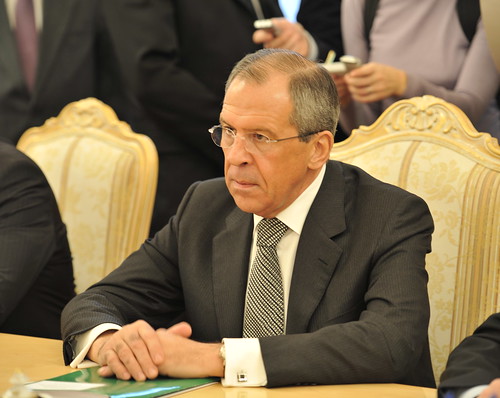
And he doesn't even mention once the European Court of Human Rights, which belongs to the Council of Europe and has more than once ruled on severe human rights violations in Russia.

There are three particular quotes that caught my attention.

The first one:
"[W]hy do not we encourage in the context of the Corfu process all the OSCE members to adhere to the law of the Council of Europe?"
This is a very strange proposal given that the OSCE countries that are not members of the Council of Europe are either definitely non-European (like the USA) or they clearly do not respect the values of the Council of Europe - human rights, democracy, and the rule of law - (like Belarus, the Central Asian countries, the Vatican).

This proposal is thus pretty non-sense and seems to be a position that Russia just takes to counterbalance the rather hesitant position that the EU and the USA have on its proposals regarding the OSCE reform. Russia proposes to "outsource" the human issues away from the OSCE to strengthen its proposal to make the OSCE a pure hard security or defence organisation.

And the second quote is clearly a critique to the European Union countries (27 of the 47 Council of Europe members are EU countries) that want the Council of Europe to focus on its core tasks as defined by the last Summit in Warsaw in 2005:
"The proposals to diminish the mandate and competence of our Organization are inadmissible, as well as the attempts to limit its independence, transform the Council of Europe into a subsidiary body of the other European structures. The Strasburg Organization must be the leading European lawmaker in the proper sense of the word."
However, Lavrov finishes with a note that I could sign without problems, except for the doubt that the Council of Europe can actually deliver this vision:
"Owing to a more effective Council of Europe, our continent will have every chance to become truly integrated space with human rights promoted according to unified standards, where every citizen of the Greater Europe would benefit from real mobility realized in the free movement of ideas and people. It is quite hard to understand that the "visa iron curtain" is drawn, unlike during the Cold War, on the opposite side."
In summary, the speech is in clear continuity of the Russian position with just some refinement and adaptation in the argumentation that reflect discussions in other fora - a sign that we won't see much development in the political landscape of the "Greater Europe" in the near future.

* PS.: Lavrov was reading really quickly - the poor translator... (see the video of the speech).

Picture: © utenriksdept / CC BY-ND 2.0

Monday, 26 April 2010

A "European Code of conduct for lobbying"?

Just stumbled upon this press release informing that the Parliamentary Assembly of the Council of Europe (PACE) voted in favour of a recommendation to set up a European Code of Conduct for Lobbyists today.

The PACE is only a consultative body of the Council of Europe, uniting parliamentarians from the 47 member states of this international organisation, and so the Recommendation 1908 (2010) is not a directly binding document.

Nevertheless, it will force the governments of the CoE member states to position themselves whether they want to follow the demand of the Assembly to set up the code that would define a common understanding of what "lobbying" is and that would, inter alia, define common rules
"applicable to politicians, civil servants, members of pressure groups and business enterprises [...], including the principle of potential conflicts of interest and the period of time after leaving office during which carrying out lobbying activities should be banned"
It will be interesting to see whether the 47 states can agree to start the work on such a text or whether the final response to the Assembly will be that there is no consensus on such a project and that member states are expected to define and regulate lobbying independently.

In any case: A matter that could be worth following.

PS.: Of 79 parliamentarians present at the time of voting, only 1 voted against the recommendation: Alejandro MUÑOZ ALONSO (Spain, Partido Popular) (cf. voting records).

Friday, 26 March 2010

The EU's accession to the European Convention on Human Rights: In the parliament

Antoine from the ECHR Blog has assembled a number of noteworthy documents from the European Parliament and the Council of Europe on discussions about the future accession of the EU to the European Convention on Human Rights.

More on this topic on this blog under the label ECHR.

Sunday, 14 March 2010

Rethinking creative rights for the Internet age

The Parliamentary Assembly of the Council of Europe is asking the 47 member states of the Council of Europe to rethink creative rights for the Internet age.

In a report that was decided upon by the Standing Committee of the assembly uniting parliamentarians from 47 European states on Friday, our national parliamentarians demand, inter alia, from European governments united in the Council of Ministers of the Council of Europe to
"initiate a future-oriented study on copyright in the digital environment and give thought to the changes required to guarantee a flexible legal apparatus, enabling copyright law to adapt more easily to technical, economic and social changes"
If I understand correctly, this recommendation is based on a motion issued by some parliamentarians three years ago.

If the national governments work at the speed of the parliamentarians, we won't see the report before 2015...

Wednesday, 23 December 2009

Press release on Protocoll 14 disappeared from the website of the Parliamentary Assembly of the Council of Europe

Two days ago I wrote about the resuming of the ratification process of Protocol 14 of the European Convention on Human Rights by Russia - but it seems that the background information that I have used is not available anymore.

My post followed the publishing of a press release of the Parliamentary Assembly of the Council of Europe (PACE) in which both the President of the PACE and the Secretary General of the Council of Europe welcomed the approval for ratification of Protocol 14 by the Russian Duma.

The press release could be found here. Now this press release has disappeared - it has been deleted.

You can see that it has been actively removed when you look at the URL:
http://assembly.coe.int/ASP/NewsManager/EMB_NewsManagerView.asp?ID=5137&L=2

This press release with the IDs 5137 (English) and 5138 (French) is not available anymore, while the previous and following press releases with the IDs 5135/5136 and 5139/5140 are still accessible.

Does that mean that the information on the change of mind of the Russian Duma provided in the press release was wrong or that it was just non-authorised?

Update: In a new press release, this time coming directly from the Council, the Secretary General welcomes "indications" that the Duma is going to resume its ratification procedure in January.

Friday, 6 November 2009

The EU's accession to the European Convention on Human Rights (ECHR): Waiting for controversies...


Follow-ups to this article: here, here & here.


With the Lisbon Treaty entering into force next month, one particular issue that has been part of legal and political discussions for years will become pertinent: The EU's accession to the European Convention on Human Rights (ECHR).

All EU member states have ratified the Convention and most have also signed and ratified the additional protocols to the convention (including the protection of property rights and free elections [Protocol 1] or the prohibition of the death penalty under all circumstances).

The rights guaranteed by the ECHR are supervised by the European Court of Human Rights (ECtHR) in Strasbourg. Since through its member states the legal traditions of the ECHR are also informally part of the EU's legal traditions, the European Court of Justice (the EU's court) is already taking into account rulings of the European Court of Human Rights, but so far there is no legal obligation for the Union to follow the Human Rights Convention's provisions.

However, now that the Lisbon Treaty will enter into force, the EU is getting legal personality and is thus able to join international agreements outside the scope of the former European Community, including the ECHR.

And, for those who did not have time yet to read the Lisbon Treaty, the document explicitly foresees that the EU will join the European Convention on Human Rights (which might mean that the EU institutions will be subject to rulings of the non-EU ECtHR). It deals with this matter in Article 6 of the Treaty on European Union (TEU) and in the Article 218 of the Treaty on the Functioning of the European Union (TFEU) as well as in the Protocol 8 and the Declaration 2 to the Lisbon Treaty.

In short, these provisions foresee that the EU shall in fact join the ECHR, but only after the EU and the member states have agreed on how the EU's legal and practical relations with the different control bodies of the convention will be and after it is clear how one will differentiate between law suits against the EU and those that would go against a member state (which could become difficult when it comes to the execution of EU law in the member states).

In the end, the Council needs to decide unanimously on the accession to the ECHR, and all member states will have to agree individually according to their constitutional provisions.

Although this is now clearly prescribed by the Lisbon Treaty, this is still going to be a very difficult legal and political process, not least seeing the debates around the Charta on Fundamental Rights and Freedoms in some member states or the latest "outrage" in Italy against the Crucifix judgement by the ECtHR.

And so even though the Council of Europe - the international organisation built around the European Convention on Human Rights - is already starting to pressure on the EU start its accession procedures, this could take some time until the EU has ruled out all complex legal and practical problems related to this accession.

Therefore, I expect the process to be quite controversial already between the EU member states and EU institutions (including its legal services), but also between the EU and the Council of Europe (including the other 20 signatory states to the European Convention on Human Rights) - and the result will probably be an unprecedented case of legal interdependencies between two different supranational regimes.

Friday, 23 October 2009

Do electoral systems influence women's representation in politics?

It is a fact that women are generally less represented in politics, and discussions around Mary Robinson are just one result of this deficit.

The Council of Europe has been dealing with questions of electoral systems at this year's Forum for the Future of Democracy (ending today), and one of the issues was the effect of electoral systems on women's representation in politics.

In a now declassified document from the Parliamentary Assembly of the Council of Europe titled "Impact of electoral systems on women’s representation in politics" the rapporteur Lydie Err comes to the following conclusions:
  • women are still grievously underrepresented in politics in most Council of Europe member states;
  • the lack of equal representation of women and men in political and public decision-making is a threat to the legitimacy of democracies and a violation of the human right of gender equality which must be rectified as a priority;
  • the most important factor leading to the current underrepresentation of women in politics is linked to attitudes, customs and behaviours widespread in society which disempower women, discriminate against them, and hold them hostage to prescribed role-models and stereotypes according to which women are “not suited” to decision-making and politics;
  • these attitudes, customs and behaviours also influence a country’s institutional, party and electoral landscape; but conversely, a change in that landscape can also impact on society’s attitudes;
  • changing the electoral system to one more favourable to women’s representation in politics, including by introducing gender quotas, can lead to more gender balanced, and thus more legitimate, political and public decision-making;
  • in theory, the following electoral system should be most favourable to women’s representation in parliament: a proportional representation list system in a large constituency and/or a nation-wide district, with legal threshold, closed lists and a mandatory quota which provides not only for a high portion of female candidates, but also for strict rank-order rule (e.g. a zipper system), and effective sanctions (preferably not financial, but rather the non-acceptance of candidatures/ candidate lists) for non-compliance.
I think I agree with the conclusions, but I am not sure whether this is of any value...

I suppose that the study itself will not have a big impact, because all it does is to reflect the complexity with which general attitudes and institutional design are intertwined. I don't see any good argumentation on how one could put the measures proposed into practice, and I don't see the actors willing to do this.

What we have here is thus yet another account of inequalities in our societies - but what we learn again leaves us at loss how to actually change the situation.

But why not repeating it, here and elsewhere, as long as the situation is as it is?

Tuesday, 29 September 2009

Thorbjørn Jagland new Secretary General of the Council of Europe

After long discussions, Thorbjørn Jagland has been elected Secretary General of the Council of Europe.

The dispute over the election of the Secretary General of the Council of Europe has been going on for a while, as I have covered in the past (here, here, and here).

Today, the Parliamentary Assembly of the Council of Europe, a mainly consultative assembly of the international organisation, in which delegates from all 47 parliaments of the Council of Europe member states meet four times a year, has finally elected the former prime minister, foreign minister, and president of the Norwegian parliament, Thorbjørn Jagland (new photo) with 165 against 80 votes for Włodzimierz Cimoszewicz a former Polish prime minister (see the press release).

The election is not a too big surprise, but I still think that the election of a Norwegian for this post is a particularly good choice.

Since the main task of the Secretary General is to moderate between the 47 member states, including the 27 EU members and most other countries of the continent, including Russia and Georgia, Turkey, Armenia and Azerbaijan, it is good that the SG is neither from an EU country nor from a country involved in conflicts with its neighbours or in serious human rights violations.

This is also of advantage for the relations between the Council of Europe and the EU, since the present Special Representative of the CoE to the European Union is former Norwegian ambassador to the Council of Europe Torbjørn Frøysnes - so the two might be able to work together in way that will strengthen the relations between both institutions.

Altogether, it was time that the Council of Europe finally got a new leadership - and I am glad that it is a profiled figure such as Mr Jagland who will be responsible for the most important human rights watchdog on the European continent.

Saturday, 8 August 2009

One year ago: Russia and Georgia at war (supplemented)

One year ago, Russia and Georgia were at war - yet another war on the European continent, Europeans killing Europeans, because big men with big balls needed to compare the lengths of their penises.

This conflict between two very different but in a sense still very similar nations - both are marked by a lack of democratic culture and their politics are built upon nationalism and false assumptions about the need for power - showed us Europeans that the phantom of war has not disappeared from our shores, that the shadow of distrust and hate has not been washed away from our lands, and that power of evil remains strong.

Putin and Medvedev as well as Saakashvilli deserve our full disrespect for what they did; they are a shame for the European continent and for the values that their countries have subscribed to as members of the Council of Europe and the OSCE!

We also shouldn't forget that this is not just about politics, it is about human beings who have been killed, it is about families disrupted, about injured souls, about lives filled with fear and anger. War is not about big man with big balls, it is about man-made weapons cutting human bodies into pieces and burning human lives into ashes.

Now, one year later, tensions are rising again in the region, although not looking as dangerous as a year ago. It makes me angry seeing this, and so I will let some else speak more calmly on the matter.

Alexander Stubb, former MEP and now Finnish foreign minister, has been the chairman of the OSCE last year and was blogging in English when he went to the region.

Yesterday, a year later, Stubb has published an article on his blog looking back and into the future:
[...] The war in Georgia shattered the European security policy configuration also at a more general level. It created tensions and persistent insecurity. [...]

What does the situation in Georgia look like now on 080809?

Firstly, domestic turmoil in the country is continuing. [...] Secondly, the security situation in the conflict regions is alarming. [...]

The most significant step forward to date is the joint incident prevention and response mechanism, which involves regular meetings at local level to discuss incidents and their prevention. However, there have been stumbling blocks in its implementation. [...]

What should the EU then do to preserve stability and help Georgia out of the woods at some phase?

I see that political intervention can take place on three tracks. 1) The cease-fire must be monitored effectively and reinforced by international presence in the entire territory of Georgia. 2) The peace process must be supported and preconditions must be sought for a gradual restoration of confidence and concrete steps forward. 3) The EU must strengthen its overall support for Georgia. This will take place in the framework of the policy of the Eastern Partnership. [...]
What Stubb writes doesn't look too encouraging, it doesn't seem that there has been much progress, and it shows the slow speed with which diplomacy moves in such cases, spending time on useless words and declarations, trying to avoid saying what needed to be said.

Still, I hope for the people in the region, as well as for the whole of Europe, that our European politicians and diplomats, but even more the responsible actors in the countries and the region will be able to secure peace on our continent - and that all of you remain aware that what we have managed to create with the EU is not self-evident, but has to be defended every day and minute in order to live in peace and relative prosperity as we do right now.

Any alternative is nothing but frightening...!

Supplement: Carl Bildt, Swedish foreign minister, now co-responsible for the Swedish EU Council Presidency, and one year ago chairman of the Council of Ministers of the Council of Europe, has also written about the first "birthday" of the war.


PS.: One year ago, this blog was still very young, and so the Russian-Georgian crisis pretty much dominated its early times as you can see in a number of articles from last year:

Monday, 22 June 2009

Is the Council of Europe dying? - Dispute over election of Secretary General continues

The oldest post-war European international organisation, the mother of the European flag and anthem - the Council of Europe - looks like it is dying.

Chronically under-financed by its member states who either think the organisation is too critical or unnecessary beside the ever expanding European Union, disturbed by the membership of Russia, freezing in the shadow of its extremely successful but not-yet-reformed European Court of Human Rights, burdened by internal bureaucracy, it is now facing a serious institutional crisis over the election procedure of the Secretary General.

I have already reported about this problematic process before, here and here, and apparently no solution has been found until now, since in his speech the Slovenian foreign minister who is holding the rotating presidency of the Council of Europe deplored that the Parliamentary Assembly of the Council of Europe (PACE) decided not put the election of a new Secretary General on the Agenda of their summer session.

This means that the intergovernmental and the interparliamentary sides of the institution are unable to communicate, they are lack the professionalism to find together and to define themselves as parts of a joint institution. They want the fight, but the question is just who will lose the most.

It is sad to the the Council of Europe in this bad shape, but sooner or later the latent internal crisis had to be followed by more visible problems - and here we are now.

Maybe the CoE is not yet dying in the 60th year of its existence, but all these are signs that it will not really get back to life...

Wednesday, 20 May 2009

Council of Europe chairman criticises Moscow Gay Pride abatement / Moldova under scrutiny

Slovenia has taken over the Chairmanship of the Council of Europe, which has celebrated its 60th anniversary on the 5th of May, from Spain last week.

And the new Chairman has already reacted in his function, criticising the abatement of the Gay Pride in Moscow last weekend.

But for those of you who might think that this is a good sign: Not really!

Since this statement is put out only in the name of the Chairman and not in the name of the whole Committee of Ministers, this means that the 47 member states of the Council of Europe (including Russia) have not agreed on this.

Only if in today's weekly meeting of the Ministers' Deputies (= the ambassadors representing the member states) the 47 member states agreed on a joint declaration put out in the name of the whole Committee, this would be a strong sign.

But I suppose that at least Russia will have something against this...

Yesterday and today, there is also a Council of Europe delegation in Moldova, investigating the post-electoral incidents that stroke the country in early April.

This coincides with the first attempt to elect a new president taking place today. There are two candidates, the former Prime Minister and an unknown doctor. The presidential majority is 61 of 101 seats, but the ruling Communists only have 60.

The question is: Will they be able to get one or several oppositional votes (some commentators have said: "buy the votes"), or will the opposition, for once, be strong enough to stick together, if only for the negative?

If there is no president elected, there will be a second round within 15 days. And then maybe a third one. If there is no president elected after the third round, there will have to be new elections.

Moldova, where are you going?

Saturday, 16 May 2009

Eurovision Song Contest: Testing Europe-wide elections and tolerating homophobia (with Norway winning)

Okay, this is not really comparable to the European Parliament elections, but I suppose it will get much more attention, and it is not limited to the European Union.

Tonight, the Eurovision Song Contest will take place in Moscow, where today the Gay Pride was broken down by the police.

Congratulations, Russia, you have already won the contest of most tolerant country, when it comes to anti-gay demonstrations. I suppose this is why Russia is member of the Council of Europe.

For the "election" tonight, already 16 countries have been "eliminated" in semi-finals. Imagine this for the EP elections...?!

The final result will be be celebrated for a week, the winner brings fame to his country by bringing the event to her/his capital in the next year. So there is a lot at stake.

And maybe next year, this will be a city where tolerance is not only for those who practice intolerance. May the best win tonight!

Update: Well, it seems like with Norway a country that does not participate in the European Parliament elections but where Gay Prides are not forbidden has won the #ESC. What a fairy tale!

Wednesday, 29 April 2009

Parliamentary Assembly of the Council of Europe rejects shortlisting of candidates by the member states - updated (2x)

The Parliamentary Assembly of the Council of Europe (PACE) has just rejected the shortlisting of only two candidates (see my previous post) for the post of the next Secretary General of the Council of Europe by the ambassadors sitting in the Committee of Ministers' Deputies (the organ representing the governments in the Council of Europe).

The parliamentarians deplore the reduction of choice which was done by the Committee of Ministers against the formal rules of procedure of the Council of Europe. Several said that reducing the list to two candidates representing socialist parties would reduce the political choice of the assembly.

Some even compared the action by the governments' side with the lack of democratic standards the Council of Europe is observing in its member states (see my Twitter coverage from this afternoon).

So with some ammendments and by only one vote against, the Parliamentary Assembly has adopted this draft resolution asking the Ministers' Deputies and the Committee of Ministers to present to them the full list with all four candidates.

Tonight at 7 p.m., the debate will most likely be continued in the Joint Committee, the body uniting representatives from the Parliamentary Assembly and the diplomats from the member states to discuss issues of joint concern.

But the reaction of PACE today was a clear slap in the face of the governments of the 47 member states of the Council of Europe, in procedural, political, and democratic terms.

Update: The press release on this matter sounds veeeery diplomatic...

Update 2 (01 May): I just learnt at Le Monde that Mr Van den Brande, on of the eliminated candidates, has been the favourite candidate of Russia and that the Russian Federation is thus not quite happy with the outcomes of vote in the Committee of Ministers' Deputies.

Monday, 27 April 2009

Parliamentary Assembly debates next Secretary General of the Council of Europe and celebrates the CoE's 60th anniversary

---------------------------------------------------------------------------
Update (29. April 2009)

Parliamentary Assembly rejects shortlisting of only two candidates for the post of Secretary General by the governmental side.
---------------------------------------------------------------------------


No, the Council of Europe is not the Council of the European Union, the Council of Europe is an independent international organisation with 47 member states from all over the European continent.

The Council of Europe is a European Union light, it is like the intelligent older brother who was expected to become the pride of the family, but the younger brother studied business, became rich (steel and coal business), was able to buy presents for everyone, and thus became the preferred child of the family. The older brother studied philosophy, he always had more true friends, wrote the better books, new the better answers and was respected among his colleagues and everyone who knew him personally.

This older brother, the Council of Europe celebrates its 60th anniversary this year.

This week, the Parliamentary Assembly of the Council of Europe (PACE) - a body that is similar to the Consultative Assembly, the predecessor of the European Parliament - meets for the second of four annual sessions. Parliamentarians from the 47 member states' parliaments discuss issues of relevance and urgency.

For sure, the anniversary of the Council of Europe plays an important role at this session. In his speech on these last 60 years - a history summarised in this video, Lluís Maria de Puig, the President of the Parliamentary Assembly, summarised the work of the Council of Europe like this:
"The Council of Europe is primarily a moral force. This force is exercised in manifold ways to the same end, through the judgments of the European Court of Human Rights which is celebrating its 50 years of existence this year, the Committee of Ministers representing the governments, the institution of the Commissioner for Human Rights, the Venice Commission and the European Youth Centre to name but a few, and of course through this Assembly which conveys the voice of 800 million Europeans via their elected representatives."
The important topics of this week will be the three urgent debates on
  • the situation in Moldova;
  • the non-ratification of Protocol 14 to the European Convention for Human Rights; and
  • the election of the next Secretary General of the Council of Europe.
For frequent readers of this blog, the reason for the first topic is very clear (see for example here and here).

The second topic is an "old" history, ongoing for four years already: 46 out of 47 member states (and thus signatories to the European Convention for Human Rights (ECHR)) have signed and ratified Protocol 14 to the ECHR, for years already. Only Russia, which has signed it, refuses to ratify this Protocol that would change and ease the working procedures of the European Court of Human Rights, which is overloaded with cases and which needs better and quicker working methods to fulfil its functions. But since Russia would not benefit from more cases (against it) at the European Court for Human Rights, it is blocking the reform that can only enter into force after all 47 members have ratified the Protocol.

The third topic might have been unnoticed by most of you. This year, the Council of Europe will get a new Secretary General. The old one, Terry Davis, is not allowed to be re-elected, and so member states were asked to present candidates.

According to several sources (like this one and this one), there were four candidates (the deadline for submission of proposals was closed in March) of which, after an internal vote (unconfirmed results published here) at diplomatic level last week, only the first two have been shortlisted and will be proposed to the Assembly at its next session in June for a final vote.

The candidates are (and were):
According to the final agenda, the debate on the next Secretary General will start on Wednesday at 3 p.m.; the debate on Moldova will follow this agenda item. Protocol 14 will be discussed on Thursday. The full sessions are broadcasted via livestream.

This seems to become an interesting week, which will include speeches by Mrs Tarja Halonen, President of Finland, and Mr José Luis Rodríguez Zapatero, President of the Government of Spain.

So I have a pledge: I know that the Council of Europe is ignored by most and disregarded by some, but the topics it discusses and the range of country it covers, makes it one of the three main European organisations, besides the European Union and the OSCE, and I can only recommend noticing what is going on in its institutions, because the political impact might not always be visible - but in many cases, especially in eastern and south-eastern Europe, and whenever the Court of Human Rights issues a judgement, it plays a central role for the core values of this continent, especially regarding the protection of human rights.

I therefore wish you happy birthday, old brother Council of Europe, and good luck for the future!

(This is the 500th post of this blog. I think it is only consequent to dedicate it to a pan-European organisation older than the European Union, mother of the European flag and the European anthem, reaching out to almost all parts of this continent, and dedicated to the values that guide my personal, political, and professional work: Human rights, democracy, and the rule of law.)

Tuesday, 31 March 2009

British Irish Rights Watch wins European human rights prize

The British Irish Rights Watch has won the first ever Parliamentary Assembly of the Council of Europe (PACE) Human Rights Prize.

According to the PACE press release, the jury praised
the organisation’s “courageous and outstanding work in monitoring and bringing to light human rights abuses, and its fight against impunity in Northern Ireland”. It also commended the NGO’s “vigilance” in ensuring that measures taken to combat terrorism were in confomity with international human rights standards.

British Irish Rights Watch – which takes no position on the eventual constitutional outcome of the conflict and works with all sides of the community – researches alleged human rights violations, provides consultancy services to lawyers, organises expert testimony and sends independent observers to trials, inquests and inquiries. Much of its work is carried out by volunteers.
Congratulations to the NGO - and let's hope that the peace process in Northern Ireland continues without violence as we have seen lately, full of embarrassment!

Thursday, 29 January 2009

Electronic democracy: Council of Europe Parliamentary Assembly debate

This week, the Parliamentary Assembly of the Council of Europe (uniting parliamentarians from 47 countries of the European continent) meets in Strasbourg to debate different pan-European issues.

After a rather pessimistic speech of the Secretary General of the Council of Europe on Monday, complaining about the lack of funds for the Council of Europe and its European Court of Human Rights, debates about the war between Georgia and Russia and discussions about the International Criminal Court and the regulation of media, the Assembly tomorrow will discuss electronic democracy.

I did not have time to go through the comprehensive report, including a resolution (directed to the 47 parliaments) and a recommendation (directed to the 47 member states), but those of you interested should watch the debate tomorrow on live broadcast from 10 a.m.

But I have doubts that the parliamentarians will show much interest in this, because first of all it is Friday (time to travel home...) - and the report (as far as I could read) does not seem very innovative but rather like a stocktacking of developments from the perspective of somebody who does not completely understand the opportunities (and true risks) that electronic means offer to a modern democracy.

Wednesday, 28 January 2009

European Data Protection Day: Commission warning echoes around the globe

Today is the European Data Protection Day, a joint initiative of the European Commission and the Council of Europe to celebrate the "birthday" of the European Convention for the Protection of Individuals with regard to Automatic Processing of Personal Data signed on 28 January 1981.

Is that why EU Commissioner Jacques Barrot warns young people to use Facebook? It feels like he is number 100 on the list of politicians to do so, and I kind of get bored.

But boredom is the biggest success of EU institutions these days, right?