Showing posts with label NATO. Show all posts

Friday, 7 May 2010

Joe Biden proposes OSCE reform

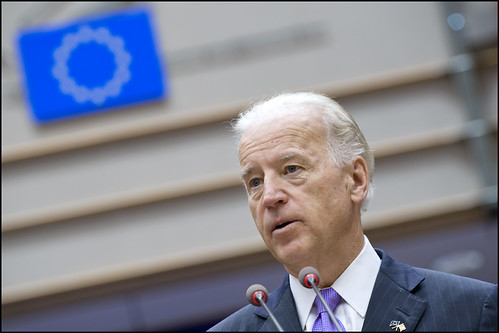
Joe Biden spoke in front of the European Parliament yesterday (see my post), and so we almost missed that he has also proposed a reform of the OSCE on the same day.

The vice president of the United States has published his proposal for OSCE reform - the US is a member of the OSCE - in the International Harald Tribune, a proposal which sound a little like a reaction to the Russian position, and may be kind of the US proposal for the "Corfu Process".

Different to Russian foreign minister Lavrov, Biden doesn't propose that OSCE takes over the functions of NATO to provide hard security on the European continent. That is no surprise, to be honest. To the contrary, he underlines that there is "the right of all countries to choose their own alliances freely" which is a clearly against Russian demands that NATO should not be enlarged towards the east.

What Biden proposes is a "OSCE Crisis Prevention Mechanism" that seems to be mainly a conclusion from the Russian-Georgian war and it is definitely a much smaller reform proposal than what Russia is envisaging.

I even have difficulties to see the difference to what OSCE already does today, for instance in the cases of Nagorno Karabakh (a frozen conflict between Azerbaijan and Armenia), Transnistria (a breakaway region of Moldova) or regarding the tensions between Turkey and Armenia.

So now we kind of have positions from Russia and from the USA - will we get an official EU position this year or while they try to wait for the Lithuanian OSCE presidency next year...?

Picture: © european_parliament / CC BY-NC-ND 2.0

Tuesday, 23 February 2010

Is there any EU citizen in favour of us killing civilians in Afghanistan?

The news is that the Netherlands are like to withdraw their troops from Afghanistan after the government collapsed over this issue.

I always had the question: Why are we down there?

It is true: I don't want to be killed by a terrorist - nobody wants - but I also don't want that 100s of human beings - many civilians - are killed to lower the perceived (!) risk that I get killed by a terrorist while not actually lowering the risk.

This thing (killing civilians) has happened time and time again and it will happen time and time again, because that is the idea of war. Soldiers from our armies are out there defending our "interest" by killing people, including civilians - probably more than all terrorist attacks have caused in the "West".

That is not in my interest. It has never been. What is human rights when my life is worth more than the life of someone living Afghanistan?

But pretending to save some lives of westerns with several billion Euros of tax money that could be put into fighting poverty or hunger or global diseases is worth killing Taliban as well as citizen happening to live there because this is where they live. It's worth making mostly young people from our armies murderers of civilians while they are risking their own lives.

I've never actually had the impression that many EU citizens were in favour of us being in Afghanistan. But our governments like it, and only when there is a group of killed people - civilians or our own soldiers - large enough to become noticed by our "journalists" who usually love to play the terror alert news cycle ("Earn money with fear.") doubts are rising and eventually a government collapses or an ex-defence minister has to resign from his new job (as happened in Germany recently).

The simple equation: 170 killed Afghans are worth 1 German minister. 21 killed Dutch soldiers are worth one Dutch government.

I know it's polemic, but it's still true.

PS.: Just got reminded that somebody said this much better than I can (just in German unfortunately):

Saturday, 4 April 2009

Rasmussen NATO Secretary General: The secret conditions

Yes, the Danish Prime Minister Anders Fogh Rasmussen will become NATO Secretary General.

His (secret) contract conditions will include the prohibition to look at any caricatures while being in office, especially those which harm the reputation of military personal of highest level or which attack militaristic dogmas and other idiotic world views promoted and worshipped (attention: worship, not warship) by NATO.

The Turkish government tried to get rid of these contract terms put in by Saint Obama but were duped by El Presidente Berlusconi (he did the same with the British Queen and the German Princess).

However, in exchange to these concessions, Turkey may now restrict the cultural freedom of Kurds, so far forbidden by Article 301 of the Turkish penal code.

Constructive exchange between EU and NATO: Barroso (outdated)

Saw some funny speculations that - after the rejection of Anders Fogh Rasmussen by Turkey and in case there is no agreement on him today - Barroso might be a possible candidate for the post of Secretary General of NATO.

This would be a nice deal...

NATO, we kindly offer you our Commission President!

(via Valéry-Xavier Lentz on Twitter)

Update: Breaking news of Rasmussen becoming NATO SG make all hopes remain in vain.

Monday, 9 February 2009

NATO is planning war on German and French territory around Strasbourg in April - updated

In early April, NATO is celebrating its 60th anniversary in Strasbourg with a huge summit.

For Christoph Marischka, writing for the (interesting but mostly quite leftish) German online portal Telepolis, this will be the state of emergency. Police, army, secret services will join in their efforts to "protect" the international VIPs, limiting citizens' freedoms and mixing up competencies between national, transnational, and international authorities with military and non-military status.

And although the scenario Marischka is painting is rather biased towards the dark side (or better: against), it gives an idea about what the French-German border area around Strasbourg can expect in April:

We will get the usual summit war between the international military (and pseudo-military) forces and the not less militaristic anti-militaristic forces from all over the continent.

Update (11 February 2009):

Today I met somebody who lives and works in Strasbourg. She says that already now it is getting crazy, she and all her colleagues have to fill out questionnaires, and have to announce which guests they expect for the days of the Summit.

She recommends avoiding Strasbourg for these days.

Monday, 8 December 2008

No new pan-European security strategy

Meeting last week in Helsinki, the foreign ministers of the Organisation for Security and Cooperation in Europe (OSCE) have disagreed with the Russian proposal to create a new European security strategy (i.e. organisation).

In fact, I am not surprised about this decision, and not surprised that the Russian foreign minister Lavrov is described as "angry" during his closing remarks. In general, this proposal is not new, and has not come with Medvedev - I have heard about this already in 2006, and I suppose this Russian idea is even older.

In general, I agree with the Russian approach to discuss about a pan-European security, a non-divisive system that overcomes the cold-war NATO (although reformed) and the logic of East and West on a continent that should be united, not just for "historical" reasons but because of the need for a common future.

However, the Russian move can also be interpreted as a move to weaken the OSCE's (formerly CSCE) influence in the fields of democracy and human rights, namely through its Office for Democratic Institutions and Human Rights (ODIHR), together with the Council of Europe one of the two main pillars of pan-European human rights protection instruments.

It is also a move to slow down the European ability to react, because within a joint European security space, Moscow would have a lot of influence and, as in other organisations, the possibility to decelerate necessary moves whenever it deems appropriate. A joint European security space with a non-democratic Russia would thereby be not less conflictual, less insecure, or less inappropriate than the present system of security.

An undemocratic Russia remains a risk for European security in general, and even a basically correct move to discuss pan-European security cannot hide this fact. The OSCE is correct in including democracy and human rights into its human security concept, and any step towards a simple understanding of security as a military concept just reveals the militaristic thinking of Russian elites stuck in old-time great power ambitions instead of modern-times co-operative efforts.

Which still doesn't mean that NATO is good....

I therefore agree with the basic rhetoric of the Russian initiative, but I don't believe neither in the right motives nor in any positive outcomes. In this regard, the pan-European reactions have been correct.